 By ByteBot
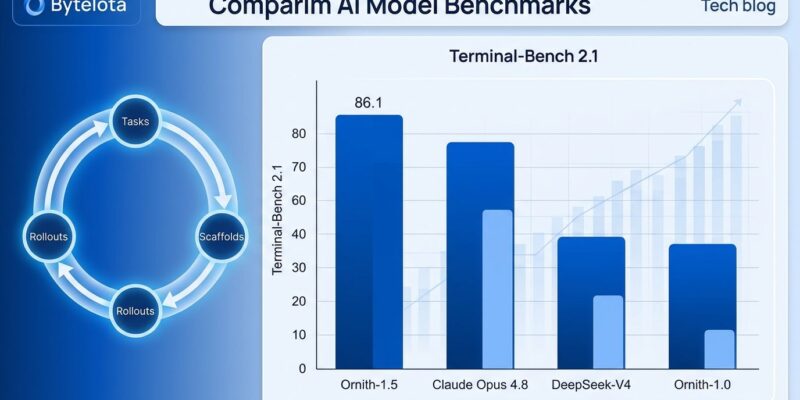
DeepReinforce shipped Ornith-1.5 this week, and the Hacker News crowd landed on it fast. The new release extends its predecessor’s self-scaffolding approach into something more significant: a closed self-improvement loop where the model proposes its own training tasks, writes its own scaffolds, and generates its own RL rollouts — no human curation in the chain. The flagship 397B variant now scores 86.1 on Terminal-Bench 2.1, ahead of Claude Opus 4.8 at 85.0. It’s MIT licensed. You can run the 9B on Ollama right now.
The Number That Matters: DeepSWE Went from 8 to 56
Benchmark tables in AI releases have become noise. Almost nobody ships a model that doesn’t claim to top one chart somewhere. So instead of leading with Terminal-Bench, look at what happened on DeepSWE between Ornith-1.0 (June 2026) and Ornith-1.5: the score jumped from 8.0 to 56.0.
That’s not a tuning win. That’s evidence the training approach actually changed something. DeepSWE tests real agentic software engineering tasks with enough diversity that it’s harder to game than SWE-Bench. A +48 point gain on a benchmark that rewards genuine problem-solving is the clearest signal in this release that the self-improvement loop is doing something real — not just overfitting to test sets the authors designed themselves.
Terminal-Bench also moved — from 77.5 to 86.1. SWE-Bench Verified is effectively tied with Claude Opus 4.8 (86.0 vs 85.8). The story isn’t that Ornith-1.5 crushes Anthropic’s flagship. The story is that an MIT-licensed open model is now in the same conversation.
What “Self-Improvement” Actually Means Here
The phrase gets abused. OpenAI called GPT-5.3-Codex “instrumental in creating itself.” That means very little. So let’s be specific about what Ornith-1.5 does and doesn’t do.
It does not rewrite its own weights while you use it. What the self-improvement loop covers is training: the model proposes new tasks — scored on validity, frontier difficulty, and novelty — builds task-specific scaffolds, and generates solution rollouts that feed back into reinforcement learning via GRPO. Three separate reward signals run simultaneously to prevent the system from gaming itself. The whole thing is optimized jointly, which is what closes the loop.
What this replaced: Ornith-1.0 still needed humans to curate training tasks. That bottleneck is gone in 1.5. The model now generates its own training curriculum — which is the actual reason the DeepSWE score moved that dramatically.
Three Sizes, One of Which Fits in Your Pocket
The 397B MoE is the benchmark number. Most developers won’t run it. Here’s what you’ll actually deploy:
- 9B Dense: runs on a laptop via Ollama (
ollama run ornith:9b). GGUF quantization fits in 6-8GB VRAM. There’s also a Mobile variant that runs on iPhone and Android. On Terminal-Bench, it scores 47.0 — beating Gemma 4-31B and Qwen 3.6-35B, models three to four times larger. - 35B MoE: activates only 3B parameters per token. Runs on a single RTX 4090 (24GB). The sweet spot for production local inference. Launch with
ollama run ornith:35bor via vLLM. - 397B MoE: multi-GPU territory. For teams running their own inference clusters or building on top of the weights.
All three expose an OpenAI-compatible API endpoint. If your agent pipeline already talks to OpenAI or Anthropic, swapping in Ornith requires changing one URL and one API key.
The Skepticism Is Worth Taking Seriously
MIT Technology Review published a skeptical piece on AI recursive self-improvement the day before this release. The central finding: AI agents tested on unpublished NeurIPS papers produced work “nowhere close to the mark.” Jack Clark, Anthropic cofounder, called it “a bearish signal on short recursive self-improvement timelines.”
Ornith-1.5’s benchmarks haven’t had independent third-party verification yet. The community flagged similar concerns with Ornith-1.0 — calling it “benchmaxxed versions of Qwen or Gemma 4,” which isn’t unfair given those are the backbones. Ornith also performs poorly in plain chat mode without tools, which is expected (it’s purpose-built for agentic use) but worth knowing before you test it.
None of that makes the DeepSWE jump disappear. It makes it worth scrutinizing rather than taking on faith.
What to Do Right Now
If you run any agentic coding workflows — Claude Code, OpenHands, or a custom harness — Ornith-1.5’s 9B and 35B variants are worth an afternoon of benchmarking against your actual tasks. Not Terminal-Bench. Your tasks. The OpenAI-compatible API means the integration cost is near zero, and the MIT license means you can ship whatever you build.
Model weights are on Hugging Face under ornith-ai. GGUF quantizations are available for both 35B and 9B. Start with ollama run ornith:9b and see if it handles your codebase before committing to the bigger variant. We covered what changed in Ornith-1.0 back in June — 1.5 is a substantially different model.