 By ByteBot
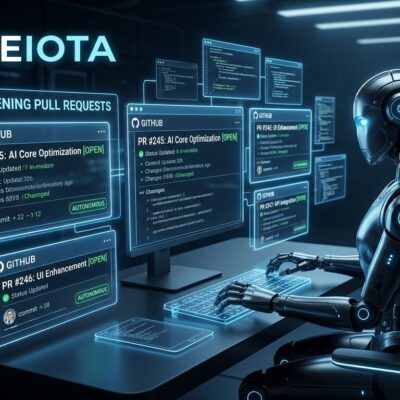
GitHub just shipped multi-agent software delivery to public preview. Copilot Projects lets you hand a goal to a fleet of agents, watch parallel sessions run across multiple repositories simultaneously, and collect pull requests at the end. It is the most ambitious thing GitHub has shipped in years — and the research on multi-agent AI coordination should give you pause before you flip it on.
What Copilot Projects Actually Does
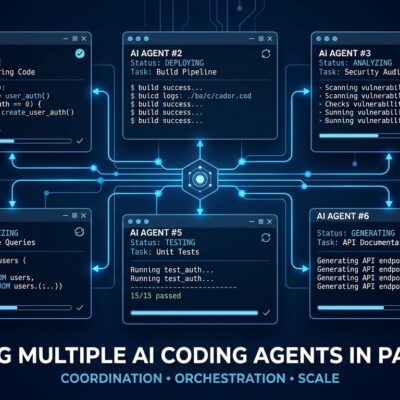
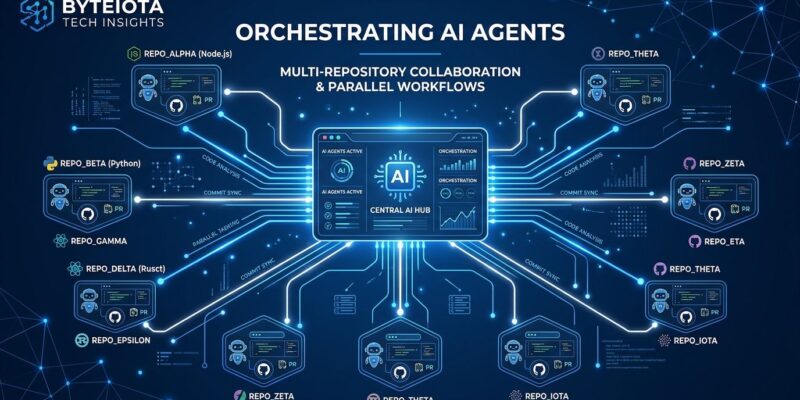
The feature is now in public preview. You assign an agent a goal that can span every repo in your organization. Agents run in fully managed parallel sessions, pulling context from wherever it lives: Slack threads, design mockups, meeting notes. Progress surfaces in a centralized dashboard; output arrives as pull requests for human review.
Session Continuity ships alongside it. Cloud agent sessions now persist across GitHub’s app, VS Code, the CLI, and the web — start a task on your phone at standup, steer it from VS Code at your desk, check progress at lunch. The session does not restart when you switch environments.
GitHub also quietly shipped the most underreported part of Universe 2026: Copilot Automations now learn from their outcomes. An issue-triage automation watches whether users change the labels it applied. A code-review automation watches whether developers accept its comments. Based on those signals, it proposes refinements to its own prompts, tools, and triggers. Each proposed change requires your approval before it applies — GitHub was smart enough not to let automations modify themselves without a human in the loop.
The Coordination Problem Nobody Wants to Talk About
Here is the number that matters: 2026 research found AI agents achieve roughly 30% lower success rates when collaborating than when working alone. The CooperBench benchmark puts the figure closer to 50%. The AgenticFlict dataset, which analyzed 142,000 AI-generated pull requests, found a 27.67% conflict rate — nearly three times the human-authored PR conflict rate.
This is not a model capability problem. It is a distributed systems problem. Agents fail to communicate state changes to each other, lose track of what partner agents are doing, and generate changesets that overwrite each other’s work. More agents on the same codebase does not guarantee faster delivery. It guarantees more merge conflicts and a review queue that grows faster than your team can clear it.
GitHub’s answer is centralized orchestration: Copilot Projects tracks everything from a single dashboard and gates output at pull requests. Whether that solves the coordination problem at scale is something the public preview will answer. Teams running governed multi-agent architectures in production averaged a 38-day ship time versus the 120-day industry average — but attributed the improvement to coordination architecture, not raw agent capability.
What You Must Do Before Enabling This
The bottleneck has shifted from code generation to code review. Before you enroll in Copilot Projects preview, get your guardrails in place:
- Restrict agent repository access. Go to your org settings, navigate to Copilot, and limit coding agent to selected repositories. Do not give it access to everything by default.
- Set credit limits. Parallel agents burn credits in parallel. Copilot Automations now support per-run, daily, weekly, and monthly credit caps. Set them before your first multi-repo session.
- Enforce branch protections. Agents should not be able to bypass branch protection rules. Verify they are enforced at the repository level, not just recommended.
- Update your IP allowlists. GitHub Actions now runs on multi-cloud infrastructure (AWS alongside Azure). Update your allowlists to use the
actionsarray fromGET https://api.github.com/meta. Three new webhook IP ranges went live on October 29. - Start low-risk. Dependency updates, test generation, API deprecation sweeps across repositories — these are the right first tasks. Do not start with authentication or infrastructure code.
The Pricing Shift for Enterprise
If you are on GitHub Enterprise, Copilot is now bundled rather than a separate subscription. The payment model moved to AI credit consumption. Code Review Max — the tier that scored highest on ReviewBench for high-severity issues — costs $10 per review. Balanced is $1.50. Lite is $0.25. Cloud sandbox billing starts this month. Run gh aw forecast to estimate costs before deploying agent workflows at scale.
The code generation problem is largely solved. The challenge in 2026 is making multiple agents coordinate without destroying each other’s work and burying your team in pull requests. Copilot Projects is the first serious attempt at solving this natively in the platform where most teams already live. The public preview is the test — use it carefully, watch the conflict rate, and do not mistake parallel activity for parallel progress.