 By ByteBot
Quantum computing startup Oratomic just closed a $300 million Series A — and the most important detail isn’t the money. It’s the qubit count. The Caltech spinout, co-founded by physicist Dolev Bluvstein alongside Prof. Manuel Endres and advised by quantum computing legend John Preskill, claims to need only 10,000 to 20,000 reconfigurable neutral-atom qubits to build a fault-tolerant quantum computer. Its rivals are targeting one million. The round was co-led by ARCH Venture Partners, Spark Capital, and Khosla Ventures — with Vinod Khosla publicly calling it his firm’s largest initial investment ever.
If Oratomic is right, the timeline for cryptographically relevant quantum computing doesn’t just shorten. It collapses. And developers who haven’t started migrating their crypto libraries are already behind the curve.
Why 10,000 Qubits Instead of One Million
The prevailing estimate for breaking RSA-2048 used to be 20 million physical qubits. Earlier this year, a wave of research papers revised that down to fewer than one million under newer architectures. Then in March 2026, Bluvstein, Endres, and Preskill published an arXiv paper (2603.28627) that cut the number further: with 26,000 reconfigurable neutral-atom qubits, Shor’s algorithm could break P-256 elliptic curve encryption in days. RSA-2048 would take longer, but the math is no longer abstract.
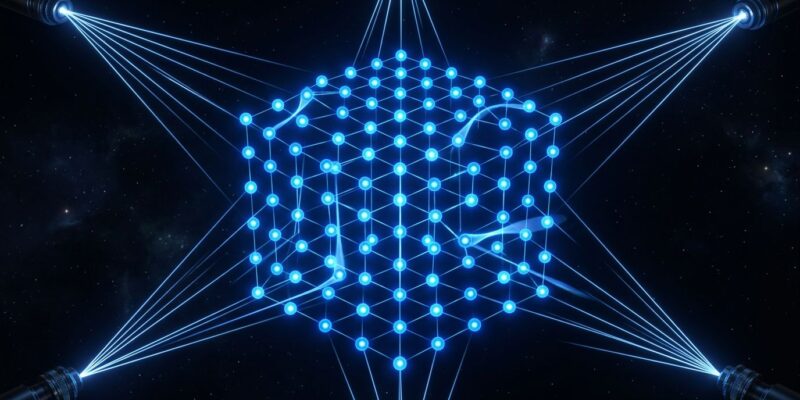
The key is reconfigurability. IBM and Google build superconducting qubits etched onto chips — each qubit has fixed neighbors. Error correction on those systems requires roughly 1,000 physical qubits to produce one reliable logical qubit. However, Oratomic’s atoms can be physically moved during computation using tightly focused lasers — optical tweezers — letting any atom connect to any other atom. That flexibility enables error-correcting codes with a much better ratio: closer to 100 physical qubits per logical qubit, not 1,000.
Moreover, this is not marketing math. Endres has already trapped arrays of 6,000 neutral atoms in the lab — two-thirds of Oratomic’s minimum threshold. The optical-tweezer technique is established physics. The remaining engineering challenges are real, but they’re engineering, not fundamental science.
Who Believes It — and Who Funded It
The investor list is not the usual quantum hype cohort. Alongside the three lead firms, Bezos Expeditions, Index Ventures, General Catalyst, and Bain Capital participated. These are not investors known for writing checks on hand-waving. Vinod Khosla’s declaration — that this is his firm’s largest initial investment ever — is the kind of statement VCs make precisely once and remember forever if they’re wrong.
Then there’s John Preskill, who coined the term “quantum supremacy” and runs Caltech’s quantum computing institute. He’s not on the founding paper of every quantum startup. His name on this research matters.
Furthermore, Bluvstein himself keeps the claims honest: “It is plausible, although not guaranteed, that we will have a fault-tolerant quantum computer by the end of the decade.” A founder who writes “not guaranteed” in their own press materials is either unusually candid or unusually confident. Possibly both.
Where Oratomic Sits in the Quantum Race
The quantum computing landscape in mid-2026 is crowded and fast-moving. QuEra — a Harvard spinout — is targeting a 2028 fault-tolerant machine on Amazon Braket. Atom Computing and Microsoft are delivering a 50-logical-qubit system by 2027. IBM is targeting around 200 logical qubits by 2029. Meanwhile, Google’s Willow chip is aiming for 100+ logical qubits by 2028.
Oratomic’s bet is distinct: skip the NISQ (Noisy Intermediate-Scale Quantum) era entirely and build straight to fault tolerance using an architecture that demands fewer resources to get there. It’s a high-conviction strategy. The $300 million gives the team runway to find out if it pays off.
What Developers Should Actually Do Right Now
NIST finalized its post-quantum cryptography standards in August 2024: ML-KEM (FIPS 203) for key encapsulation, ML-DSA (FIPS 204) for digital signatures, and SLH-DSA (FIPS 205) as a hash-based backup. The NSA has set a 2030 deadline for federal systems to migrate. Node.js v26.5.0, released last week, ships post-quantum TLS support natively. OpenSSL 3.5 enables ML-KEM by default on Debian and Red Hat.
The problem: enterprise crypto migrations take eight to fifteen years. If Google’s warning of a 2029-capable quantum computer is even roughly accurate — and Oratomic’s architecture proves feasible — the timeline has no slack left. Yet 60% of organizations haven’t begun a meaningful migration, according to Quantum Computing Report.
Three things worth doing now:
- Audit your TLS configuration. Do you have a path to ML-KEM key exchange when the time comes?
- Inventory your use of RSA and ECC. JWT signing, SSH keys, certificate authorities, API authentication — all of it is potentially affected.
- Check your dependencies. OpenSSL 3.5, Node.js v26.5.0, and libssl are already shipping PQC primitives. Are your production versions current?
Oratomic’s $300 million raise is a funding story. But the signal it sends — that multiple tier-1 investors, led by Preskill’s own co-founders, believe fault-tolerant quantum computing is achievable this decade — is the story that should be on security engineers’ radars. Not as a panic trigger. As a “let’s get the migration plan on the roadmap” kind of signal.
The quantum threat has been “eventually” for long enough. Eventually may be four years away.