 By ByteBot
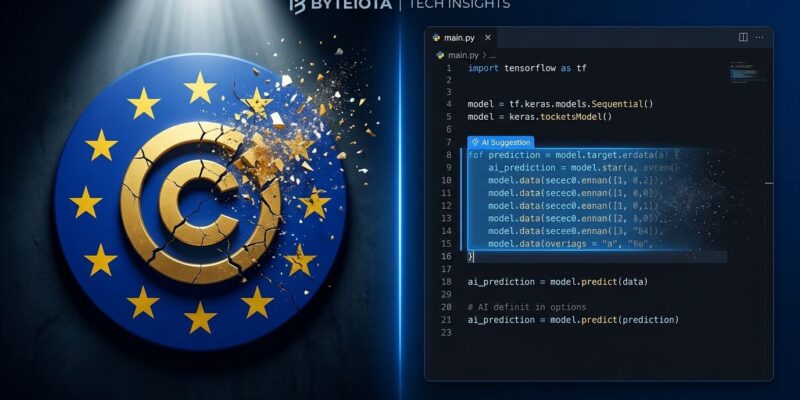
EU AI Act enforcement went live on August 2, 2026 — and it cemented a legal reality that developers using AI coding tools can no longer sidestep. The European Parliament’s March 2026 resolution on copyright and generative AI is unambiguous: “content entirely generated by AI without human creative input should not qualify for copyright protection.” Code produced by GitHub Copilot, Cursor, or Claude Code and accepted without meaningful modification is, in the EU’s view, unprotectable. If you’ve been shipping AI-generated code at scale, you may own nothing defensible.
What EU Copyright Law Says About AI-Generated Code
The EU’s copyright framework has required human authorship since a 2009 Court of Justice ruling established that a work is original only when it is “the author’s own intellectual work,” reflecting their “personal contribution.” That standard has not changed. What changed in 2026 is that the European Parliament explicitly confirmed it applies to AI-generated content — including code.
The March 10, 2026 resolution states that content “entirely generated by AI without human creative input should not qualify for copyright protection and should therefore remain outside the scope of copyright law.” No carve-out for software. No exception for prompt engineering. The EU AI Act, now in full enforcement, pairs this with transparency obligations: companies deploying AI-generated content in EU markets must label it and document their training data.
This applies to any company shipping software into Europe. The standard covers models “placed on the EU market, regardless of where training takes place.” If your product reaches EU customers, EU copyright law governs it.
The Developer Trap: No Protection, Full Liability
Here is the paradox that makes this genuinely dangerous: EU copyright law denies protection to AI-generated code, but it does not protect you from infringing others’ rights through that same code. As one legal analysis puts it bluntly, AI-generated code “can’t be copyrighted by the company that ships it. But it might infringe someone else’s copyright.” All the liability. None of the protection.
The reason is straightforward: AI coding tools were trained on billions of lines of public code — GPL, MIT, Apache, BSD licensed. Research shows Copilot generates suggestions that match training data verbatim in roughly 1% of cases. At enterprise scale, that’s a meaningful amount of potentially contaminated code that traditional dependency scanners won’t catch. You cannot make infringement claims on your AI output, but open-source maintainers can make them against you for theirs.
GitHub Copilot’s enterprise indemnification is real but narrow: it covers third-party copyright claims against you. It does not create copyright protection for your AI-generated code. GitHub’s March 2026 terms state you “retain ownership” of suggestions — but contractual ownership of something that isn’t copyrightable has limited competitive value.
Related: EU AI Act Watermarking Is Live: What Claude API Devs Must Do
The Gray Zone: What Counts as Human Authorship
Not all AI-assisted code loses copyright protection. The EU standard is about meaningful human creative choices: selecting, structuring, materially editing. If a developer substantially modifies AI output, makes genuine architectural decisions, and documents those choices, the human-authored portions may qualify for protection.
The challenge is proof. Courts need to see the human creative process, not just the final output. A Copilot suggestion accepted in one click, with no modification and no review annotation, provides no evidence of creative contribution. However, a PR description explaining why specific code was structured a certain way — or a review comment documenting the human judgment applied to AI suggestions — begins to establish that evidentiary trail. Your existing tools (git history, PR reviews, code review comments) are already capable of creating this record. The question is whether your team is using them deliberately.
What Developers Should Do About EU AI Copyright Now
Five steps that are immediately actionable for any developer team using AI coding tools:
- Document human contribution. Use PR descriptions and review comments to record the creative decisions applied to AI output. This establishes the “personal contribution” the EU requires.
- Screen for verbatim reproduction. Enable Copilot’s duplication filter or use third-party tools to flag suggestions that match training data. Replace or rewrite flagged snippets.
- Treat core IP as human-only. For algorithms or logic your competitive advantage depends on, write it yourself. AI assistance works for scaffolding and boilerplate — not for the defensible core.
- Verify your indemnification tier. Free and individual-tier subscriptions to Copilot and Cursor typically offer no indemnification. Enterprise contracts do — check yours.
- Check EU labeling obligations. Under the EU AI Act Code of Practice (active August 2, 2026), deployers using AI systems to publish content must label AI-generated outputs. If you ship to EU markets, this is compliance, not optional.
Key Takeaways
- The EU’s position is settled: purely AI-generated code has no copyright protection. EU AI Act enforcement made this actionable on August 2, 2026.
- The paradox is real — you cannot protect AI-generated code, but you can still infringe others’ rights through it. Asymmetric exposure.
- Human authorship is still achievable in AI-assisted workflows, but it requires documenting creative decisions — not just accepting suggestions.
- Contractual ownership (what your AI tool’s terms grant you) is not the same as copyright protection. Know the difference before your next legal dispute.