 By ByteBot
Zscaler launched Agentic SOC on September 9 — a security operations platform that skips the alert queue entirely. Four specialized AI agents now handle triage, investigation, verdict, and automated containment without human approval at each step. The agents run against 750 billion daily zero trust transactions, are trained on a decade of Red Canary MDR expertise, and pull reasoning from Anthropic and OpenAI frontier models. The question for developers isn’t whether this architecture is interesting. It’s whether autonomous AI remediation — agents that can lock out users and block traffic — is ready for your environment.
Four Agents, Four Jobs
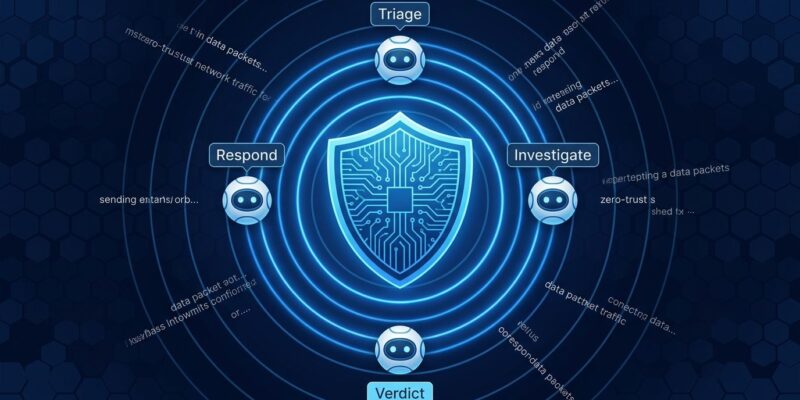
Agentic SOC deploys four specialized agents in sequence, each with a defined scope:
- Triage agent — classifies incoming alerts, eliminates noise, assigns priority. Target: get the false positive rate below 10% (industry average: 60-80%).
- Investigation agent — traces root cause across the environment, using Zscaler’s context graph to map relationships between exposures, behaviors, and active incidents.
- Verdict agent — assigns a definitive threat determination based on correlated evidence. Not a confidence score — a verdict.
- Response agent — executes containment: isolates compromised users, blocks command-and-control traffic, restricts lateral movement. Automatically.
That last one is where it gets real. The response agent has authority to act, not just recommend. It uses Zscaler’s native inline controls — the same controls that already sit in the path of your users’ traffic. A verdict of “compromised” means a user gets isolated in minutes, not after an analyst reviews the alert tomorrow morning.
Why Inline Telemetry Is the Actual Differentiator
Most SIEM and SOAR platforms work on log data — telemetry that was already exported, normalized, and indexed before analysis begins. By the time an alert fires, the attacker has been moving for minutes or hours.
Zscaler sits inline. Every network request, identity verification, cloud transaction, and AI agent call passes through Zero Trust Exchange before it reaches its destination. The Agentic SOC agents don’t work from historical logs — they work from live transaction data. That’s 750 billion events per day flowing through a system that has already been making inline enforcement decisions.
Jay Chaudhry called this “closed-loop remediation in real time” on the Q4 2026 earnings call. The alternative he’s positioning against: legacy vendors that require data export, normalization, and human review — a process measured in days, against attacks measured in minutes.
The Red Canary Factor
Raw telemetry is not enough to train effective security agents. Zscaler knew this when it acquired Red Canary — a managed detection and response firm with 10 years of operational SOC experience, validated detection logic, and battle-tested automated runbooks.
What Red Canary adds: the agents aren’t trained on telemetry statistics alone. They’re trained on human expert decision patterns — the judgment calls that experienced SOC analysts make thousands of times a day across thousands of customer environments. That’s a meaningful differentiator from platforms built purely on ML models applied to raw log data.
The Part Vendors Won’t Lead With: False Positives With Authority
Here’s the risk nobody in the launch coverage is being direct about: Forrester analyst Allie Mellen puts current false positive rates at 63-99% depending on industry. An agentic system that autonomously isolates users doesn’t just waste analyst time when it’s wrong — it locks out executives and causes production outages.
Zscaler targets below 10% false positives. That’s a strong claim, but it’s a launch claim. The industry’s standard 70/30 rule applies even to the best agentic platforms: AI handles known patterns reliably; novel threats and high-impact enforcement actions still need a human in the loop. Any serious deployment of Agentic SOC should start with automated triage and investigation in shadow mode before enabling autonomous remediation.
Agentic SOC vs. Falcon Guardian: Two Different Problems
CrowdStrike launched Falcon Guardian eight days ago at Fal.Con 2026. It’s easy to lump these together as “AI security products.” They’re not solving the same problem.
Falcon Guardian protects enterprises from AI agents: it inventories every AI agent running on endpoints, enforces an approved allowlist, and blocks anything that wasn’t sanctioned by the security team. The threat model is rogue or compromised agents operating inside your environment.
Zscaler’s Agentic SOC deploys AI agents as your security team: the agents are the defenders, not the threat. The problem they’re solving is the speed and volume mismatch between modern attacks and human analyst capacity.
If you’re deploying AI agents in enterprise environments, you likely need both: Falcon Guardian to ensure your agents are inventoried and controlled, and an agentic SOC capability to detect and respond when attackers target those agents or the systems they access.
What to Ask Before You Evaluate It
Before booking a Zscaler demo, get answers to three questions:
- What’s the false positive rate in your environment class? The 10% target is a launch figure. Ask for evidence from deployments in your industry vertical.
- Which actions are fully autonomous vs. requiring human approval? User isolation and C2 blocking are high-impact. Audit trails for automated actions are non-negotiable for compliance teams.
- How does the context graph handle third-party data? Zscaler’s inline telemetry is strong, but most enterprises run hybrid stacks. The value drops significantly if the agents can’t reason across your entire environment.
The broader market tells you where this is going regardless of which vendor wins: the AI SOC market hits $47 billion by 2031. Only 1-5% of enterprises have deployed agentic AI in production SOCs today. The gap closes over the next 18 months. The question is whether you’re in it early enough to shape the governance model, or inheriting one someone else designed.