 By ByteBot
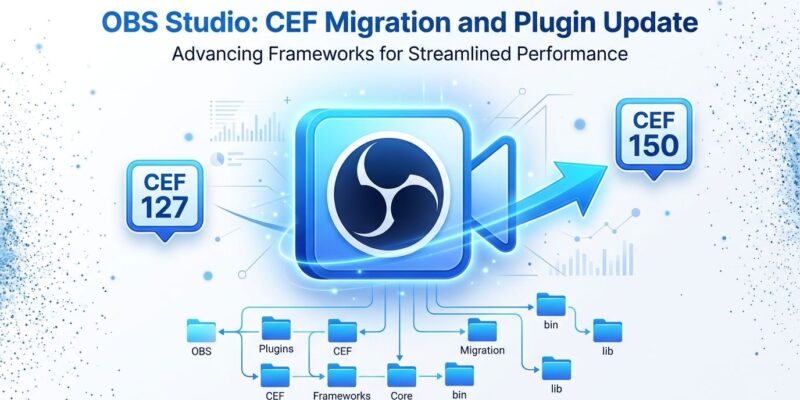
OBS Studio 33.0.0 shipped on October 23, delivering the Chromium Embedded Framework upgrade the streaming community has waited two years for. CEF jumped from version 127 (July 2024) to 150 (September 2026) in a single release, landing roughly two years of browser engine advancement at once. Consequently, the release also redesigns the plugin directory structure — and that second change has a hard deadline attached: third-party plugins that don’t migrate will stop loading entirely when OBS 34 ships.
The Plugin Migration That Can’t Be Ignored
The headline change for plugin developers is a complete restructure of where OBS loads third-party plugins. On Windows, the old path — C:\Program Files\obs-studio\obs-plugins\64bit\ — is now considered legacy. The new required path is under C:\ProgramData\obs-studio\plugins\<plugin-name>\, a separate directory that grants write permissions without requiring admin elevation. Furthermore, first-party built-in plugins move to a dedicated core folder entirely.
In OBS 33, plugins still in legacy locations load normally but display a “Legacy” badge in the Plugin Manager (Tools menu). However, that badge is not cosmetic — it is OBS telling plugin developers their clock is ticking. OBS 34.0 ends legacy path support completely. Plugin authors therefore need to update their NSIS or Inno Setup installers to target the new ProgramData structure before then. The Streamlabs browser plugin already shipped an updated PR targeting the new paths within days of the OBS 33 release candidate. Nevertheless, popular tools like NDI and scene switchers may still show “Legacy” for users who have already upgraded.
Two Years of Browser Engine in One Release
CEF powers OBS’s Browser Source — the embedded Chromium view that renders stream alerts, chat overlays, donation widgets, and countdown timers inside OBS. CEF 127 was built on Chromium from July 2024, while CEF 150 is September 2026. The OBS team deferred this upgrade across versions 31 and 32 due to Chromium API compatibility risk, accumulating two years of technical debt to avoid breaking the plugin ecosystem mid-cycle. OBS 33 finally clears that debt.
For overlay developers, the upgrade is mostly good news: browser sources now have access to newer JavaScript APIs, CSS features, and early WebGPU support unavailable on CEF 127. However, overlays with behaviors hardcoded to older Chromium quirks may silently change. The OBS team flagged this specifically in their release announcement: “If you rely on browser sources or plugins — hello, literally everybody — please read on for details.” Additionally, one known issue at launch: WebGPU acceleration on Windows is broken in 33.0.0 and a patch is pending. Don’t build WebGPU-dependent browser sources against this release yet.
OBS Studio 33 API Breaking Changes Beyond the Path Rename
Plugin authors who think updating install paths is the only required change should review the full OBS Studio 33 release notes. Several APIs changed: the monitoring_type field on audio sources is replaced by monitoring_enabled (a boolean), libnsgif updated to version 1.0.0 with breaking changes for any plugin using it, and MbedTLS 3 is now required for anything doing TLS. Moreover, build toolchains also shifted — Visual Studio 2026 and Windows SDK 26100 are the new minimums. FFmpeg 6.x/7.x and Qt 6.4-6.9 are no longer supported. Ubuntu 24.04 LTS is dropped as a build target.
The practical implication: updating your installer path is necessary but not sufficient. Specifically, plugins must be recompiled against the OBS 33 SDK headers to avoid runtime failures. The Legacy badge in OBS 33 means the install path is wrong. In contrast, silent crashes in OBS 34 may mean the API is incompatible. Update both.
What Else Shipped in OBS 33
Beyond the platform changes, OBS 33 delivers NVENC hardware encoding support on ARM64 devices, smarter source snapping with full-axis alignment and a visual indicator, per-source audio monitoring hotkeys, and a meaningful set of Linux crash fixes including USB microphone disconnect crashes and duplicate PipeWire screencast sources in Studio Mode. The Linuxiac coverage has a detailed breakdown of the full Linux change list for users on those platforms.
Key Takeaways
- OBS Studio 33.0.0 shipped October 23 — the CEF 127→150 upgrade closes two years of deferred Chromium technical debt
- Third-party plugins using legacy install paths show a “Legacy” badge in OBS 33 and will stop loading in OBS 34 — plugin authors must migrate installers now
- On Windows, the new required path is
C:\ProgramData\obs-studio\plugins\<plugin-name>\— not Program Files - Path migration alone is not enough: plugins must be recompiled against OBS 33 SDK due to API changes in monitoring_type, libnsgif, and MbedTLS 3
- Streamers: check Plugin Manager for “Legacy” badges before relying on your setup; back up scene collections before upgrading