 By ByteBot
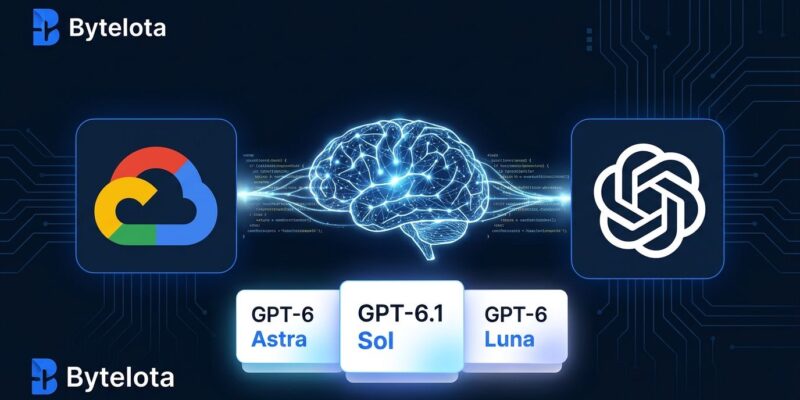
OpenAI’s biggest competitor just became one of its distributors. Google Cloud announced on October 21 that GPT-6 Astra, GPT-6.1 Sol, and GPT-6 Luna — plus OpenAI’s Codex agentic coding workflows — are coming to Google Cloud’s Model Garden. For developers already building on GCP, this removes the last practical reason to maintain a separate Azure account just to access OpenAI’s frontier models.
Three Models, One Catalog
Google Cloud is adding three GPT-6 series models to Model Garden, the same catalog that already houses Gemini, Claude, Llama, and Mistral. Each covers a different price-performance tier:
- GPT-6 Astra — the high-performance option, aimed at coding, computer use, and scientific research
- GPT-6.1 Sol — mid-tier, near-Astra capability at lower cost, strong for agentic coding tasks
- GPT-6 Luna — fast and cost-efficient, built for everyday scale work
That makes Google Cloud the only hyperscale provider running GPT, Claude, and Gemini on the same platform. Private preview starts now for select enterprises; general availability is coming in the next few weeks.
Codex Gets a GCP Sandbox
The more interesting piece for developers is Codex. OpenAI’s agentic coding system runs each task in an isolated cloud sandbox preloaded with your repository. The CLI uses git worktrees, so multiple tasks — a feature build, a bug fix, and a refactor — can run in parallel without stepping on each other. It is built for batch-style work: dependency upgrades, test coverage expansion, code style migrations, and bug fixes described in natural language. It iterates until tests pass, which means a solid test suite gives it real leverage.
One honest limitation: computer use in Codex is research-style browsing only. If your workflow requires driving a browser or automating a GUI, that is still Claude Code’s territory. Both are now available on GCP — pick by task, not by cloud vendor.
The Billing Win Is Real
For GCP-native teams, the commercial case is straightforward. All OpenAI usage shows up on your single Google Cloud invoice, counts toward your existing GCP spending commitments, and applies against Flexible Savings Plans. No separate OpenAI contract, no separate billing cycle, no procurement process. Developers can also keep model names out of their business logic — swap between Astra, Sol, and Gemini behind a config key without touching application code.
What This Means for Azure
Some context worth stating plainly: until April 27, 2026, Microsoft had exclusive cloud distribution rights for OpenAI. That changed when the exclusivity deal expired and OpenAI moved onto AWS first, then GCP now. Azure still ships OpenAI products first under the revised agreement, and Microsoft remains the primary cloud partner — but the exclusive angle that drove enterprise Azure adoption for AI workloads is gone. If your team is already on GCP or AWS, there is no longer a model-access argument to move workloads to Azure.
Data Governance: What Is Live Now vs. What Is Coming
Enterprise developers in regulated industries need to read the fine print. The essentials are active: your prompts and outputs stay inside your GCP data perimeter, are never used to train foundation models, and are protected by VPC Service Controls and unified audit logging. However, Zero Data Retention and Confidential Compute are listed as coming soon. If your organization requires those controls for sensitive workloads — healthcare, financial services, government — wait for those features before migrating production workloads. The infrastructure is sound; the full compliance stack is not complete yet.
What to Do Now
- Request preview access — Submit interest at cloud.google.com/resources/interest/openai-models
- Audit your GCP commitments — Check whether your existing spending commitments and Flexible Savings Plan credits can offset OpenAI costs immediately at GA
- Pilot Codex on a non-critical repo — Test it against your actual test suite now so you have a working evaluation framework ready before general availability