 By ByteBot
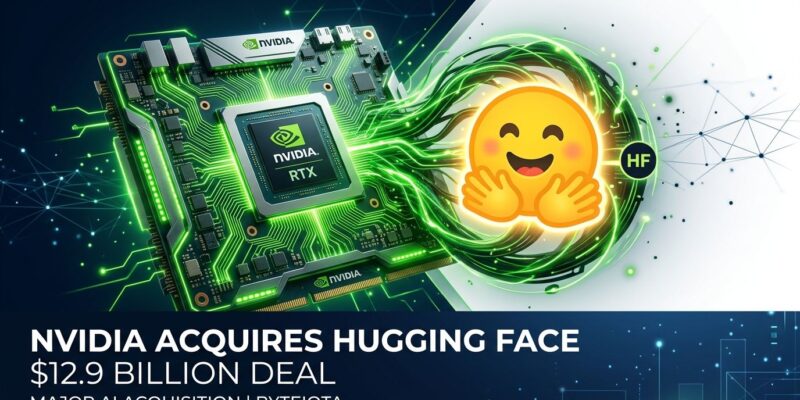
Nvidia has agreed to acquire Hugging Face — the platform that hosts over 3 million open-source AI models and serves 13 million developers globally — for $12.9 billion. The deal, first reported by The Information on August 27 and corroborated by CNBC and Bloomberg, would be Nvidia’s largest acquisition ever. Neither company has issued a formal press release, but multiple independent sources have confirmed the agreement is in place. The open-source AI community, which trusted Hugging Face specifically because it didn’t belong to any hardware or cloud vendor, is now reckoning with what that trust was worth.
This Is a Hardware Play, Not a Software Play
To understand why Nvidia spent $12.9 billion on a model repository, ignore the AI hype and look at the supply chain. Every developer who downloads a model from Hugging Face eventually needs compute to run it — and that compute is, overwhelmingly, Nvidia GPUs. The company already controls roughly 80% of the AI chip market. The threat to that dominance isn’t AMD or Intel; it’s Amazon, Google, and Microsoft building their own chips specifically to cut Nvidia out. Owning Hugging Face gives Nvidia the top of the developer funnel: influence which models get adopted, and you influence which hardware those models run on.
This is also why the deal is nearly double Nvidia’s previous largest acquisition (Mellanox, $6.9B in 2020). Mellanox was infrastructure. Hugging Face is influence.
What Actually Changes for Developers
The honest answer is: not much immediately. Nvidia is financially incentivized to keep Hugging Face popular. Any heavy-handed move — restricting model access, favoring CUDA-only models, raising prices for non-Nvidia inference paths — would trigger a mass migration to alternatives, which defeats the entire purpose of the acquisition. Expect at least 12 months of status quo while the deal clears regulatory review.
After that, watch for subtler shifts. Inference Endpoints (HF’s hosted API service) may quietly default to or exclusively support Nvidia hardware. Pricing for AMD ROCm or Apple Silicon inference paths may drift upward. Enterprise agreements may bundle Nvidia compute credits. Model discovery rankings could begin favoring CUDA-optimized variants. None of this will be announced. It will just happen.
The models themselves are a different story. They’re git repositories — open weights, versioned, cloneable. Nvidia can’t lock them without the community forking the entire catalog, which will happen the moment they try. The models are safe. The infrastructure around them is not.
The Neutrality Problem
Hugging Face’s founders previously rejected a cheaper acquisition offer — reportedly around $4.5 billion — specifically to protect the platform’s independence. The argument was that the platform’s value depended on being nobody’s hardware ally. That argument was correct. It’s also now moot.
The chip company that controls 80% of AI compute will now own the platform where 13 million developers discover, compare, and download AI models. Imagine GitHub being purchased not by Microsoft the corporation, but by Microsoft Azure specifically — the division that competes directly with every other cloud where developers might want to run their code. That’s the structural conflict that now exists inside Hugging Face.
The real question isn’t whether Hugging Face’s model catalog disappears. It won’t. The question is whether the platform subtly tilts — and whether you’ll notice when it does. The New Stack’s analysis of the neutrality problem is worth reading in full.
Open-Source AI Infrastructure Is Being Locked Up
This acquisition doesn’t exist in isolation. OpenRouter was acquired by Stripe earlier in 2026. Replicate was acquired by Cloudflare in November 2025. Now Hugging Face is going to Nvidia. Every major independent model hub has been absorbed in roughly 18 months. The “open” infrastructure layer of AI is consolidating into a handful of corporate owners, each with their own strategic interests in how you build and deploy models.
Regulatory review is certain. The FTC and DOJ will receive mandatory HSR filings; the EU, where Nvidia already faces active antitrust inquiries over GPU supply allocation, will open its own review under AI Act enforcement. Given the complexity, the deal won’t close before mid-2027 at the earliest.
What You Should Do Now
Nothing urgent. But if you depend on Hugging Face models in production, spending an hour on this now is reasonable insurance:
# Mirror models you depend on before anything changes
pip install huggingface_hub
huggingface-cli download meta-llama/Llama-3.1-8B --local-dir ./models/llama-3.1-8b
For alternatives, Together AI, Modal, and Fireworks AI remain independent. Ollama and vLLM handle self-hosted inference cleanly. The signal to watch isn’t the acquisition itself — it’s whether Hugging Face CEO Clement Delangue stays on after it closes. His exit would mean the founders’ original neutrality argument is finished. At that point, start evaluating alternatives seriously.