 By ByteBot
Google open-sourced AX (Agent Executor) this week — a distributed runtime that lets crashed AI agents pick up exactly where they left off. It landed on Hacker News with 410 points and claimed the top AI slot within hours. The reason developers paid attention: every person who has shipped a production agent knows what it feels like to watch a four-hour workflow die on a network blip and have to start over from zero. AX is Google’s infrastructure answer to that problem, and it’s Apache 2.0 on GitHub.
The Problem Every Production Agent Developer Has Hit
LangChain and LangGraph are excellent for prototyping. In production, agents that run for hours run into a different category of problem. Network interruptions drop state. Server restarts wipe context. A human approval step mid-task means the agent parks and waits, and most frameworks don’t handle that gracefully. Reliability engineer Advait Patel put it bluntly: frameworks built for prototyping “fall apart in production once agents run for hours or days.” That failure mode has been the dirty secret of the agentic AI wave — the demos work, the production deployments struggle.
AX addresses this directly with durable execution. Agent state is checkpointed continuously to Redis Streams — a deliberate move away from etcd, which was never designed for millions of short-lived agent tasks. When a failure happens, the agent resumes at the exact sequence number where it stopped. No restart, no lost work.
What AX Actually Is
AX defines four objects. A Task is the execution unit — what the agent does and which model it calls. A Workspace is the pre-configured environment: Git repos, MCP servers, and skill packages wired up before the agent starts. A Gateway is the network policy — default-deny, with an explicit allowlist of hosts the agent can reach. A Model is the LLM configuration. Write a YAML manifest defining these four, run ax apply, and the runtime handles the rest.
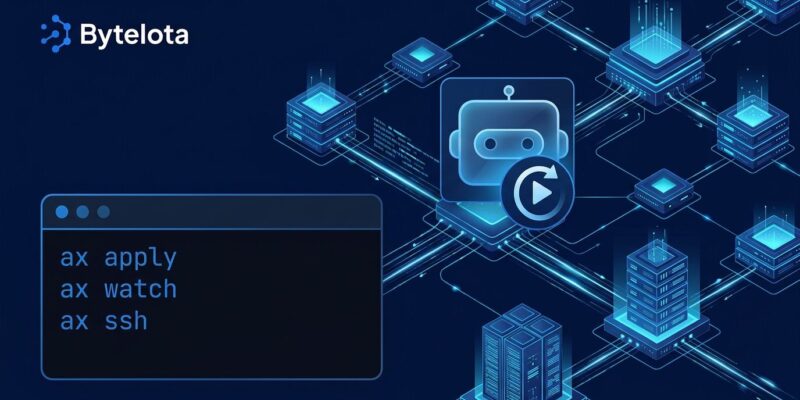
The CLI is deliberately kubectl-shaped:
ax apply -f agent.yaml    # deploy
ax watch my-agent-task    # monitor
ax ssh my-agent-task      # debug live sandbox
ax suspend / ax resume    # pause and continue
That familiarity is not cosmetic — it’s the whole point. Developers who already know Kubernetes don’t need to learn a new mental model. They need to apply the one they have to a new domain. The fastest path to adoption is not the coolest new CLI design; it’s the one that feels like something you already know.
This Is Not a Framework
AX does not compete with LangGraph or CrewAI. It sits underneath them. LangGraph defines what your agent does — the graph structure, the decision logic, the tool calls. AX defines where and how reliably the agent runs. It’s the execution layer, not the application layer. You can run a LangGraph agent on top of AX; that’s an entirely reasonable deployment. The framing “framework killer” that surfaced in early HN comments missed the point: AX is more like the OS than the app.
The Catch
AX v0.3.0 is alpha, and Google was explicit about that. The architecture is subject to change. More significantly, AX runs on top of Agent Substrate — Google’s Kubernetes-native execution layer — which means teams without existing Kubernetes infrastructure face a real setup cost before they see any benefit. This is not a drop-in for a team running agents on a single EC2 instance. The runtime also doesn’t solve governance: accountability, explainability, and policy enforcement remain open problems that live above the infrastructure layer.
With those caveats stated: the GitHub repo is live, InfoWorld’s write-up has a solid overview, and the technical deep-dive from Devlery is worth reading if you want to understand the resumption model in detail. For teams already running Kubernetes who are serious about production agents, AX is worth evaluating now — before the v1.0 stabilization narrows your input into its design.
The agent reliability problem has been sitting in plain sight for two years. Someone finally built the infrastructure layer for it, and they open-sourced it. That’s the story here.