 By ByteBot
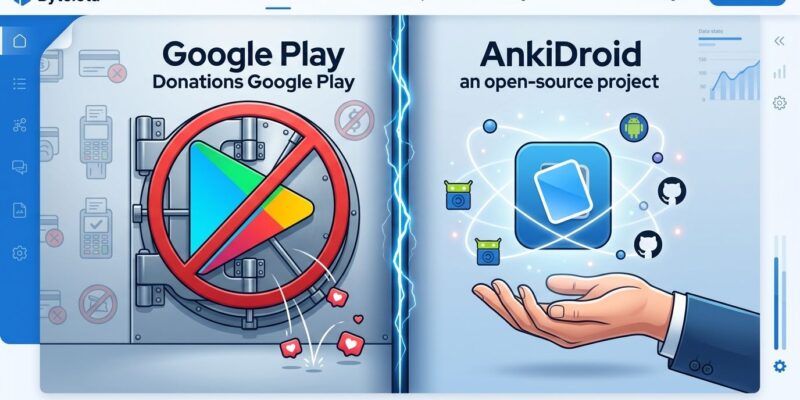
Google Play issued AnkiDroid a removal notice on July 20, 2026, citing a link to its Open Collective donation page as a policy violation. Unless something changes, the app disappears from Google Play for 99% of its 23 million users on September 11. The stated reason: Open Source Collective, a legitimate IRS-recognized nonprofit that hosts 3,500+ open source projects, does not qualify as a “tax-exempt organization” under Google’s payment policy. That ruling contradicts what the IRS actually says.
The 501(c)(6) Problem Google Won’t Acknowledge
Google’s payment policy permits donation links only to “validated tax-exempt organizations,” citing 501(c)(3) as an example. Open Source Collective holds a valid IRS 501(c)(6) determination letter — and 501(c)(6) organizations are, by definition, tax-exempt. The IRS does not dispute this. Google’s reviewers do.
After AnkiDroid submitted the IRS documentation, Google responded on August 6 with a clarification that donations may only go to “a validated 501(c)(3) charitable organization.” When AnkiDroid pushed back with the actual IRS letter, Google replied that Open Source Collective “is not tax-exempt.” That is factually incorrect. The distinction the policy is actually drawing — even if its language doesn’t — is between tax-exempt and tax-deductible. A 501(c)(6) organization pays no taxes (tax-exempt). Donations to it are not deductible for the donor (not tax-deductible). These are different legal concepts. Google is enforcing the second while citing the first. The full exchange is documented in AnkiDroid’s GitHub issue #21656.
This Is Bigger Than AnkiDroid
AnkiDroid is the most visible victim, but it is not alone. Open Source Collective is the fiscal host for over 3,500 open source projects, including webpack, Babel, and thousands of smaller tools with Android presence. Any of them that displays a donation link inside an app now faces the same exposure. Aves, an open-source Android photo gallery, has already opened its own GitHub issue asking what to do when Google enforces the same policy in September 2026.
Moreover, the practical impact on AnkiDroid is substantial. The app is embedded in medical education — studies show 94% Anki adoption among some medical student cohorts. These are users who sync decks across devices, depend on offline access, and have years of study data in the app. Forcing them to sideload from F-Droid is a friction barrier that will cost real installs. Medical students mid-exam season do not have time to research alternative app stores. The Hacker News discussion on this topic hit 709 points — one of the highest-scoring threads of the day — reflecting genuine developer outrage.
The Real Issue Is Control, Not Tax Law
Google cannot extract a payment cut from AnkiDroid’s Open Collective donations — the app earns nothing, and Play Billing does not support nonprofit donations in this form. So this enforcement does not help Google financially in any direct sense. However, it reinforces the norm that all payment interactions on Android flow through Google-controlled channels. Open-source apps that exist outside that system, accept zero Google revenue, and send users to external payment pages are increasingly unwelcome in that arrangement.
This is not unprecedented. In 2019, WireGuard faced an identical challenge over its donation link and resolved it by moving to Software Freedom Conservancy, a 501(c)(3). That path is not available to most open-source projects. The IRS does not consider software charitable simply because it is free — which is why Open Source Collective uses 501(c)(6) rather than 501(c)(3). Asking the entire open-source Android ecosystem to restructure its legal entities around Google’s interpretation of tax law is not a reasonable outcome.
What To Do Right Now
AnkiDroid is already available on F-Droid and distributes APKs directly from its GitHub releases page. If the app disappears from Google Play on September 11, users can install it without the Play Store: download the F-Droid APK from f-droid.org, enable “install from unknown sources” in Android settings, and AnkiDroid appears immediately. Obtainium is another option — it pulls APKs directly from GitHub releases and handles updates automatically.
For open-source maintainers using Open Collective as their fiscal host, the practical options are limited: move to a 501(c)(3) fiscal host such as Software Freedom Conservancy or Apache Software Foundation (qualification is difficult and slow), remove the donation link from the app and link only from the project website, or treat F-Droid as the primary distribution channel and Google Play as secondary. The third option is increasingly the right default anyway.
Key Takeaways
- Google Play is removing AnkiDroid on September 11, 2026 over a donation link to Open Source Collective — a legitimate 501(c)(6) nonprofit that the IRS recognizes as tax-exempt.
- The policy error is real: Google is treating “tax-deductible” and “tax-exempt” as synonyms. They are not.
- 3,500+ open source projects use Open Source Collective as their fiscal host. Any Android app among them is at identical risk.
- AnkiDroid is available on F-Droid and via GitHub APKs — users are not without options, but friction costs installs.
- Open-source maintainers should audit Play Store apps now and remove or relocate donation links that route through non-501(c)(3) fiscal hosts.