 By ByteBot
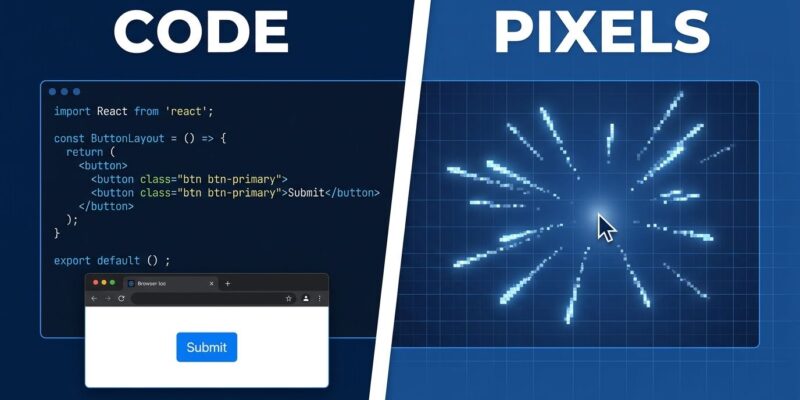
Runway shipped Solaris on August 31, and the pitch is worth reading carefully: it does not generate code for your interface. It generates the interface itself — pixel by pixel, frame by frame — as live video that responds to your clicks in real time. No HTML. No JavaScript. No DOM tree. The browser executes nothing, because there is nothing to execute. That is either a breakthrough or a reliability nightmare, depending on what you need to build.
How Solaris Works
Solaris runs two models in parallel. A language model reads your interaction — a click, a drag, a typed instruction — and decides how the interface should respond. A separate world model, built on Runway’s Gen-4.5 video generation architecture, renders each resulting frame. You see a live stream. The model sees a sequence of frames to predict. Your button press is conditioning data for the next frame, not a function call.
This is the same architecture Runway used for GWM-1, its General World Model for simulating physical environments. The company repurposed that video machinery to simulate software instead. The result: Solaris can handle interactions that were never programmed — because nothing was programmed. The mouse cursor becomes a contextual tool. Menus adapt. Layouts shift. The interface improvises.
The Problem With Improvising Buttons
That improvisational quality is exactly what makes Solaris technically interesting and exactly what disqualifies it from most production environments. Runway’s announcement puts it plainly: “A system that generates visual behavior probabilistically cannot, in its current form, provide these guarantees.” The guarantees they mean are the ones software has always taken for granted — same input produces same output, every time, auditable, testable, diffable.
For consumer prototyping tools or early-stage UX exploration, probabilistic rendering is a feature. For financial dashboards, medical record interfaces, and administrative workflows, it is a structural blocker — not a bug to be patched, but a consequence of how world models work. You cannot version-control a pixel stream. You cannot write a unit test for a predicted frame. You cannot audit what a screen reader cannot read.
The Accessibility Gap Is Architectural
Solaris generates pixels. Screen readers consume semantic structure — ARIA roles, DOM nodes, HTML elements. There is no bridge between those two things. Generated frames cannot expose an accessibility tree, because the accessibility tree is a property of code, and Solaris has no code. This is not a missing feature on Runway’s roadmap. It is a consequence of removing the intermediate representation entirely. WCAG compliance in any regulated software environment is off the table until that fundamental architecture changes.
The Evaluation Numbers (Read These Carefully)
Runway ran a preference study: 250 evaluators, 30 interaction scenarios, roughly 7,500 pairwise judgments. Solaris versus Claude Opus 5 generating coded UIs from the same starting image and instruction. The results were lopsided: 61% of evaluators preferred Solaris for instruction-following, 71% for natural behavior. The coded baseline came in at 24% and 21% respectively.
These are real numbers from a real study. They measure visual fluidity and how natural the interaction feels — which is exactly what Runway optimizes for. They do not measure accuracy when text rendering glitches (acknowledged as an open problem), reliability across long sessions, or what happens when a user returns expecting previous interface state to persist. Runway evaluated its own research. Independent benchmarks do not yet exist.
What “Early-Access Research” Means Here
There is no public API. There is no launch date. There is no pricing. Runway is collecting access requests via form and says it is “working with key partners” — standard language for a well-funded research demo seeking enterprise pilots. The compute cost of real-time 720p frame generation is undisclosed, but real-time video generation at interactive frame rates is not cheap.
Runway has been building toward this. GWM-1 simulated physical environments. Solaris simulates software. The trajectory suggests Interface World Models will keep moving up the stack — but Solaris is the first step of that journey, not the destination. Read The New Stack’s analysis for a solid breakdown of what the generated-software model means for how applications are built.
The Bottom Line
Solaris is genuinely novel research, and Runway deserves credit for shipping something that does not exist anywhere else. But the “no code” framing is a marketing story sitting on top of a harder technical truth: removing code also removes everything that makes software inspectable, testable, and safe to deploy at scale. The 61% preference score matters less than the unanswered questions about text accuracy, session persistence, and the accessibility wall.
Watch this space — world models simulating software interfaces is a real trajectory worth tracking. But do not reorganize your frontend team around it. Solaris is a proof of concept, and a good one. Production-grade Interface World Models are at least two to three years from solving the problems that currently matter most.