 By ByteBot
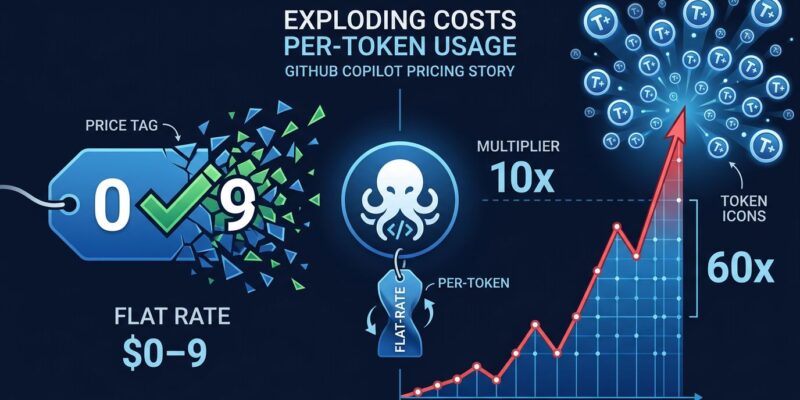
GitHub Copilot’s flat-rate era ended today. Effective June 1, 2026, GitHub has replaced its Premium Requests Unit model with usage-based GitHub AI Credits billing — and the numbers are making developers stop and recalculate. Bills projected at $29/month are now tracking toward $750. Teams paying $50 are running the math and landing at $3,000. Moreover, the fallback that kept things predictable — the automatic downgrade to a cheaper model when you hit your limit — no longer exists.
What GitHub Copilot Token Billing Actually Costs
The mechanics are straightforward on paper. One AI Credit equals $0.01. Code completions and Next Edit Suggestions remain free — no credits consumed. However, everything else — chat, agentic sessions, Copilot CLI — now pulls from a monthly credit pool tied directly to your plan:
- Copilot Pro: $10/month with $10 in included credits
- Copilot Pro+: $39/month with $39 in included credits
- Copilot Business: $19/user with $19 in included credits per user
- Copilot Enterprise: $39/user with $39 in included credits per user
What does $39 in credits actually buy in a real session? According to the GitHub community discussion thread, one developer answered that with a receipt: a single GPT-5.5 conversation lasting three minutes consumed 405 credits, roughly $4. That means $39 buys approximately 10 non-trivial GPT-5.5 questions per month. The frontier models hit even harder — Claude Opus 4.8 runs $25 per million output tokens. Developers who averaged roughly 1,500 requests per month under the old system are now looking at about 140 requests for the same budget. Furthermore, the official Copilot pricing table shows GPT-5.5 at $30 per million output tokens, making agentic sessions genuinely expensive at scale.
The Detail Everyone Missed: No More Fallback
The bigger problem isn’t the token pricing. It’s what happens when you run out.
Under the old system, exhausting your premium requests wasn’t catastrophic. Copilot fell back to a cheaper base model automatically. You kept working — slower, perhaps, but working. Under GitHub Copilot’s new AI Credits system, once credits are exhausted at the default $0 overage budget, Copilot simply stops. Not degrades gracefully. Stops. No mid-session warning. No fallback. The session ends.
This is the change that actually disrupts most workflows. The token pricing is annoying. The removal of the safety net is a hard wall that appears without warning during active coding sessions.
The Community Response Is Not Subtle
GitHub’s community discussion thread on the change has 913 thumbs-down reactions against 22 thumbs-up — a 41-to-1 negative ratio. TechCrunch ran it with the headline: “What a joke: GitHub Copilot’s new token-based billing spurs consternation among devs.” The frustration follows a predictable pattern: developers on annual plans feel bait-and-switched. They locked in pricing expecting one product and received a different one mid-subscription.
There’s a counterargument making the rounds: disciplined engineers who write targeted prompts won’t blow through credits. That’s probably true. It also sidesteps the point entirely. Exploratory coding, debugging sessions, and multi-step agentic workflows are not inefficient usage. They are, in fact, how agents work. Calling that “vibe coding” misses why developers bought an agentic product in the first place. Additionally, the $500M AI bill problem isn’t unique to Copilot — ByteIota’s coverage of how agentic loops break enterprise budgets documented exactly this cost spiral months ago.
Why GitHub Made This Change
The economics broke down. Independent analysis suggests GitHub was absorbing close to $1 billion monthly in subsidized compute costs at peak usage. A heavy agentic user consuming 300 premium requests could represent $250 in actual API costs against a $39 monthly subscription. Consequently, multiplying that across millions of users running multi-hour coding sessions — the kind Copilot has been actively marketed for — and the math does not work.
“A quick chat question and a multi-hour autonomous coding session can cost the user the same amount.” — GitHub Blog
That quote is accurate. It’s also an admission that the original pricing model was designed for a pre-agentic era, and GitHub needs developers to absorb that correction now. This follows the Project Polaris announcement where GitHub invested heavily in its own AI model — a cost that flat-rate subscribers were inadvertently funding.
Where Developers Are Moving Next
Cursor ($20/month flat rate) and Windsurf ($15/month) are both reporting increased interest from developers migrating away. Claude Code, model-agnostic BYOK tools like Cline and Aider, and local inference via LM Studio are gaining attention from developers who prioritize cost predictability. DeepSeek V4 under an MIT license remains a strong option for teams comfortable managing their own inference stack.
Nevertheless, the bigger signal here isn’t which tool wins the migration. GitHub just made the economics of flat-rate AI coding explicit. Every other AI coding platform — Cursor included — is running the same infrastructure model. When agentic usage scales, flat-rate pricing becomes a liability. GitHub is the first major player to blink. The rest will follow on their own schedules, with their own “surprise” announcements.
If your workflow depends on Copilot for agent-heavy tasks, set your overage budget and review your model routing strategy now — not when Copilot stops mid-session during a production incident.