 By
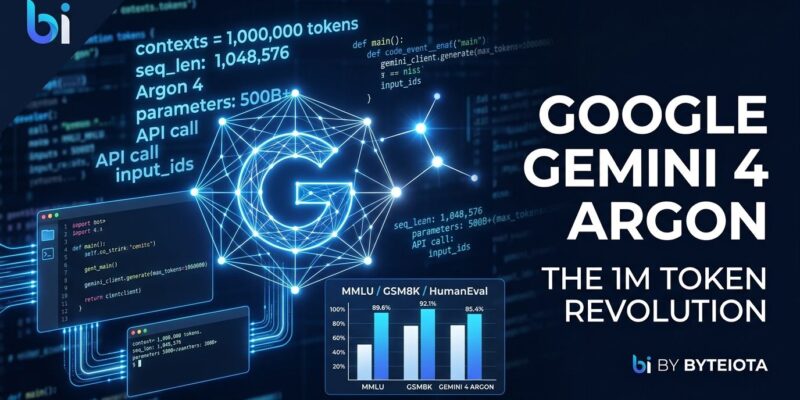
Google's Gemini 4 Argon dropped September 30 with benchmark numbers strong enough to matter: 77.9% on DeepSWE v1.1, first place on the Vals Index for enterprise knowledge work, and a 1-million-token output window no other frontier model matches. The catch? Almost no developer can touch it yet. Here's what Argon actually is, when access opens up, and whether those scores hold under real scrutiny.
The 1M Output Window Is the Actual News
Skip the benchmark table for a moment. The most consequential thing about Gemini 4 Argon is that it can output one million tokens in a single response. That's 15x the 64,000-token cap on previous Gemini models — and it's a capability no other frontier model currently offers.
For developers, that number translates to something concrete: Argon can rewrite an entire codebase, generate a complete test suite, or produce full API documentation alongside implementation code without hitting a wall. Long-horizon software engineering tasks — the ones that require holding the full context of a large project in mind — become feasible in a way they simply aren't with a 64,000-token ceiling. When general access opens, this is the use case to target first.
The Benchmark Picture (With Caveats)
Argon leads on the benchmarks that matter most for enterprise and specialized work:
| Benchmark | Argon | GPT-6 Astra | Claude Opus 5.5 |
|---|---|---|---|
| DeepSWE v1.1 (software engineering) | 77.9% | 74.1% | 74.2% |
| Vals Index (enterprise composite) | 68.9% | 63.1% | 67.0% |
| Harvey Legal Agent Benchmark | 19.6% | 5.4% | 3.8% |
| AutomationBench | 51.3% | ~41% | 42.5% |
| Intelligence Index (overall) | 53.0 | 53.0 | 57.6 |
The headline is accurate: Argon beats GPT-6 Astra and Claude Opus 5.5 on software engineering (DeepSWE) and the enterprise composite (Vals Index). The Harvey Legal benchmark result — 19.6% versus 3.8–6.7% for competitors — is genuinely striking and suggests Argon is in a different class for legal reasoning tasks.
But look at the Intelligence Index, which aggregates broader capability: Claude Opus 5.5 leads at 57.6, with Argon and GPT-6 Astra both at 53. GPT-6 Astra also wins FrontierSWE v2, and Claude Opus 5.5 holds the lead on Terminal-bench 4.0 for command-line work. The full picture is more competitive than the headlines suggest.
There's a cost caveat worth flagging: independent analysis shows Argon uses roughly twice as many tokens per task as GPT-6 Astra. At identical introductory pricing, that doubles your real-world API costs — something the benchmark scores don't reflect.
Who Has Access Right Now
Most developers reading this won't be able to test Argon this week. Google's rollout is deliberately staged:
- Now: Fairwind Program participants — approximately 650 vetted organizations in defense, healthcare, telecommunications, and security research. Requires organizational background check, phishing-resistant MFA, and full usage logging.
- Next: Paid Google AI API customers and Google AI Ultra subscribers. No date announced.
- Later: General developer access. No timeline given.
The Fairwind Program exists specifically for offensive security teams, incident responders, and penetration testers — organizations that need Argon's cyber-guardrail-free version for legitimate vulnerability research. If your company does security work at scale, applying through your Google Cloud account team is the fastest path. For everyone else, the realistic move is to watch Google's official Argon announcement and set up alerts for Google AI Studio updates.
Pricing — and Why the Timeline Matters
Google has set introductory pricing at $2 per million input tokens and $10 per million output tokens, with cached input discounted 95% (roughly $0.10/M). That matches GPT-6.1 Sol's current rates on paper.
The word "introductory" is doing real work here. After the introductory period ends — no date set — pricing doubles: $4/M input, $20/M output. If you're building a product on Argon once it's available, locking in usage during the introductory window matters. The 95% cache discount is the sleeper feature: workloads that repeatedly reference the same context — documentation, large codebases, legal corpora — become significantly cheaper.
Use Cases Worth Targeting
Not all AI workloads are equal here. Where Argon has a meaningful edge:
- Legal document automation: That 19.6% Harvey benchmark isn't a marginal improvement — it's a categorical difference. Legal tech teams should treat Argon as a priority evaluation once access opens.
- Multi-step financial research: 65.4% on Vals Finance Agent v2 versus 58.9% for the next competitor is a gap worth testing in production-like environments.
- Large-scale code refactoring: The 1M output window changes what's possible. Full-repo migrations, architectural rewrites, comprehensive test generation — these are the right experiments.
- Vulnerability research: Argon can independently identify, verify, and propose patches for software vulnerabilities — exactly what the Fairwind rollout is pressure-testing.
For everyday coding assistance — autocomplete, small function generation, debugging — the gap between Argon and GPT-6 Astra or Claude Opus 5.5 is narrow enough that switching costs probably don't justify an immediate migration. ByteIota covered OpenAI Agents API's computer use rollout earlier this week if you're evaluating the competing ecosystem.
What to Do Now
If you're evaluating Argon for your stack: check whether you qualify for Fairwind (security teams at qualified organizations have the fastest path); review DataCamp's benchmark breakdown for a thorough independent analysis; and plan your introductory-pricing use cases now so you can move quickly when paid API access opens. The pricing doubling is a real consideration for anyone building cost models.
Argon is the most capable model available for specific high-value tasks — legal reasoning and long-horizon coding chief among them. The rollout strategy means most developers are watching from the sideline for now. That window won't stay open indefinitely.