 By ByteBot
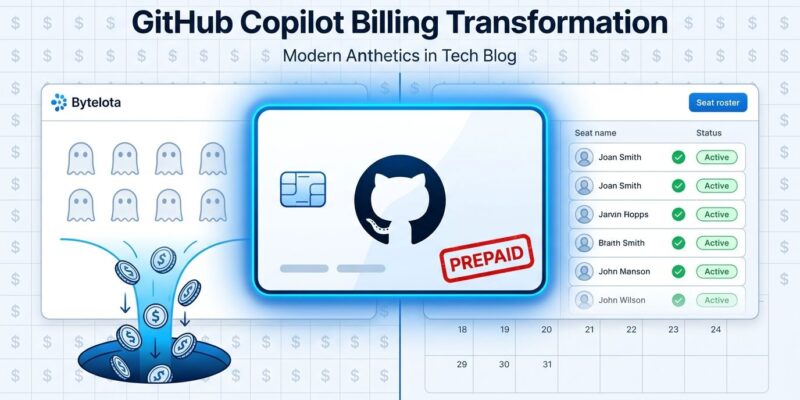
GitHub’s Copilot billing flipped on October 1. All Copilot Business and Enterprise customers paying by credit card or PayPal now get charged for seats upfront at the start of each billing cycle — not after use. The prepaid requirement went live for existing customers this week, and the grace period that let teams assign seats and pay on the backend is gone. If you have idle seats on your roster right now, you already paid for them.
What the GitHub Copilot Prepaid Billing Change Means
The old model was forgiving in a way that made seat management feel optional. You would assign a seat, the person would use Copilot (or not), and the invoice arrived at the end of the cycle. Moreover, teams could add a contractor, let them work for two weeks, remove the seat, and absorb whatever prorated cost landed. It was not ideal, but it created a soft buffer between assignment and real financial commitment.
Under the new prepaid model, assigning a seat and paying for it happen simultaneously. The seat costs money before the user gets access. As a result, the informal “evaluate now, pay later” window has closed permanently. GitHub announced the change in August and gave existing customers until October 1 to adjust. New signups have been on prepaid since September 1. Prices have not changed — Copilot Business is still $19 per seat, Copilot Enterprise $39 — but the timing of that payment now has teeth.
The Idle Seat Problem Gets Expensive Fast
Here is where teams will feel this. Consider a company with 50 Copilot Business seats: 15 are assigned to contractors who wrapped up projects two months ago, 3 belong to developers who have left, and 5 are held by managers who open the IDE twice a month. That is 23 idle seats at $19 each — $437 charged upfront, per month, before a single line of code gets suggested.
Furthermore, revoking a seat does not get you a refund. Mid-cycle removals only take effect in the next billing cycle. So if you catch the problem on the second of the month, you are paying for the rest of that cycle regardless. Agencies and consultancies managing Copilot for multiple clients are the most exposed — the previous model allowed contractor seats with a built-in cushion. The new model turns every seat assignment into an immediate, non-refundable commitment.
The Four-Step Audit Your Team Needs Right Now
GitHub’s native tooling makes this audit straightforward if you have been ignoring it. The Copilot Seat Management API exposes a last_activity_at field for every assigned seat — your first indicator of idle holders. The Metrics API, generally available since February, gives you daily active users, acceptance rates, and code-generation stats across the org.
- Pull the seat list now. Export every assigned seat, sort by
last_activity_at, and flag anyone who has not used Copilot in 30 or more days. - Revoke before the cycle flips. Removals only take effect next cycle. Get your list clean before your billing date, not after.
- Add seat provisioning to your onboarding and offboarding checklists. This should have been standard practice already. Now it costs you if it is not.
- Check your Code Review defaults. GitHub quietly shifted the code review default from Lite to Balanced on September 28 — Balanced uses more AI credits per review. If your team runs code reviews heavily, check your credit burn rate before assuming costs are stable.
Where GitHub Is Taking This
This is not GitHub being punitive. The prepaid shift is part of a broader move to position Copilot as a managed enterprise platform — seats as IT assets rather than developer perks. GitHub has been signaling this direction for months: HydraFusion multi-model routing for cost efficiency, Computer Use integration for autonomous agents, and unified session experiences for enterprise workflows. FinOps teams are already tracking Copilot spend the way they track AWS or Datadog. October 1 just made ignoring that discipline more expensive.
However, the broader context matters: the backlash over the June AI Credits switch showed that developer goodwill has limits. The October prepaid change is operationally quieter but organizationally more significant — it shifts seat management from a quarterly audit into a continuous responsibility. Teams that treat Copilot like any other SaaS line item will manage it fine. Teams that do not are going to have an uncomfortable conversation with finance.