 By ByteBot
If you use Claude Fable 5 through a Pro, Max, Team, or Enterprise plan, your free access window closes today. Starting July 8, every Fable 5 token costs extra — on top of your existing subscription. If you haven’t enabled usage credits in the Claude Console yet, Fable 5 goes dark with no grace period. This isn’t a soft throttle. It’s a hard cutoff, and the Fable 5 billing cliff lands tonight.
What Changes on July 8
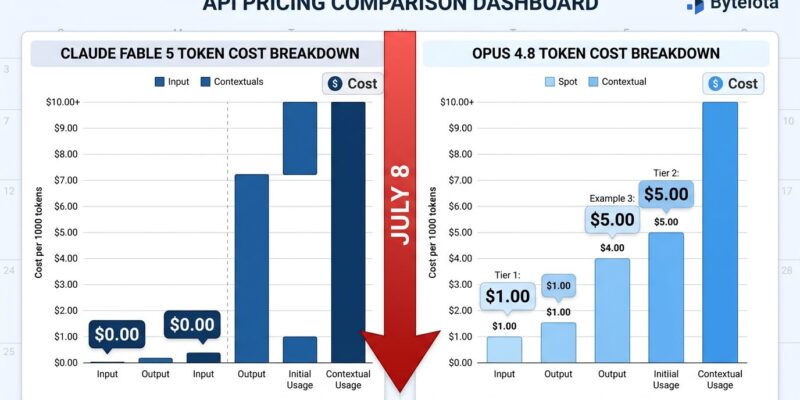
Through July 7, Fable 5 has been included in Pro, Max, Team, and Enterprise Premium plans at up to 50% of your weekly usage limit. That inclusion ends tonight. Starting July 8, Fable 5 access runs exclusively through usage credits, billed at $10 per million input tokens and $50 per million output tokens.
Enterprise Standard seats never had inclusion — if you’re on that tier, usage credits have been required since day one. API customers are similarly unaffected; they’ve always paid metered rates.
Anthropic is framing this as temporary. A Claude Code lead engineer stated the goal is to “restore Fable as a standard part of our subscriptions as soon as capacity allows.” However, there’s no timeline attached to that. Demand for Fable 5 turned out to be significantly higher than anticipated, and Anthropic is managing compute constraints by charging for it until capacity catches up. BleepingComputer confirmed this is a temporary measure, not a permanent pricing policy shift.
The Fable 5 Pricing Math You Should Run
Fable 5 costs exactly twice as much as Opus 4.8. That comparison is worth sitting with before you route any pipeline through it.
| Model | Input (per 1M tokens) | Output (per 1M tokens) |
|---|---|---|
| Claude Fable 5 | $10 | $50 |
| Claude Opus 4.8 | $5 | $25 |
| Claude Sonnet 5 | ~$2 | ~$10 |
For heavy daily use — roughly 200,000 input and 50,000 output tokens per day — expect around $135 per month on top of your subscription. Intensive agentic coding sessions run $5–$20 per hour. That adds up fast without a spend cap in place.
The counterargument is real, though. According to TrueFoundry’s benchmark analysis, Fable 5 scores 80.3% on SWE-Bench Pro versus Opus 4.8’s 69.2%, and the gap widens on complex, multi-step tasks. The model often completes jobs in fewer turns, which partially offsets the 2x price difference. For long-horizon agent runs and high-stakes code migrations, Fable 5 earns its premium. For routine, well-scoped tasks, sending everything through it because it’s the best model is an expensive default assumption.
The Auto-Rerouting Detail Nobody Is Mentioning
Fable 5 has a built-in safety filter that silently routes certain requests to Opus 4.8. The affected domains are cybersecurity, biology and chemistry, and model distillation queries. More than 95% of sessions run entirely on Fable 5, so the rerouting is rare — but security researchers and developers in biotech may be hitting it more than they realize.
Moreover, the practical billing upside is real: rerouted requests are charged at Opus 4.8 rates, not Fable 5 rates. You’re also notified in the interface when rerouting happens rather than having requests silently fail. Anthropic blocks reported bypass attempts in 99%+ of cases, and any flagged request gets routed transparently.
What to Do Before the Cutoff
The priority action is enabling usage credits before the deadline. Here’s how by platform:
- Claude.ai (Web): Settings → Usage → Enable usage credits → Set a monthly spend cap
- Claude Console (API/Teams): Console → Settings → Billing → Buy credits → Enable auto-reload
- Mobile subscribers: Credits can only be enabled from the web version, not the mobile app
Setting a spend cap is not optional if you’re running any autonomous workflows. An agent loop with no cap and Fable 5 as the default model can generate a significant bill before you notice. See the Claude Help Center guide on managing usage credits for plan-specific details and auto-reload configuration.
Beyond enabling credits, a few pipeline decisions matter now:
- Audit your pipelines and identify which jobs actually require Fable 5’s capability level
- Route routine, high-volume tasks to Opus 4.8 or Sonnet 5 — neither exits subscription coverage
- Build fallback logic so agents degrade to Opus 4.8 when Fable 5 credits run low
- Review ByteIota’s earlier breakdown of what Fable 5 actually unlocks if you haven’t yet decided whether the premium is justified for your workloads
Fable 5 is genuinely the most capable model Anthropic has shipped. The billing change doesn’t alter that. What it changes is the cost of treating it as the default — and for most workloads, it shouldn’t be. Enable credits, set your cap, and route deliberately. The model that makes you most productive isn’t always the most expensive one.