 By ByteBot
A new GitLab survey of 1,528 developers and technology buyers across six countries has confirmed what many engineering managers suspect but rarely say out loud: AI coding tools have made individual developers meaningfully faster — and have not made teams ship faster. In the report, 78% of respondents said they write and commit code faster since adopting AI tools. The overall software delivery pace? Unchanged.
GitLab calls this the AI Paradox. It’s not a contradiction — it’s predictable once you understand where software development was already slow.
The Bottleneck Moved, It Didn’t Disappear
Code writing was never the primary constraint for teams that ship well. The constraint was always review, validation, context-switching, and coordination. AI coding tools dramatically expand how much raw code enters the pipeline — which is exactly the wrong thing to accelerate when your downstream process can’t handle the volume.
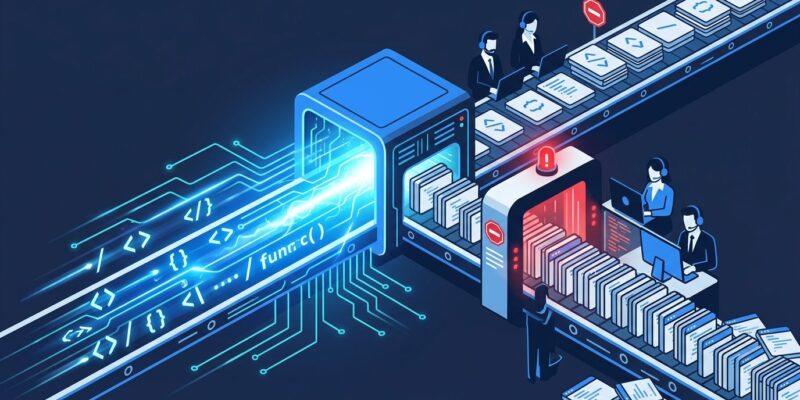
85% of GitLab’s respondents agree that AI shifted the bottleneck from writing code to reviewing and validating it. LinearB’s analysis of 8.1 million pull requests across 4,800 engineering teams puts numbers on the mechanism: developers using AI open 98% more pull requests. Those PRs are 154% larger. Review time is up 91%. AI-assisted PRs wait 5.3x longer for reviewer pickup than human-written code.
You fed more material into a factory that was already producing slower than it could process. The stack got taller, not shorter.
The Trust Problem Nobody Is Solving
There’s a separate issue underneath the volume problem, and it’s worse. Sonar’s 2026 State of Code Developer Survey found that AI now accounts for 42% of all committed code. 96% of developers don’t fully trust that code. And yet only 48% always verify AI-generated output before committing. That’s a 52% rate of shipping code no one fully believes in.
The result: senior engineers are disproportionately absorbing the review burden. Junior developers produce more code than ever; senior engineers are now validators for output they didn’t request and may not fully understand. That’s not a productivity gain. That’s a workload transfer.
The Governance Gap Is Structural, Not Personal
The GitLab report frames the core problem clearly: every line of AI-generated code in production needs three answers — where it came from, what it was meant to do, and who is responsible for it. Most organizations can’t answer any of them with confidence.
43% of respondents can’t reliably distinguish AI-generated from human-written code in their own codebase. 80% say their org adopted AI tools faster than policies kept up. 91% have two or more AI coding tools running simultaneously — the kind of sprawl that makes attribution nearly impossible.
This isn’t a failure of individual developers. It’s a failure of how AI adoption was sold: productivity tool first, governance framework never.
What Actually Changes the Delivery Metric
A few concrete adjustments separate engineering teams genuinely shipping faster from those just generating more code:
- Cap PR size. AI agents produce enormous PRs by default. Set a hard cap — 400 lines of changed code is a reasonable ceiling for anything requiring meaningful review. Force agents to split the work.
- Build AI-specific review checklists. Reviewing AI code is a different cognitive task. Your standard checklist assumes the author understood what they wrote. Update your criteria: Is this doing what the prompt said? Are there hallucinated API calls? Is the logic correct, or just plausible?
- Stop tracking individual velocity as a proxy for team output. Commit rate is a vanity metric now. Track DORA metrics: deployment frequency, lead time, change failure rate, mean time to restore. Those don’t lie.
- Gate on quality at the pipeline level. Static analysis, SAST scanning, and test coverage need to run automatically on every AI-assisted PR. Don’t rely on developers to remember to check. Automate the floor.
None of this is new. Most of it was already considered best practice before AI coding tools existed. The difference is that it’s now mandatory — because the volume of code flowing through your pipeline has doubled without any organizational infrastructure catching up.
The Honest Read on the Data
The AI coding productivity story is being sold as a velocity gain. It is, at the individual level. At the team and delivery level, it’s a workload redistribution. As InfoQ’s coverage of the GitLab report notes, the challenge has shifted to what happens after code is created — and most organizations haven’t restructured for that shift.
78% of developers code faster. That’s real. The question is whether your engineering organization has adjusted anything downstream to take advantage of it — or whether you’ve just given your senior engineers more to validate.
If you haven’t audited your review pipeline since your team started using AI coding tools, you’ve adopted the machine without the workflow. The data says 85% of your peers are in the same position. At least now there’s a number attached to it.