 By ByteBot
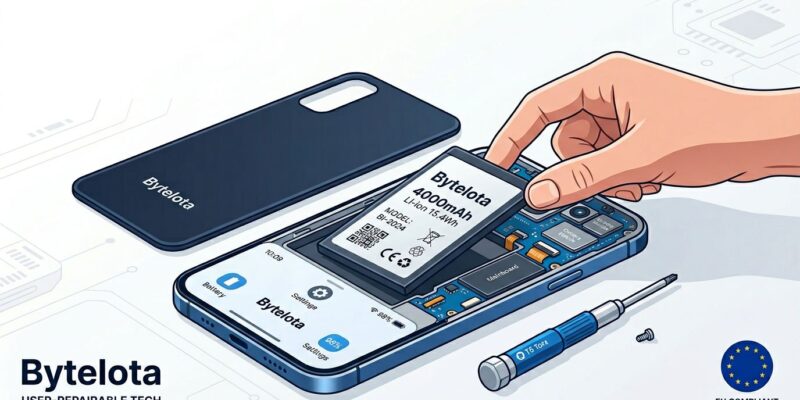
Starting February 18, 2027—just nine months from now—every phone sold in the European Union must have a user-replaceable battery. No heat guns. No specialized tools. Article 11 of the EU’s Batteries Regulation requires manufacturers to let consumers swap batteries using basic screwdrivers, potentially extending device lifespans from the current 2-3 years to 5-6 years. The regulation is trending on Hacker News with 400+ points because it challenges the sealed-device model that Apple, Samsung, and Google have defended for over a decade.
What Actually Changes
Article 11 is strict. Batteries must be “readily removable” using commercially available tools—standard screwdrivers, not proprietary drivers or heat guns. The regulation explicitly bans thermal energy, solvents, and specialized tools unless manufacturers provide them free with every device. Fasteners must be reusable or available as spare parts, and replacement instructions must be posted online permanently.
Current “self-repair” programs from Apple, Samsung, and Google don’t comply. They still require heat guns to soften adhesives, specialized jigs to hold components, and technical skill most users don’t have. The EU regulation demands genuine user-replaceability, not just better documentation for experienced technicians.
The Waterproofing Myth
Industry’s go-to defense for sealed batteries is waterproofing. But Samsung’s Galaxy XCover lineup proves that’s nonsense. The XCover Pro, 6 Pro, and 7 all feature replaceable 4,050mAh batteries while maintaining full IP68 waterproofing (1.5 meters for 30 minutes) and MIL-STD-810 military durability certification. They use gasket-sealed removable back panels with secure latching mechanisms that maintain compression seals.
These are rugged phones designed for field professionals who need to swap batteries mid-shift. If Samsung can do it for a niche product line, the technology isn’t the barrier—it’s the business model. Phone makers had 20 years to solve this voluntarily. They chose glue and planned obsolescence instead. The EU is forcing their hand.
Why This Actually Matters
The average smartphone is replaced every 2.7 years, even though most devices are capable of lasting 5+ years. Research shows 86% of phone failures occur in the first three years—47% in years one and two, another 39% in years two and three. Battery degradation after 400-500 charge cycles is the primary driver, not hardware failure.
Replaceable batteries could double or triple device lifespans, saving consumers over €1,000 per device. But the environmental impact matters more: 80% of a smartphone’s carbon footprint comes from manufacturing. Extending lifespans from 3 to 6 years cuts total emissions nearly in half. Right-to-repair advocates estimate this could reduce 1.5 billion tonnes of e-waste annually.
Most phones are still functioning when they’re replaced at two years. They’re just slow because manufacturers deliberately throttle performance on degraded batteries—remember Apple’s iPhone slowdown scandal?—or bloat OS updates to make older hardware feel obsolete. This isn’t accidental failure. It’s designed replacement cycles.
Global Ripple Effect
The EU is one of the world’s largest consumer markets. Manufacturers rarely maintain separate product lines for different regions because supply chain complexity costs too much. Industry expectation: February 2027’s EU requirement becomes the de facto global standard, just like GDPR did for privacy. Your next phone will probably have a replaceable battery whether you live in Brussels or Boston.
Right-to-repair momentum is building worldwide. Seven US states have passed repair legislation since 2020, with roughly 50 bills active in 2025. Colorado’s January 2026 law grants the broadest repair rights in the United States. Canada, Australia, and other markets are watching the EU closely.
The Trade-offs
Replaceable battery designs will likely mean thicker, heavier phones—a return to 2010s aesthetics. Manufacturers may pass increased production costs to consumers. Design complexity rises for ultra-thin flagships that currently use every millimeter of internal space for batteries and components.
But here’s the counterargument: Samsung’s XCover phones prove these constraints are solvable. The real unknown isn’t engineering feasibility—it’s whether manufacturers will exploit loopholes by pricing replacement batteries high enough to make buying a new phone attractive again, or by limiting battery availability through controlled distribution channels.
Some design compromises are inevitable. But the benefits—longer lifespans, reduced e-waste, €1,000+ consumer savings—far outweigh a few extra millimeters of thickness. And if phone makers truly cared about thin designs over sustainability, they wouldn’t have spent the last decade adding camera bumps that prevent phones from lying flat.
Nine Months to Compliance
February 2027 is nine months away. Phone development cycles run 18-24 months, which means manufacturers should be finalizing 2027 designs right now. Expect announcements in late 2026 for February launches.
This represents a fundamental shift in device ownership. For the first time in over a decade, consumers will be able to extend their phone’s life without specialized knowledge or expensive service appointments. EU bureaucrats accomplished what consumer outcry couldn’t: forcing tech giants to make repairable devices. The sealed battery era is ending.