 By ByteBot
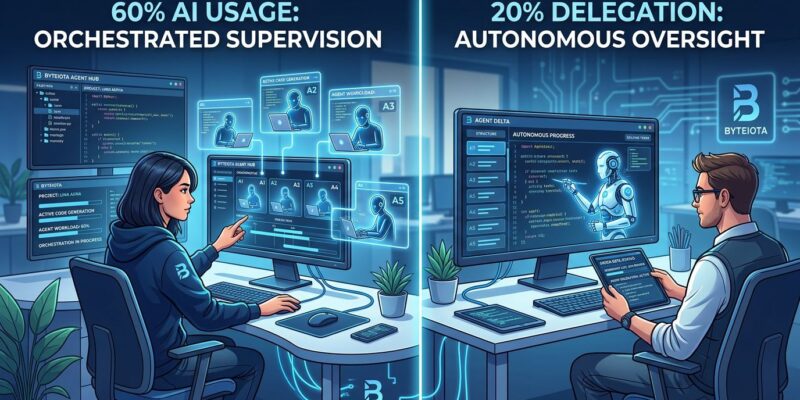
Anthropic’s 2026 Agentic Coding Trends Report reveals a striking paradox: developers now use AI in 60% of their work, but can only fully delegate 0-20% of tasks. This “delegation gap” explains why AI hasn’t replaced developers—and why the shift from writing code to orchestrating agents is more complex than the hype suggests. The report, featuring case studies from Rakuten, TELUS, CRED, and Zapier, outlines eight trends reshaping how software gets built in 2026.
The Delegation Gap: 60% Usage, 20% Trust
The most revealing finding isn’t about productivity gains or automation milestones. It’s about what developers won’t delegate. Engineers use AI coding tools constantly—in roughly 60% of their work—but fully hand off only 0-20% of tasks to autonomous agents.
Why? Developers delegate tasks that are “easily verifiable” or low-stakes: quick scripts to track down bugs, boilerplate generation, routine refactoring. The moment work becomes conceptually difficult or design-dependent, humans keep control. An experienced engineer can course-correct a wandering agent mid-task—spot when generated code drifts off-spec—but you can’t delegate what you can’t verify.
This gap contradicts the narrative that AI is replacing developers. Pervasive usage doesn’t equal full autonomy. What we’re seeing instead is a shift in how developers spend their time: less tactical coding, more supervision, architecture, and design review. The delegation gap reveals where AI coding actually is—not where the hype claims it’s going.
The 8 Trends: Foundation to Impact
Anthropic’s report organizes trends into three categories: foundation shifts, new capabilities, and broader impact.
Foundation:
- Engineering roles shifting toward agent supervision, system design, and output review
Capability:
- Single agents evolving into coordinated multi-agent teams
- Task horizons expanding from minutes to days or weeks
- Human oversight scaling through “intelligent collaboration” (the delegation gap in action)
- Agentic coding expanding to legacy languages (COBOL, Fortran) and non-developer roles
Impact:
- Productivity gains reshaping software economics
- Non-technical teams building automations
- Dual-use security risks requiring security-first architecture
Three of these trends deserve deeper attention: expanding task horizons, multi-agent coordination, and the unexpected expansion beyond engineering.
Trend #3: Rakuten’s 7-Hour Autonomous Run
Task horizons used to be measured in minutes. An AI agent might generate a function, refactor a module, or write a test suite—but it needed constant supervision. Rakuten’s case study shows how far this has shifted.
Engineers at Rakuten tested Claude Code on implementing activation vector extraction in vLLM—a 12.5-million-line codebase spanning multiple programming languages. The AI ran autonomously for seven hours and completed the feature with 99.9% numerical accuracy. No human intervention during execution. Just a problem spec, seven hours, and working code.
This isn’t a demo or proof-of-concept. It’s production work on a massive, multi-language codebase. “Set it and forget it” is becoming viable for complex tasks that would have required constant developer oversight a year ago. Task horizons are stretching from minutes to hours, and in some cases, days.
Trend #2: From Assistant to Dev Team
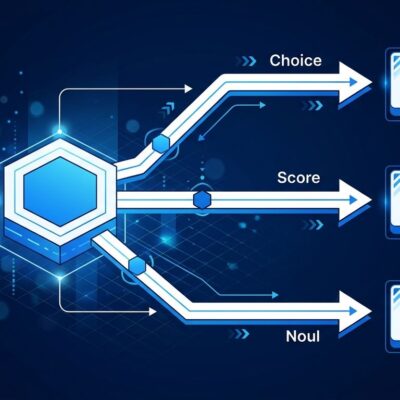
Single-agent workflows are giving way to coordinated multi-agent systems. Claude Code Ultra’s architecture illustrates the shift: three parallel exploration agents each independently attempt the same problem, while a dedicated critic agent evaluates their outputs before producing a final answer.
Each explorer works in its own isolated context window, which means they arrive at genuinely different solutions. The critic then evaluates quality, correctness, and trade-offs across all three approaches. It’s less like using a coding assistant and more like managing a small dev team with specialized roles.
The benefit isn’t just speed—it’s diversity of approach. Parallel reasoning reduces the risk of a single agent getting stuck in a local optimum or missing an edge case. Multiple agents exploring the solution space simultaneously means higher-quality outputs and fewer blind spots.
Trend #7: Zapier’s 97% Adoption Across All Teams
Agentic coding started as an engineering tool. It’s not anymore. Zapier reported 97% AI adoption across their entire organization as of January 2026—not just developers, but sales, marketing, legal, and operations teams.
One case in the report describes a lawyer with no coding experience who built self-service tools that automated contract review. This wouldn’t have been possible with traditional development—legal teams don’t have time to learn JavaScript or Python. But agentic coding abstracts the implementation layer enough that non-technical users can describe what they need and let agents handle the code.
The challenge? Non-technical users can’t evaluate generated code for correctness. An engineer can glance at output and spot logical errors or performance issues. A lawyer can’t. That means specifications must be correct before the agent starts, because there’s no mid-task course correction. The delegation gap applies even more stringently outside engineering.
The Real Impact: TELUS and Industry-Wide Metrics
TELUS, a communications technology company, created over 13,000 custom AI solutions and saved 500,000 hours—an average of 40 minutes per AI interaction. Their engineering teams now ship code 30% faster. CRED, a fintech platform serving 15 million users, doubled execution speed by implementing Claude Code across their entire development lifecycle.
Industry-wide metrics back this up. Data from 22,000 developers across 4,000+ teams shows epics completed per developer are up 66%, and code-related tasks rose 210% at the team level. Productivity isn’t incrementally improving—it’s compressing timelines enough to change software economics. Projects that would have taken six months might now take two or three.
What This Means for Developers
The shift is real, but it’s not about replacement. It’s about role transformation. Developers are spending less time writing boilerplate and debugging edge cases, more time on architecture, system design, and deciding what to build. Tactical work moves to agents. Strategic work stays human.
The delegation gap makes clear where the boundaries are. Developers can’t—and won’t—fully delegate complex, design-heavy work until agents can handle ambiguity and trade-offs at the same level humans do. Until then, the role is supervision and orchestration, not obsolescence.
Anthropic’s report doesn’t predict a future where AI replaces developers. It documents a present where developers manage AI that writes most of the code. The distinction matters.