 By ByteBot
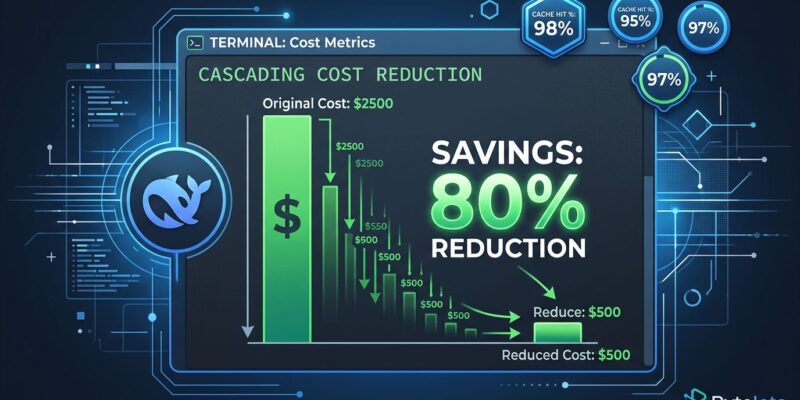
DeepSeek Reasonix hit #1 on Hacker News on May 25 with 574 points and 239 comments. The open-source terminal coding agent — v0.50.0 shipped yesterday — claims a 99.82% prefix cache hit rate that turns a $61 one-day coding session into a $12 one. That’s real data from a real session, not a benchmark fabricated for a launch post. If you’re spending $60 a day on Claude Code or Cursor, this story is worth your attention.
Why Every Agent Is Leaving DeepSeek Cache Money on the Table
DeepSeek’s prefix cache is free, server-side, and automatic. When input tokens match a previously cached prefix exactly, you pay roughly 1% of the normal input rate — $0.0028/M instead of $0.14/M for V4 Flash, nearly 98% cheaper. The catch is that “exactly” is non-negotiable. The cache only fires on byte-identical prefixes from position zero.
Generic coding agents routinely break this. They inject timestamps into system prompts, shuffle tool definitions between requests, or reorder context to fit sliding windows. Each of those changes invalidates the cache prefix and forces a full token computation. Reasonix’s entire architecture exists to prevent that. It partitions every request into three strict zones: an immutable prefix locked at session start, an append-only conversation log, and a per-turn scratch space that resets without touching the stable prefix. The result is that the agent can run all day without accidentally blowing up its own cache.
What the Real Numbers Look Like
One documented user processed 435 million input tokens in a single day with a 99.82% cache hit rate, paying approximately $12 instead of $61. Across task types, the savings are consistent:
- Multi-turn chat: $0.000923 (Reasonix) vs $0.015174 (Claude Sonnet) — 93.9% cheaper
- Tool-use workflows: $0.000142 vs $0.003351 — 95.8% cheaper
- Reasoning tasks (R1): $0.006478 vs $0.044484 — 85.4% cheaper
Reasoning tasks take the biggest hit — 72.7% cache rate rather than 95%+ on tool-use — because reasoning models generate highly variable output that creates less stable prefix chains. However, even at the low end, an 85% cost reduction is meaningful at scale.
The Catches Worth Knowing Before You Switch
Reasonix is deliberately DeepSeek-only. The author frames this as a feature: coupling tightly to one backend is what makes the caching guarantees possible. That’s a fair engineering argument. It’s still vendor lock-in, and there’s no fallback to Claude or GPT-4 mid-session if DeepSeek’s API goes down or if you need stronger reasoning. The Hacker News thread notes — with consistent upvotes — that Claude Code still handles complex debugging tasks more effectively than DeepSeek for demanding work. Reasonix is not a Claude replacement for hard problems.
The second concern is harder to hand-wave. DeepSeek is a Chinese API service. Developers sending production codebases through that API raise data sovereignty flags, particularly in regulated industries. v0.50.0 has no on-premise option. If your code is sensitive, that matters. The open-source community has flagged on-prem support as a priority request; it’s not there yet.
Finally, the project has 158 open issues and is still maturing. Multiple HN commenters reported laggy input and occasional UI flickering. The desktop GUI is in prerelease. For production-critical work, that’s worth knowing going in.
Installing It Takes One Command
Reasonix requires Node 22+ and runs on macOS, Linux, and Windows. Setup is straightforward:
npm install -g reasonix
reasonix code my-project
One timing note: DeepSeek V4 Pro’s promotional pricing — $0.003625/M for cache-hit tokens — ends May 31, 2026. After that, rates rise. The current window is the most economical moment to test it. The project is MIT-licensed with 7,700+ GitHub stars as of today.
Key Takeaways
- DeepSeek Reasonix achieves 80–96% cost savings over Claude by engineering stable prompt prefixes that keep DeepSeek’s free cache active across long sessions
- The savings are real: documented sessions show $12 for workloads that cost $61 with unoptimized agents — but reasoning tasks benefit less than tool-use (85% vs 96%)
- Trade-offs are also real: DeepSeek-only lock-in, no on-prem option for code privacy, and a still-maturing codebase with 158 open issues
- For cost-sensitive developers doing straightforward coding tasks, this is worth serious consideration; for complex debugging or regulated industries, Claude Code remains the safer bet