 By ByteBot
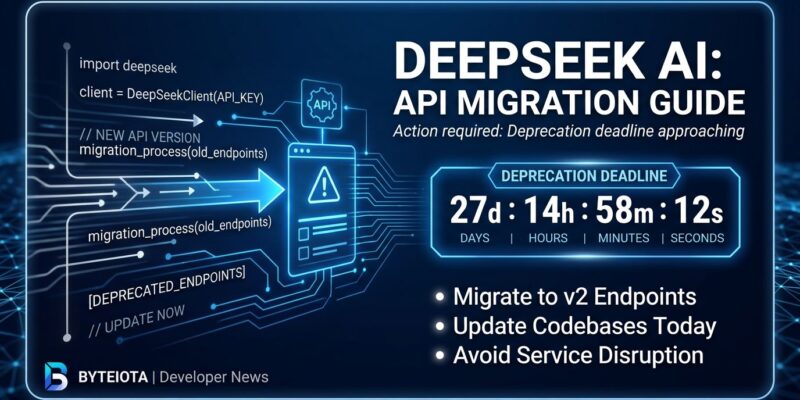
DeepSeek is retiring the deepseek-chat and deepseek-reasoner API aliases on July 24, 2026 at 15:59 UTC. After that timestamp, any code still calling those model names returns an error — no grace period, no fallback. The fix is a one-line change. But there is a trap hiding inside the deepseek-reasoner migration that will catch teams off guard.
What Gets Deprecated and When
DeepSeek launched V4 (Flash and Pro) on April 24, 2026 and kept the legacy aliases alive for a 90-day migration window. That window closes July 24. After the deadline, deepseek-chat and deepseek-reasoner return errors on every call.
Here is what they map to:
deepseek-chat→deepseek-v4-flash(non-thinking mode)deepseek-reasoner→deepseek-v4-flashwith thinking enabled
Notice that second one. deepseek-reasoner maps to Flash, not Pro. If you were using the reasoning alias because you needed strong chain-of-thought performance and you do a straight alias swap, you will get Flash-tier reasoning at Flash prices. For most tasks that is fine. For hallucination-sensitive pipelines or deep agentic loops, it is not — and you need to make that call explicitly by switching to deepseek-v4-pro.
The Migration Is a One-Line Fix
Base URL, API key, and request structure are all unchanged. Only the model parameter needs to move.
Replacing deepseek-chat
# Before — breaks July 24
client.chat.completions.create(
    model="deepseek-chat",
    messages=[{"role": "user", "content": "..."}]
)

# After
client.chat.completions.create(
    model="deepseek-v4-flash",
    messages=[{"role": "user", "content": "..."}]
)
Replacing deepseek-reasoner
# Before — breaks July 24
client.chat.completions.create(
    model="deepseek-reasoner",
    messages=[{"role": "user", "content": "..."}]
)

# After — Flash with thinking (same cost, lighter reasoning)
client.chat.completions.create(
    model="deepseek-v4-flash",
    messages=[{"role": "user", "content": "..."}],
    extra_body={"thinking": {"type": "enabled"}}
)

# After — Pro with thinking (if you need the upgrade)
client.chat.completions.create(
    model="deepseek-v4-pro",
    messages=[{"role": "user", "content": "..."}],
    extra_body={"thinking": {"type": "enabled"}}
)
LangChain users: swap the model string in your ChatOpenAI instantiation. Everything else stays the same. The official thinking mode docs cover the full parameter reference.
Flash or Pro: The 30-Second Decision
Both models support 1M token context and 384K max output. The difference is scale and reasoning depth.
| Model | Active Params | Input | Output | Best For |
|---|---|---|---|---|
| deepseek-v4-flash | 13B | $0.14/M | $0.28/M | High-volume, RAG, most production tasks |
| deepseek-v4-pro | 49B | $0.435/M | $0.87/M | Complex reasoning, agentic loops, enterprise QA |
Flash handles roughly 70% of production workloads at a price that makes the math easy. Pro is about 6x more expensive on output but still sits well below Claude Opus 4.8 ($25/M) or GPT-5.5 (roughly $30/M). The recommended default is Flash, with Pro reserved as an escalation tier for the requests where reasoning depth actually matters.
On cache hits, Flash drops to $0.0028 per million input tokens — about 50x cheaper than a cache miss. If your prompts are repetitive (system prompts, structured data, repeated context), the cache savings compound quickly. See the full DeepSeek pricing page for current rates.
Thinking Mode Is Now a Parameter, Not a Model Name
The old API split reasoning into a separate model (deepseek-reasoner) to make it easy to opt in. The new API unifies thinking under a request parameter: thinking: {"type": "enabled"}. This is a cleaner design — you pick the model tier you want, then toggle reasoning independently.
One constraint worth knowing: thinking mode does not support temperature, top_p, presence_penalty, or frequency_penalty. If your current deepseek-reasoner calls set any of those, strip them out when you migrate. For reasoning effort level, xhigh gives you uncapped chain-of-thought; high bounds the token budget and costs less.
What to Check in Your Codebase
The DeepSeek API migration surface is wider than just Python scripts. Check:
- Application code and LLM wrapper classes
- LangChain / LlamaIndex model configuration
- Claude Code or Cursor DeepSeek backend configs
- Infrastructure-as-code and environment variable defaults
- CI/CD pipelines that run evals or automated tests against the API
- Prompt templates and documentation with hardcoded model names
A simple grep -r "deepseek-chat\|deepseek-reasoner" across your repo will surface everything. The fix is mechanical. The only judgment call is whether to upgrade deepseek-reasoner callers to Pro — and that decision comes down to how much you were actually relying on reasoning depth versus just the API alias. The WaveSpeed Pro vs Flash comparison breaks down the benchmarks if you need to make that call with data.
Do this before July 24. It takes ten minutes and prevents a production incident on a Tuesday afternoon when you least expect it.