 By ByteBot
One developer on Hacker News posted a question in April 2026 that cut through all the AI coding hype: “Which tool won’t torch my credits?” Another reported a $1,400 Cursor bill for a single month. A third hit their $200/month quota at 3pm on Wednesday, unable to work the rest of the week. While 78% of Fortune 500 companies now use AI-assisted development—up from 42% in 2024—the economics of agentic coding tools are breaking individual developers and small teams. The tools that promise to 10x productivity are increasingly affordable only to those who need them least.
The $20 Entry Price That Becomes $2,000
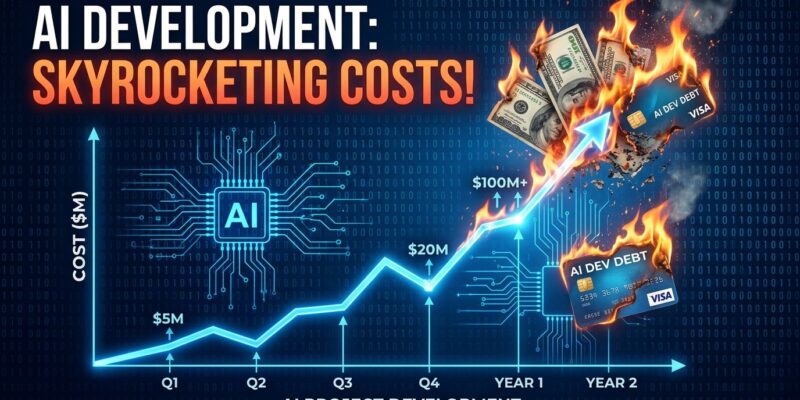
The pricing pages tell one story: GitHub Copilot for $10/month, Cursor Pro for $20, Claude Code starting at $20. Your credit card statement tells another. Heavy users report monthly bills between $500 and $2,000. The Hacker News developer who paid $1,400 isn’t an outlier—they’re a warning.
What changed? Agentic coding workflows are fundamentally different from autocomplete. When you use GitHub Copilot to finish a line of code, you’re consuming a few hundred tokens. When you use Claude Code to refactor a microservice, you’re loading a 1 million token context window—your entire codebase, API contracts, database schemas, and test infrastructure. That single operation can cost $100 to $500 depending on the model and output length.
The trap works like this: You start with the “cheap” $20/month plan. Agentic features require premium requests or compute credits. Usage limits trigger mid-sprint. You upgrade to avoid blocking your work. The bill escalates: $20, then $60, then $200, then north of $500 per month. Meanwhile, internal GitHub data shows that the cost of serving Copilot customers has nearly doubled since January. Vendors are feeling the squeeze too, and that pressure will flow to pricing.
Context Windows: Architectural Awareness at Architectural Cost
The context window arms race explains the cost explosion. In 2021-2023, coding assistants worked with 4,000 to 8,000 tokens—enough to see a single function. By 2024, that expanded to 32,000-100,000 tokens, covering full files. In 2026, we’re at 200,000 to over 1 million tokens, giving tools microservice and architecture-level awareness.
This is a genuine capability leap. AI can now write architecturally coherent code across multiple files, understanding how your changes ripple through an entire system. But there’s a cost math problem: a 200,000-token conversation costs 10 times what a 20,000-token conversation costs. Agentic tools resend the full conversation history with every API call, so costs compound throughout a session. One complex debugging session with Claude Opus 4.6 can consume 500,000+ tokens, running up a $15+ bill for a single afternoon’s work.
Developers are discovering that high-context operations deliver architectural insight at architectural cost. The question becomes: is this worth it for every task, or only for critical refactors and green-field projects?
Enterprise Math Works, Indie Math Doesn’t
For a 1,000-developer enterprise team, the economics make sense. At $200 to $500 per developer per month, that’s a $2.4 million to $6 million annual budget. Case studies from companies like Bancolombia and JPMorgan show productivity gains between 20% and 40%. Even conservative estimates of 10% improvement deliver a 3-5x ROI. By late 2026, 20-30% of engineering operating expenses going to AI tooling will be standard for large teams.
For a solo developer or five-person startup, the math breaks. A solo developer paying $200 to $2,000 out-of-pocket per month faces a cash flow problem that productivity gains don’t solve. A five-person startup burning $1,000 to $10,000 per month on AI tooling has no economies of scale for infrastructure, governance, or cost optimization.
The market signals confirm this bifurcation. Cursor raised $2 billion in February 2026 at a $50 billion-plus valuation—investors are betting on pricing power. Job postings requiring AI coding tool experience increased 340% between January 2025 and January 2026, while implementation role postings declined 17%. The market expects adoption regardless of economic barriers, but it’s enterprise teams hiring for AI orchestration skills, not indie developers who can afford the tools.
The uncomfortable truth emerging in 2026: “AI will replace developers” is morphing into “only big companies can afford AI developers.” A two-tier development ecosystem is forming—AI-augmented teams at enterprises, traditional workflows for indies and small teams.
Cost Optimization Exists, But It’s Sophisticated
Developers can cut AI coding costs by 40-70% through optimization strategies, but these require expertise and infrastructure most individuals lack. Model routing—sending simple tasks to cheap models like Claude Haiku and complex tasks to frontier models like Opus—saves 30-40% and is the single highest-leverage optimization. Prompt caching, which stores intermediate computations for repeated prompt prefixes, can reduce input token costs by up to 90%. Context compaction cuts conversation size by 50-70%. Batch processing guarantees 50% savings by trading latency for cost.
The catch: implementing these strategies requires technical sophistication and infrastructure. Enterprises can invest in centralized routing, shared caches, and usage monitoring. Individual developers using SaaS tools have limited control over model selection and no access to organizational-level optimizations.
Open-source alternatives exist—Qwen2.5-Coder-32B, StarCoder 2-3B, GLM-5—offering local inference with free compute if you buy the GPU hardware ($1,000 to $5,000 upfront). But there’s a quality gap versus frontier models and no agentic orchestration infrastructure unless you build it yourself.
Optimization helps, but it doesn’t solve the fundamental problem: costs are still 10-100x higher than traditional autocomplete. The gap between enterprise capabilities and indie affordability persists.
Pricing Will Be 2026’s Battleground
With the capabilities race plateauing, pricing will become the next competitive differentiator. The April 2026 developer question—”which tool won’t torch my credits?”—signals a market shift. Cursor switching from request-based to compute-based billing in June 2025 blindsided users. Windsurf moved to daily and weekly quotas on March 19, 2026. Usage limits, not capabilities, are now the top developer complaint.
Here’s the prediction framework: Q2-Q3 2026 will see the first wave of price increases from well-funded players, followed by developer backlash. By 2026-2027, cost-effective mid-market alternatives will emerge. Long-term, the market bifurcates—enterprise tools at $100+ per month versus open-source local inference. Consolidation to three to five major players controlling 80% of the market is likely by 2027.
What developers need is transparent, predictable pricing—not compute-based mystery charges. Right-sized tiers for small teams, not just individual $10 plans or enterprise $10,000 contracts. Cost controls: spending limits, model selection, context budgets. ROI visibility through productivity tracking versus cost tracking.
Cursor’s $50 billion valuation assumes pricing power. Developers assume competitive pressure will force prices down. Who wins that bet determines whether agentic coding scales beyond enterprise or remains elite tooling for companies that can afford the freight.