 By ByteBot
China just put its most powerful AI models behind a licensing wall — and the registration requirement is already live. On October 16, China’s Ministry of Commerce published draft export controls targeting model weights above 2 trillion parameters, multi-step agents, and frontier chip designs. If you ship code that calls DeepSeek, Qwen, or any Chinese frontier model, here is what actually changed — and what did not.
What MOFCOM Announced
Announcement No. 48 proposes adding 40 technologies — 23 of them in AI — to China’s export control catalogue. The draft covers model weights, checkpoints, source code, and training methods for any model that meets one of three thresholds: 2 trillion or more parameters, 1026 training FLOPs, or a global top-10 capability ranking. Multi-step agents that orchestrate dozens or hundreds of sub-agents are also in scope.
The public comment period closes November 15, 2026. But the registration requirement took effect the day the announcement was published, applying even to exports already underway. The compliance burden falls on the Chinese exporter — the lab publishing the model — not on the developer downloading or calling it.
What Is Not Controlled
The draft carve-outs matter more than the controls themselves, at least for most developers reading this.
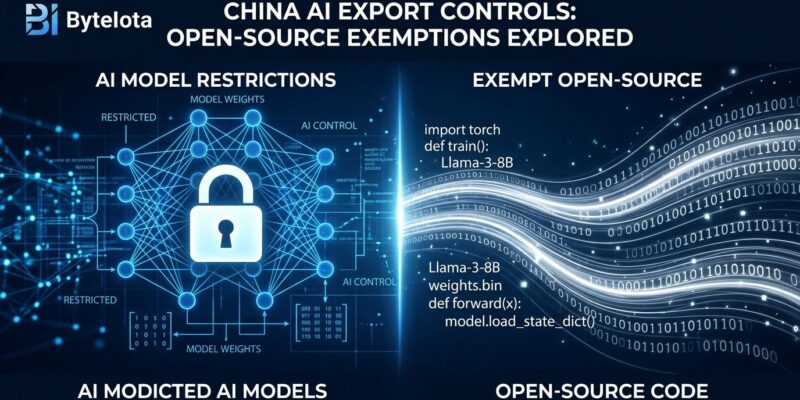
First, weights that are already public are explicitly exempt. MOFCOM’s own language states that technology “already public through open source or academic papers is not included.” You cannot un-publish what is already published, and China’s legal framework acknowledges this. Second, API access — using any covered model through a hosted endpoint, SaaS platform, or application — is explicitly excluded from the controls. Third, open-source releases get automatic licenses: MOFCOM’s term is 即报即出, report and export, near-instant approval.
Where Your Stack Stands Today
Most Chinese open-weight models that developers actually use today are either already exempt or below the 2-trillion-parameter threshold:
- DeepSeek R1 and V3 (671B MoE) — published before October 16, exempt
- DeepSeek V4.1-Flash (552B MoE, released September 2026) — pre-draft, likely exempt
- Kimi K2 (1T total, 32B active) — total parameter count under the 2T threshold
- Qwen 2.5 family (up to 72B) — well under threshold
- Qwen2.5-Max and Doubao — API-only anyway, controls do not apply
The models you are running today are almost certainly fine. The risk lives in the next generation.
The Real Problem Is What Comes Next
DeepSeek V5, Qwen 4, the next Kimi release — if any of these cross the 2-trillion-parameter threshold after the draft becomes final, the lab will need a license to release the weights openly. That is a speed bump, not a wall. But it changes the calculus for Chinese labs deciding whether to open-weight their next flagship.
There is an irony here. China’s open-source AI push was itself a strategic response to US chip export controls — when GPU access is restricted, you optimize your models and release them freely to build ecosystem lock-in. Now China may be placing the same friction on its own labs. The geopolitical loop has closed. AI Safety China’s analysis puts it plainly: this is not the end of open-weight Chinese AI, but it is the end of consequence-free releases at the frontier.
Four Things to Do Before November 15
- Audit your Chinese AI dependencies. List every tool in your stack and identify which base model sits underneath it. DeepSeek derivatives, Qwen fine-tunes, and Kimi-based products are common in third-party tooling.
- Prefer API access over self-hosted weights. API and SaaS access is explicitly exempt under the current draft. If you are self-hosting frontier Chinese model weights on cloud infrastructure, that is the exposure zone.
- Build provider abstraction. Model-agnostic architectures that swap providers without rewrites are no longer a nice-to-have. If the next DeepSeek release cannot be open-weighted due to licensing requirements, you need a fallback path.
- Watch the November 15 comment period close. Final rules could loosen the open-source carve-out, tighten the thresholds, or add agent-specific language. The Developers Digest analysis tracks how Chinese labs are responding — their submissions will signal whether future releases go open-weight or API-only.
If you use Chinese AI models via API, or through weights that were publicly available before October 16, you are not directly regulated by these controls. Your immediate worry should not be compliance — it should be supply chain resilience for the releases that come after the comment period closes.