 By ByteBot
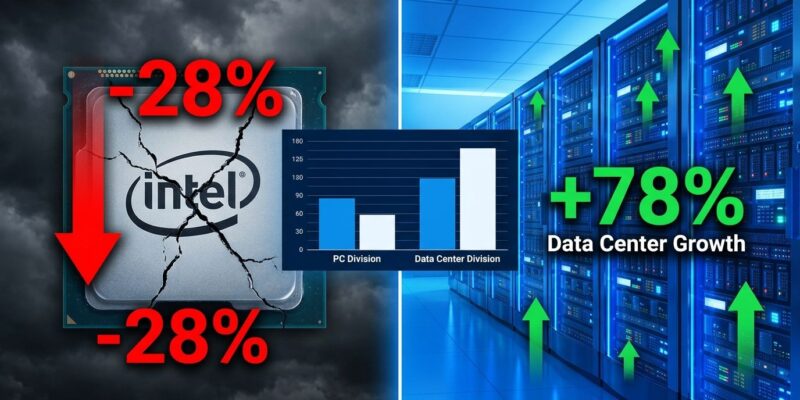
Intel’s stock fell 28% on October 30 — its worst single-day collapse since the 1970s — after the company’s Q4 revenue guidance landed roughly $1 billion below analyst expectations. The sell-off swept through the entire semiconductor sector, dragging Nvidia, AMD, TSMC, Arm, and Broadcom down with it and erasing approximately $1 trillion in chip stock market capitalization in a single session.
The forces behind that guidance miss are not random. AI infrastructure is consuming the memory, NAND, and substrate components that consumer and developer PC hardware depends on. That pressure is now showing up in Intel’s numbers — and in the rising cost of developer workstations and cloud compute.
What Actually Broke Intel’s Quarter
Intel’s Q3 itself beat guidance: $16.5 billion in revenue, up 21% year-over-year. The problem is Q4, where Intel guided $15–16 billion against analyst expectations of about $17 billion. CEO Lip-Bu Tan was direct about the cause: “Our customers began signaling a PC slowdown based on the memory prices and availability.” AI infrastructure builds are consuming DRAM, NAND, and substrates that PC manufacturers need, pushing prices up and slowing enterprise PC refresh cycles.
A factory explosion at Intel’s Israel fabrication plant compounded the miss. The incident, which occurred in early October, added approximately $600 million in revenue headwinds across Q3 and Q4. Intel’s gross margin is guided to drop from 44.1% in Q3 to approximately 38% in Q4 — a sharp compression that surprised the market on top of the revenue miss.
The $1 Trillion Chip Sector Contagion
Intel’s bad guidance triggered a sector-wide sell-off that went well beyond Intel itself. According to CNBC’s Q3 earnings coverage, Arm fell 12.68%, AMD dropped 12.48%, Qualcomm slid 12.14%, and Applied Materials fell 8.73%. Paradoxically, Nvidia — whose AI chip business is stronger than ever — lost more in absolute dollar terms than Intel did, because of Nvidia’s much larger market cap. The Nasdaq Composite fell 2.86%, its worst day since June.
However, the reaction reveals what the market is actually nervous about: any signal that the AI capex cycle might be cooling. When Intel’s PC numbers miss because AI is eating component supply, investors immediately worry whether the AI infrastructure spend justifying those component purchases is sustainable. It is a confidence shock as much as a fundamentals one.
The Part Intel Did Not Lead With: Data Center AI at +78%
Intel’s data center and AI segment (DCAI) grew 78% year-over-year to $7.3 billion — the company’s strongest data center growth in 15 years. Operating income for that segment tripled to $3.04 billion. Intel Foundry revenue grew 58%, with its Intel 3 and 18A process nodes ramping for external customers. Data center is now almost as large as Intel’s PC division ($7.3B vs $8.1B), and the trajectory suggests it may overtake the PC business within two quarters.
CEO Tan described Xeon AI chip demand as “extraordinary” — and supply-constrained, not demand-constrained. That is an unusual problem for Intel to have. New Arizona fabrication facilities are expected online in 2028, which would significantly expand Intel’s ability to meet that demand. Intel is not exiting the chip market. It is pivoting — and the financial turbulence of that transition is what the market priced in today.
Related: MacBook Pro M6: Local AI, Xcode Gains, and the RAM Trap
What This Means for Developers
Three things are likely to stay true through at least H1 2027. Developer workstations and laptops will continue to cost more as AI infrastructure captures memory supply. Xeon-based cloud instances may face availability pressure as Intel’s supply-constrained data center chips get prioritized for large hyperscaler contracts. And ARM-based developer hardware — Apple Silicon, Snapdragon X Elite — will continue gaining share as Intel’s PC unit volumes decline. Not because Intel is not trying, but because the structural component competition documented in Intel’s own earnings call is not going away anytime soon.
Key Takeaways
- Intel fell 28% on October 30, dragging chip stocks to a $1 trillion single-day market cap loss — the worst semiconductor session in recent memory
- The PC slowdown is structural, not cyclical: AI infrastructure is crowding out the memory and components that developer and consumer hardware needs
- Intel’s data center AI business grew 78% year-over-year — the company is pivoting, not collapsing; the pain is transitional
- Developer hardware costs are likely to stay elevated through H1 2027; Xeon cloud instance availability may tighten as Intel AI chips prioritize hyperscaler demand
- Intel’s new Arizona fabs (2028) and 18A process node represent the long-term bet — this story has a chapter still unwritten