 By
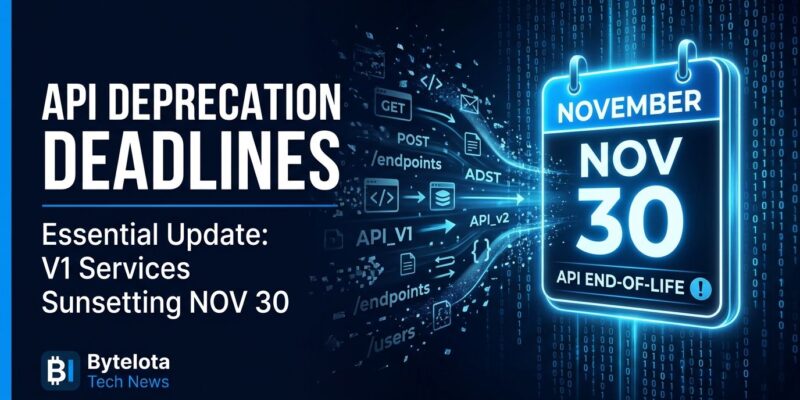
Three OpenAI platform services shut down permanently on November 30, 2026 — 29 days from today. Agent Builder workflows stop running. The Evals dashboard goes dark. Any production code calling the /v1/prompts endpoint starts returning errors. This is not a soft deprecation or a “we recommend switching” notice. It is a hard cutoff, and if you haven’t audited your OpenAI API usage yet, this is the week to do it.
What’s Going Away — and When
| Service | Status Today | Status Nov 30 |
|---|---|---|
v1/prompts API | Working | Requests fail |
| Agent Builder | Working | Gone — no export after shutdown |
| Evals Dashboard | Read-only since Oct 31 | Gone — data inaccessible |
Evals /evals API | Working | 404 |
All three deprecations were announced June 3, 2026. That’s generous by industry standards. But plenty of teams still haven’t migrated — and if you’re one of them, the remaining window is closing fast.
The Silent Killer: v1/prompts in Production Code
Agent Builder is a UI tool. Evals is a dashboard. Most developers know whether they use them. The v1/prompts API is different — it’s embedded in backend code, often written months ago, and it will silently break on December 1 if you don’t find it first.
The fix is straightforward: move your prompt templates out of OpenAI’s hosted storage and into your application code. If you’re using the Responses API with a prompt_id, the change looks like this:
# Before (breaks November 30)
response = client.responses.create(
    model="gpt-5.6-sol",
    prompt={"id": "pmpt_abc123", "variables": {"topic": "AI safety"}}
)

# After (works)
response = client.responses.create(
    model="gpt-5.6-sol",
    input=[{"role": "user", "content": "Write about AI safety"}]
)
Store your prompt versions in git. It’s better practice than relying on a vendor dashboard anyway — you get version history, code review, and portability without any API dependency.
Agent Builder: Export Before the Window Closes
This one has a deadline within a deadline. You can export your Agent Builder workflows right now by opening each workflow, clicking Code in the top navigation, and selecting the Agents SDK (TypeScript or Python). Save that code to a repository. Screenshot the canvas. Document your credentials.
On December 1, that export option is gone. There is no recovery path once the service shuts down.
Where you migrate depends on what you built. This detailed migration guide outlines four realistic destinations:
- Agents SDK — full control, high effort, right for engineering teams
- ChatGPT Workspace Agents — minimal lift for internal-only automations
- n8n or Zapier — best for integration-heavy workflows that don’t need custom model logic
- LangGraph — the right choice for complex stateful systems, though it requires the most work
One thing that does not transfer automatically: credentials. Every integration you built requires re-authentication in the new environment. Budget time for that before you consider the migration complete.
Evals: The Data Is Still There — For 29 More Days
The Evals platform went read-only on October 31. If you logged in and noticed you couldn’t create new runs, that’s why. The data is still accessible, but the final export window closes November 30.
Before then, export four things: your eval definitions as JSON, your test item JSONL files, your run configurations (model, prompt, sampling parameters), and your historical results. That last one matters for establishing a performance baseline after you’ve migrated — without it, you’re running new evals blind.
For the migration itself, OpenAI points to Promptfoo as the primary destination — it’s MIT licensed, CLI-friendly, and now owned by OpenAI though it remains open-source. For teams inside a LangChain stack, LangSmith is the tighter fit. For SaaS teams running CI-integrated eval pipelines, Braintrust is worth evaluating. This export guide covers what to save and how to structure the migration.
Note: migrating model-graded checks takes real work. String match assertions translate cleanly to any tool, but LLM-as-judge graders need to be re-validated against your baseline results — they produce different scores depending on implementation.
The Pattern Worth Noticing
These three deprecations don’t exist in isolation. OpenAI shut down the Assistants API in August. The Videos API in September. Now Agent Builder, Evals, and the Prompts API in November. The consistent signal: OpenAI is consolidating its developer surface around the Responses API and Agents SDK. Everything else is getting trimmed.
That’s not a complaint — the Responses API is genuinely better than the Assistants API was. But it means the right posture for any team using OpenAI is to audit your full API surface now, not after the next deprecation notice lands. The next wave hits December 1 (image models) and December 11 (gpt-5, o3 series). Then gpt-4o and gpt-4.1 follow in January.
And if you’re using multiple AI providers: Anthropic’s Claude Sonnet 4.5 also retires November 30 on the Claude API, AWS, and Microsoft Foundry. The replacement is Sonnet 5.5, but the migration has real breaking changes around temperature parameters, thinking budgets, and tool use. Two providers, one deadline — check both.
Action Checklist
- Today: Search your codebase for
/v1/prompts,prompt_id, andpmpt_. Inventory every Agent Builder workflow. Log into the Evals dashboard and download your data. - This week: Export Agent Builder code via the Code dialog. Begin moving prompt templates into application code. Choose your Evals replacement and set up a test environment.
- Before November 30: Test migrated workflows in staging. Validate Evals grader parity. Remove all
v1/promptscalls from production.
Twenty-nine days is enough time to do this properly. It’s not enough time to keep procrastinating.