
 By ByteBot
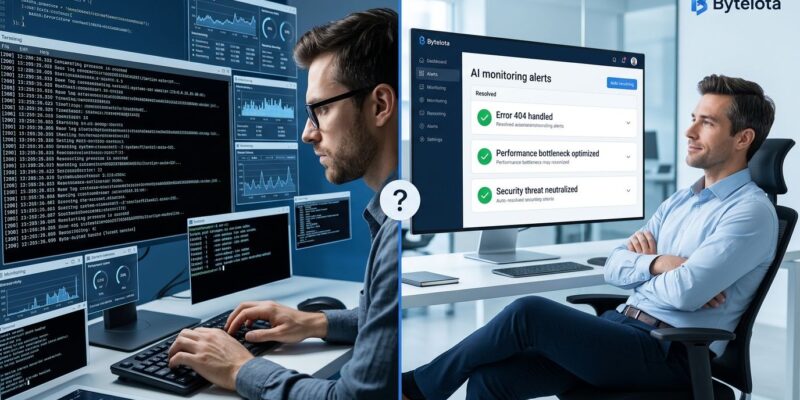
A site reliability engineer writing this week put it bluntly: “Somewhere over the past year, AI stopped being a tool I occasionally reached for and became the first thing I reach for, always… I can feel the rust.” That confession, from a SigNoz post that hit 461 points on Hacker News today, captures a problem the industry has not figured out how to measure: AI tools are making SREs more efficient at resolving each incident while making them worse at the craft of incident response overall. The productivity metrics stay green. The expertise erodes.
The Bainbridge Paradox: This Was Always Coming
In 1983, cognitive psychologist Lisanne Bainbridge described what she called the “Ironies of Automation.” Her finding: the more you automate a process, the more critical the human operator becomes during the rare moments automation fails — and the less practice they get. She was writing about industrial control systems. The SRE community just rediscovered it.
The analogies from other fields are uncomfortably precise. FAA regulations mandate minimum manual flying hours for commercial pilots, not because autopilot is unreliable, but because pilots relying on automation show measurable degradation in situational awareness and manual flying ability. The fix is deliberate, mandated inefficiency. In medicine, endoscopists using AI assistance for polyp detection saw unassisted detection rates drop from 28% to 22% after sustained AI use — not because the knowledge disappeared, but because the practice did.
SRE teams are walking into the same dynamic. AI tools now handle alert noise reduction, runbook execution for known failures, log pattern detection, anomaly flagging, and auto-remediation. These are not peripheral tasks. They are the foundational pipeline through which debugging expertise is traditionally built.
Three SRE Skills Going Quiet
The erosion is specific, not general. Three skills are eroding fastest, and each one matters precisely when AI cannot help.
First, raw log reading. AI summarizes logs, so engineers stop reading raw streams. The pattern recognition that used to develop through hundreds of hours of manual log triage quietly atrophies. Second, hypothesis formation. AI suggests root causes, removing the diagnostic reasoning loop that senior SREs built through years of being wrong, adjusting, and being right. Third, mental model building. AI maps system dependencies on demand, eliminating the need to internalize architecture. When that map fails — and it will — the engineer looking at it has no internal model to fall back on.
Each of these skills is precisely what separates a senior SRE from a tool operator during a novel incident: the kind that breaks the AI because it has never seen it before. However, the deskilling crisis is hard to detect because AI-assisted work feels like mastery. The dashboard looks clean. MTTR is down. The rust is invisible.
Never-Skilling: The Deeper Problem
Deskilling describes losing expertise you had. Never-skilling describes never building it. Junior SREs entering the field in 2026 may never develop foundational incident response intuition because AI has automated the pipeline through which that intuition is traditionally built.
The math is straightforward and troubling. Experienced SREs handle the complex incidents AI cannot resolve. AI handles everything else. Junior engineers never encounter the complex ones. Consequently, the tacit knowledge transfer that used to happen organically through shared incident response — a senior walking a junior through a novel failure in real time — no longer has an occasion to occur.
In three to five years, organizations face a compounding problem: senior SREs who retire and a junior cohort that cannot fill the gap. Not because AI took the jobs. Because it blocked the learning path.
Related: GitHub Octoverse 2026: AI Agents Start 40% of Pull Requests — AI automation is reshaping every part of the development lifecycle, not just incident response.
What to Actually Do About It
Awareness is not a solution. Knowing that deskilling happens does not stop it. The organizations that will come out ahead are the ones that mandate practice architecture, not just acknowledge the risk.
Two concrete interventions translate directly from other domains. First, deliberate inefficiency: designate certain incidents as human-first regardless of AI capability. Route them to engineers before AI triage. Treat this the same way the FAA treats manual flying hours — non-negotiable maintenance of capability, not a productivity experiment. Second, redesign the collaboration model. The critical distinction is between human-on-the-side (engineers approve AI recommendations) and human-in-the-loop (engineers reason through each step alongside AI). Approval workflows preserve throughput; collaborative reasoning preserves skill. One leads to rust. The other does not.
The U.S. Navy addressed the same problem fifty years ago by building automation that required humans to physically execute actions rather than approve them — deliberately preventing the skill loss that comes from purely supervisory roles. The engineering decision was intentional. SRE teams need to make the same one.
Key Takeaways
- AI SRE tools are eroding the three foundational skills — log reading, hypothesis formation, mental model building — that matter most during novel incidents AI cannot handle
- Never-skilling is the more serious long-term risk: junior engineers may never build the intuition senior SREs spent years developing
- The Bainbridge Paradox (1983) predicted this: automation makes humans more critical during failures while depriving them of practice for exactly those moments
- Deliberate inefficiency works — the FAA mandates it for pilots; SRE teams need the equivalent
- Human-in-the-loop design (collaborative reasoning) preserves skill; human-on-the-side design (approval workflows) does not


