 By ByteBot
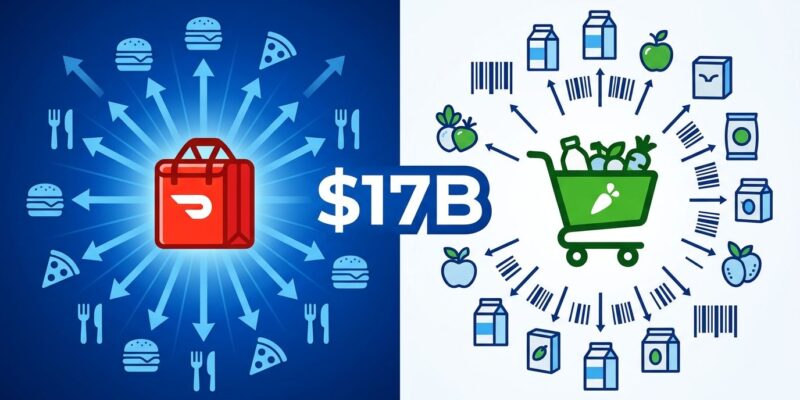
DoorDash is buying Instacart. Announced October 29, 2026, the $17 billion deal ends Instacart’s 14-year run as an independent company and hands DoorDash control of roughly 60% of the third-party grocery delivery market. The FTC launched a data pricing investigation the same day. This is not a done deal, but it may be the most consequential delivery tech merger in years.
The Numbers Behind DoorDash Acquiring Instacart
DoorDash agreed to pay $65 per Instacart share, a 26% premium over Instacart’s October 22 closing price. The total equity value lands at roughly $17 billion, structured as at least 75% cash with the remainder payable in DoorDash stock. JPMorgan Chase is providing bridge financing. Instacart’s board unanimously approved the deal; about 19% of shareholders have already committed to voting yes.
The close date is far off — expected at the end of 2027 or in the first half of 2028 — subject to antitrust review and a shareholder vote. Both companies will continue operating independently until then.
What DoorDash Is Actually Buying
DoorDash already commands roughly 59% of overall U.S. delivery platform spending, with a 60% share in convenience delivery. It dominates restaurant takeout. What it lacks is the grocery-specific technology stack Instacart has spent years building: the Instacart Connect API, which powers white-label grocery e-commerce for major retailers; Carrot Ads, the advertising platform that brings in over a billion dollars annually from CPG brands; and deep relationships with grocery chains that DoorDash doesn’t have.
Together, the combined entity would control approximately 60% of the third-party grocery delivery market, according to the American Economic Liberties Project, which is already pushing regulators to block the deal. DoorDash CEO Tony Xu framed it differently: “When more people shop local, more dollars stay local.” Whether that framing holds under antitrust scrutiny is another question.
Caper Carts Are Going Away
In the weeks before the announcement, Instacart disclosed it would wind down its Caper Cart smart shopping cart business by the end of Q2 2027, taking $55–$80 million in pre-tax charges. Instacart acquired Caper AI in 2021 for a significant sum; the hardware bet didn’t pan out at scale.
This matters because it signals what the combined company will actually prioritize post-merger: software platforms, AI tools for retailers, and advertising infrastructure — not hardware. The replacement investment is going into smart price tags and computer vision inventory systems. DoorDash isn’t buying a hardware company; it’s buying a software commerce platform.
Regulatory Risk Is Real
The timing of the FTC’s concurrent data pricing study is not coincidental. Regulators have been focused on food delivery economics for years — dynamic pricing, algorithm-driven wages, and the structural power platforms hold over both drivers and retailers. A combined entity controlling 60% of third-party grocery delivery gives them something concrete to examine. TechCrunch’s coverage of the deal notes the acquisition still requires Canadian and Israeli regulatory approval in addition to U.S. clearance.
Given the timeline — close not expected until late 2027 or early 2028 — there is well over a year of regulatory risk ahead. The deal could be blocked outright or require divestitures. Compare this with Intel’s $2.2B acquisition of Classiq, which sailed through comparatively quickly. A $17B grocery delivery monopoly will face a different level of scrutiny.
What This Means If You’re Building on These Platforms
DoorDash has said it will keep Instacart’s enterprise technology products and apps operating independently until the deal closes — and presumably afterward. However, “independent operations” during a 14-month review period is not the same as “no changes coming.”
Developers building on Instacart Connect or waiting for the DoorDash Drive API — still application-only, not publicly available — should track the integration roadmap closely. No SDK mergers or API deprecation timelines have been announced, but that will change. The safe assumption is that Instacart’s white-label grocery tech survives; it’s the crown jewel of the acquisition. The less certain question is what happens to DoorDash’s commerce platform and how the two API ecosystems eventually converge.
For retailers building their own e-commerce stacks, moreover, the consolidation means fewer independent partners to negotiate with. Instacart reportedly walked away from Uber Eats before agreeing to DoorDash. That’s one fewer option — and DoorDash knows it.
The Bigger Picture
This deal is DoorDash’s play to become a full commerce infrastructure company — not just a delivery app, but the underlying platform for how local and grocery retail sells online. According to DoorDash’s official announcement, the combined company will serve over 100,000 current stores plus 50,000 additional retail locations. Amazon and Walmart are the real long-term competition. The restaurant-and-grocery combination, plus Carrot Ads, plus Instacart’s retailer relationships, gives DoorDash a bundle that’s hard to replicate quickly.
Whether regulators let it happen remains the open question. The FTC’s day-one investigation is a signal worth taking seriously. The 2027–2028 close window leaves a lot of room for the deal to change shape — or not close at all.