 By
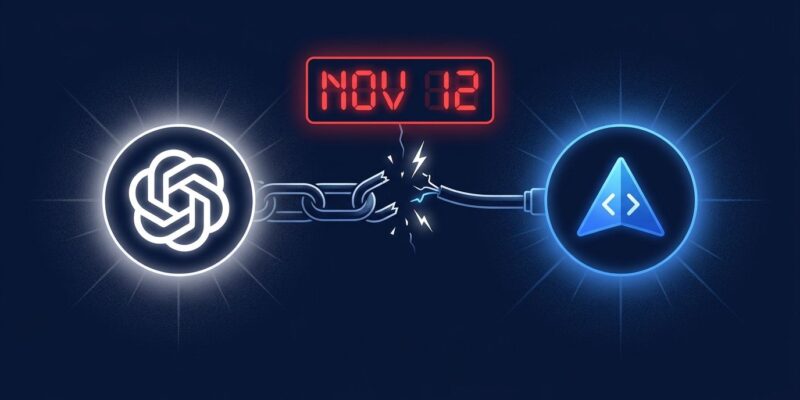
OpenAI is pulling its models from Cursor on November 12 — thirteen days from today. The termination follows SpaceX’s $60 billion acquisition of Anysphere and ends Cursor’s direct access to GPT-5.6 Luna, Sol, and Terra. For most developers, daily coding sessions are unaffected. For teams running automated workflows pinned to those model IDs, the deadline is real and the workarounds are limited.
The Real Impact: Automated Workflows, Not Your Daily Session
Cursor CEO Michael Truell has pointed out that OpenAI models represent roughly 5% of Cursor’s user traffic. That number is easy to dismiss — until you realize that 5% is almost entirely concentrated in unattended pipelines. Automations, Background Agents, and CLI scripts that hardcode a GPT-5.6 model ID will break on November 12 with no documented in-Cursor workaround.
There is also a widespread misconception worth clearing up immediately: Cursor Tab autocomplete is not affected. Tab runs on Cursor’s own Fusion model — a custom low-latency model trained specifically for inline suggestions. No OpenAI contract required, no cutoff. If Tab is your primary use of Cursor, you have nothing to do here.
What Breaks, What Doesn’t
The line between affected and unaffected features splits cleanly along one question: is the workflow running unattended?
Unaffected after November 12: Cursor Tab, any workflow using Claude, Gemini, or Grok models, local Chat and Agent sessions you run manually.
Breaks without action: Any Automation or Background Agent with a hardcoded gpt-5.6-luna, gpt-5.6-sol, or gpt-5.6-terra model ID. Cursor CLI sessions routing to GPT. Cursor API and SDK calls that depend on OpenAI models.
Bring-your-own-key (BYOK) covers less ground than most assume. You can drop your OpenAI API key into Cursor and preserve local Chat and Agent sessions. But BYOK does not extend to Auto routing, Background Agents, Automations, the CLI, or the SDK. It also requires a separately funded API account — a ChatGPT Plus subscription does not count — and it forfeits Cursor’s data retention guarantees.
Replacements Are Already in Cursor
The good news is that Cursor’s model roster is deeper than it was six months ago. Grok 4.6, developed in partnership with SpaceXAI, has been available in Cursor Pro+ and Teams plans since August 26. It ships with a 500,000-token context window and is included in the usage pool rather than metered separately. Anthropic committed additional compute immediately after OpenAI’s announcement, expanding Claude model availability. Gemini models were never affected.
For most developers, the migration path is straightforward: open your model selector, switch from a GPT-5.6 option to Claude, Gemini, or Grok 4.6, and run a day of real work. For automated workflows, that switch needs to happen in configuration files before the deadline.
Five Steps to Run Before November 12
- Search your repos and CI configs for any hardcoded
gpt-5.6model ID strings. Check.cursor/,.github/, YAML files, and any scripts that call the Cursor CLI or API. - Re-pin Automations and Background Agents to an unaffected model. Claude 4.5 or Grok 4.6 are the closest performance equivalents for agentic tasks.
- Fund a separate OpenAI API account only if you need GPT in local Chat specifically. A ChatGPT Plus subscription does not cover BYOK usage.
- Set a budget cap on any BYOK account before connecting it. Metered API spend accumulates faster than subscription-style usage.
- Test your replacement model on real work this week. Benchmark scores do not predict day-to-day fit for your specific codebase and workflow.
The Bigger Lesson
This is the second time in fourteen months that an AI coding IDE has lost model access from a major lab. Anthropic cut Windsurf’s Claude access in June 2025 with under five days’ notice. OpenAI is giving Cursor 76 days. The notice periods are getting longer, but the structural problem is the same: model access inside any editor is a vendor relationship, not an infrastructure guarantee.
The practical response is to treat model dependencies the same way you treat any third-party integration. Store rules in version-controlled files (Cursor’s .cursor/rules or AGENTS.md), keep at least two models tested and ready to swap, and audit automated pipelines for single-provider dependencies the same way you would audit for single-point infrastructure failures.