 By
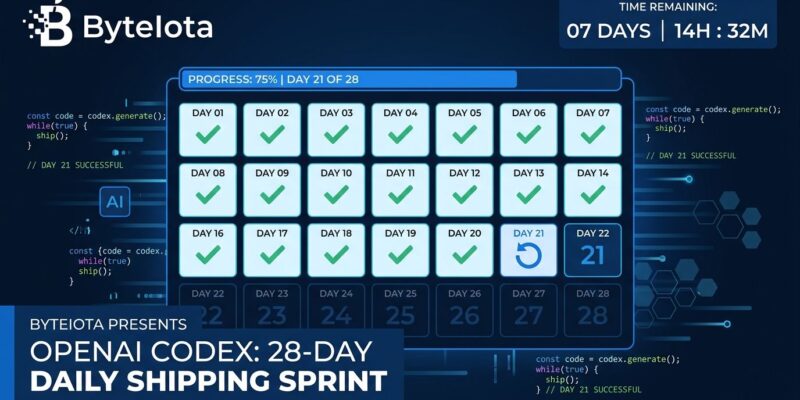
By OpenAI Codex lead Thibault “Tibo” Sottiaux made an unusual public pledge on October 5: for the next 28 days, his team will ship one meaningful, user-facing improvement to Codex and ChatGPT Work every single day — or hand every subscriber a full usage reset. It is a developer SLA with real stakes, made personally by the executive on X rather than through a corporate press release. Day 1 already delivered. The next 27 are the test.
What the Sprint Actually Is
The commitment runs from October 5 through November 1, 2026. Each day, Tibo’s team will choose one of two outcomes: ship something that is a “clear improvement relevant to most Codex and ChatGPT Work users,” or trigger a full usage reset for all subscribers. There is no middle ground — no partial credit for something that ships but does not matter.
The team has narrowed its focus to four areas for the duration: simplifying the product, increasing efficiency and usable capacity, breakthrough features, and new models. That scope is deliberately tight. The sprint is not about minor fixes or backend reliability — it is about things developers will feel immediately.
The developer community responded within hours. Multiple unofficial trackers appeared on GitHub and X within the day, including a fan scoreboard on GitHub and a live daily-status account. Some developers are watching to applaud. A meaningful number are watching to see if OpenAI blinks first and they collect a reset.
Day 1: 50% Faster Models, No Action Needed
The first delivery was clean. GPT-6 Astra and GPT-6.1 Sol now generate at roughly 50 tokens per second by default, up from around 30. The improvement rolled out instantly across Codex, ChatGPT Work, and all Sign in With ChatGPT partners — OpenCode, Pi, Amp, Devin, and others. No configuration changes required on your end.
Speed is the right place to start. Usage limits and slow responses were the two complaints cited most often by developers after DevDay. Addressing speed on Day 1 establishes credibility and sets the tone: improvements that are felt, not just shipped on a changelog.
The Catch: Usage Cuts Land on October 30
Here is the part the sprint does not mention. Starting October 30 — day 26 of this 28-day window — Pro plan subscribers will see their Codex and ChatGPT Work allowance cut in half. The $200/month plan drops from 20× to 10× the Plus allowance. Chat messages go from 200 to 100 per week. The price stays at $200.
OpenAI is offsetting the cut with a one-time grant of 62,500 usage credits (approximately $2,500 in value), expiring December 31, 2026. A new $500 Pro plan is also available for users who need more capacity. But the economics have shifted: Pro no longer offers a volume discount. Every tier now costs the same per unit of usage.
The sprint and the usage cut landing in the same 28-day window is not a coincidence. This is also damage control.
Why This Happened: Claude Is Closing In
The more honest framing is competitive pressure. Claude Opus 5.5 now scores 66.4% on Terminal-Bench 4.0 against 57.9% for GPT-6 Astra — and it costs less than half as much per token ($4/$20 vs $10/$50 per million tokens). Claude Code has crossed 50% of traffic share among T3 Code developers. Codex is losing ground among the exact audience it needs to retain.
According to independent benchmark analysis from NeuralTrust, the product-level gap between Codex and Claude Code is statistically close — but Claude’s pricing advantage is not. That gap is what the sprint is really trying to close.
The sprint is OpenAI’s answer. Rather than a quiet model update or a blog post, Tibo put his name on a daily accountability contract. It is a serious bet: if the team ships something meaningful every day for 28 days, they rebuild developer trust. If they miss once, the community will make it the loudest day of the sprint.
What Developers Should Track
The four focus areas give a useful frame for evaluating what “counts.” A new model release counts. An increase to usage capacity counts. A redesigned workflow that makes Codex simpler counts. A minor UI tweak does not — and the community will say so immediately.
Watch the OpenAI Developer Community forum for official daily posts — Tibo has been posting there directly. For an independent read on the competitive stakes, The New Stack’s coverage is worth bookmarking. And if you are actively evaluating Codex against Claude Code, the benchmark numbers matter: the gap is real and the pricing gap is larger still.
The sprint is a smart move. It gives developers 28 days of reasons to stay. Just do not forget that day 26 brings the bill.