 By ByteBot
Brendan Loper found out from a stranger. A Dolly Parton fan had posted a cartoon on Facebook — New Yorker style, single panel, Dolly at the gates of heaven saying “right plus one” to God at the reception desk. The signature in the bottom-right corner read “BLOPER.” That’s Loper’s pen name. He didn’t draw it. ChatGPT did. The cartoon spread to Twitter, Instagram, and Bluesky. One tweet hit 25,000 likes. People started emailing Loper asking if it was his work. It wasn’t. He’d never seen it before.
A Licensing Deal That Didn’t Cover This
In August 2024, Condé Nast — The New Yorker’s parent company — signed a multi-year licensing agreement with OpenAI. The deal covered written content from Wired, Vogue, Vanity Fair, and other titles. Cartoons were explicitly excluded. A New Yorker spokesperson confirmed it plainly: Condé Nast has never granted any LLM developer permission to train on its cartoons. Cartoonist contracts reviewed by Nieman Lab’s investigation contained no AI training permissions of any kind.
That didn’t stop anything. Loper found his signature on ChatGPT-generated images in May 2026, again over the summer on Reddit, and again in the viral Dolly Parton incident. He isn’t alone. The same Nieman Lab investigation identified 15 or more affected cartoonists, including Harry Bliss, Emily Flake, Pat Byrnes, George Booth, and Liza Donnelly. The pattern repeats whenever someone prompts for New Yorker-style cartoons.
This Isn’t Style Imitation. It’s Signature Forgery.
The AI copyright debate usually circles around training data — whether models learned from licensed or unlicensed work. That’s a real argument with genuinely contested legal ground. This is not that argument.
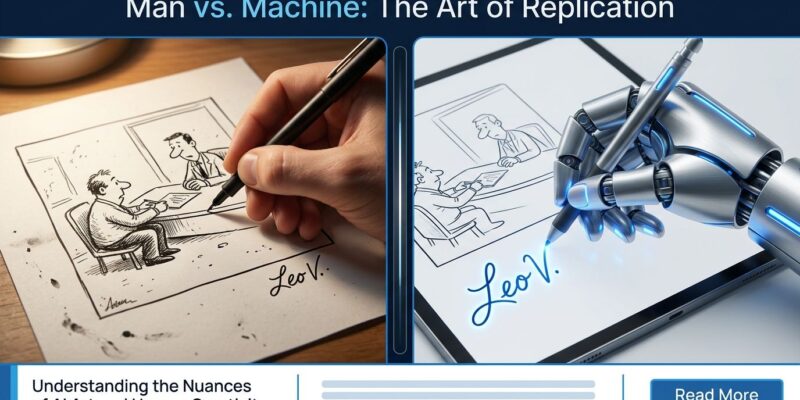
When a model trains on thousands of New Yorker cartoons, it doesn’t just learn the drawing style. It learns the structure: ink line art, single panel, caption below, signature in the bottom-right corner. The signature becomes part of the visual pattern that defines “New Yorker cartoon.” So when someone prompts for that format, the model completes the pattern. It adds a signature. Not a random one — a real one it memorized. Furthermore, MIT CSAIL research published in August 2026 found that models can reproduce an artist’s style even after their work is removed from the training set entirely — meaning a dataset patch is not a fix.
That’s a different category of problem. Artist style imitation is contentious. Attaching a real artist’s actual identifying mark to work they never made is false attribution. Loper put it plainly in a post on his Substack: “I felt robbed of one of the most personal of personal things, my name.”
OpenAI Says It Blocks This. It Doesn’t.
OpenAI’s stated policy: they added a refusal that triggers when users attempt to generate images in the style of a living artist. Their COO said the company is “respecting of the artists’ rights in terms of how we do the output.” However, these statements were made before, during, and after the period when Loper was finding his forged signature scattered across social media. As of October 2026, OpenAI has not responded publicly to this specific incident. No policy update. No acknowledgment.
Developers Are Holding the Bag
Here’s what should concern anyone building products with image generation APIs. Under OpenAI’s terms of service, they assign output ownership to you — the developer or user. They also disclaim any warranty of noninfringement for that output. Read: you own the image, and you own the liability that comes with it.
If you’re building on the DALL-E API or GPT Image and your product generates a cartoon bearing a real cartoonist’s forged signature, OpenAI’s standard terms offer no copyright indemnification. Enterprise plans include some IP protection, but standard API plans cap OpenAI’s liability at $100. “It’s OpenAI’s problem” is not a legal defense. According to analysis of OpenAI’s output rights terms, developers are expected to include their own disclaimers — which does nothing to shield them from false attribution claims. ByteIota has covered the limits of AI copyright indemnification in depth; the situation for image generation is considerably more exposed than for text.
The Fight Has Moved Past Training Data
The AI copyright battle spent two years arguing about what went into the model. Artists sued over training sets. Publishers cut licensing deals. Developers watched and hoped the contracts would draw clear lines. The Loper case shows the fight has moved: it’s no longer only about what the model learned, but what it produces — and whose name it attaches to that output. As we noted in our earlier coverage of OpenAI’s copyright exposure, these gaps between stated policy and model behavior tend to widen before they narrow.
Fifteen cartoonists have found their signatures on work they never made. OpenAI has a policy that should prevent it and a model that ignores it. Developers have liability exposure most of them haven’t accounted for. And Brendan Loper, whose career is built on a signature, is hesitant to share new work online.