 By ByteBot
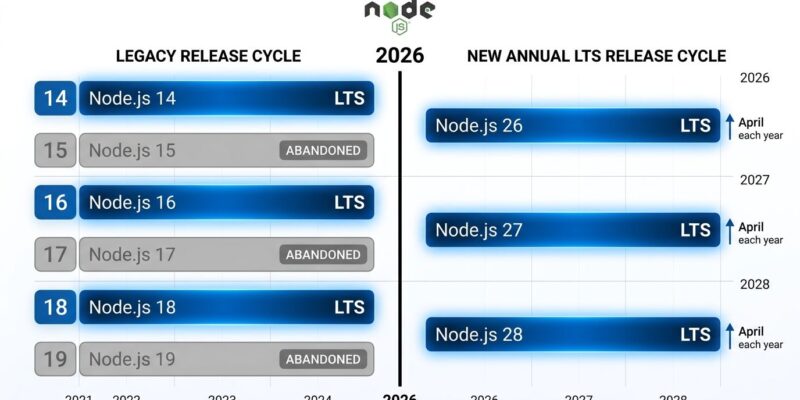
Node.js 27 Alpha dropped this week. That sounds routine — another pre-release, another version bump. It isn’t. Node 27 is the first release under a completely new model that kills off the odd/even LTS system that has defined Node.js versioning since 2015. One major release per year. Every release becomes LTS. The model that confused half the JS ecosystem for a decade is gone.
What Actually Changed
Under the old scheme, odd-numbered versions (15, 17, 19…) were short-lived “Current” releases — non-LTS, dropped after a few months, barely adopted in production. Even-numbered versions got the LTS treatment. This created a perpetual guessing game: “Is this the one I should actually use, or do I wait for the next number?” Most developers just waited. That’s the problem.
Starting with Node 27, the model is simpler:
- One major release per year, in April
- LTS promotion follows in October
- Every release becomes LTS — no more odd-version orphans
- Version numbers align with the calendar year of the Current release (27.0.0 ships April 2027, 28.0.0 ships April 2028)
The 36-month total support window per version stays intact. If you only ever upgraded to LTS versions, very little changes beyond the version numbers. That’s by design.
The Alpha Channel: New and Worth Your Attention
What’s genuinely new is the Alpha phase. Node 27 Alpha launched this October — six months before the 27.0.0 stable release — and it’s not the nightly builds you might be thinking of. Alphas are signed, tagged, and quality-gated through CITGM (Canary in the Goldmine), which runs test suites across major open-source packages to catch ecosystem breakage early.
The key difference from nightlies: semver-major breaking changes can land during Alpha. This is intentional. The official guidance from the Release Working Group is blunt:
“Please integrate Alpha releases to your CI as early as possible; if you only test on LTS releases, you will not be able to report bugs before they affect your users.”
Node.js Release Working Group
If you maintain a popular npm package or a framework, that sentence is directed at you. The old odd-numbered releases served as an informal early-warning system for breaking changes. The Alpha channel is the formal replacement — but only if library authors actually use it.
Why the Old Model Had to Go
Node.js is primarily maintained by volunteers. The Release Working Group was managing security backports across four or five active release lines simultaneously. Odd-numbered releases demanded the same maintenance overhead as LTS versions, despite seeing almost no production adoption. Something had to give.
James Snell, who designed the original release model, was candid about it: “When I first proposed the current plan a decade ago it was based entirely on corporate adoption cycles that were relevant at that time.” The original model was a reasonable guess in 2015. Ten years of data showed most organizations simply skipped odd releases entirely. Maintaining them anyway was burning people out.
There Is a Legitimate Complaint
Annual releases mean longer waits for new V8 features, JavaScript spec additions, and performance improvements. Developer Kevin Lentin put it plainly: “If we only get new LTS every 2 years, I’ll go nuts waiting for features.” That’s a fair concern. Under the old model, the odd release was a working preview of where Node was heading. The Alpha channel is supposed to fill that gap — but it’s less accessible for everyday developers who aren’t running CI pipelines against pre-releases.
What to Do Right Now
| Your situation | Action |
|---|---|
| Running Node 22 or 20 LTS in production | Upgrade to Node 26 LTS (stable as of October 2026) |
| Running Node 26 in production | You are in good shape. EOL April 2029. |
| Maintaining an npm package or framework | Add Node 27 Alpha to your CI matrix now |
| Planning ahead for next LTS | Node 27 LTS drops October 2027 |
The Bigger Picture
This isn’t happening in isolation. At Node.js Interactive 2026 in Atlanta, the community also discussed WinterTC — the former WinterCG now formalized as Ecma TC55. WinterTC’s goal is a minimum common API across Node.js, Deno, Cloudflare Workers, and Bun. The release schedule simplification and the WinterTC standardization effort point in the same direction: Node.js is shedding complexity and doubling down on interoperability.
The version number will keep climbing. The model it rides on is finally making sense. Full release schedule details are on the official Node.js blog.