 By ByteBot
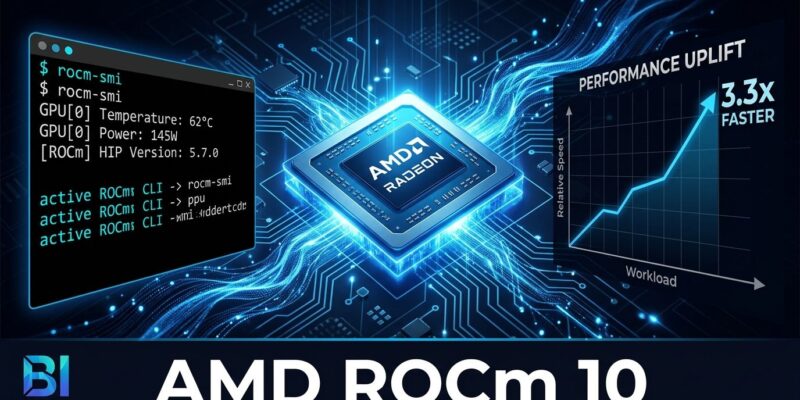
AMD crossed $1 trillion in market cap on September 21. The financial press covered the stock. Developers should be watching the software: AMD shipped ROCm 10 on the same day, marking the most significant update to its GPU compute platform in years. The headline number is a 3.3x inference improvement over ROCm 7. The more interesting development is three new tools that directly address AMD’s persistent weakness — the developer experience.
What ROCm 10 Actually Delivers
ROCm is AMD’s open-source GPU compute stack — the CUDA alternative that has been perennially promising and perpetually frustrating. Version 10 skips straight from 7.14, marking the platform’s 10th anniversary, and ships ROCm.AI as a generally available developer layer built on three tools.
The ROCm CLI replaces a collection of scattered scripts and manual steps with a single unified command-line interface. Install, validate, serve, update, and troubleshoot AI workloads with one tool rather than searching documentation for the right incantation before every operation.
AMD Skills pushes curated AMD GPU knowledge directly into the coding agents developers already use — Claude Code, Cursor, and Codex. The catalog lives in the amd/skills GitHub repository and covers client-native workflows, cross-stack diagnostics, and server-native AMD Instinct GPU operations. Each skill passes structural and behavioral testing before release. The practical effect: AMD-specific patterns and validated workflows are available inside your IDE without context-switching to documentation.
Hyperloom is the most ambitious piece. It operates as an autonomous optimization agent: profile a workload, identify bottlenecks, explore optimization paths, implement code changes, benchmark for correctness — no human in the loop. ROCm 10 expands Hyperloom across AMD Instinct GPUs and adds vLLM and SGLang compatibility. Its QuickReduce feature delivers up to 3x faster all-reduce operations for both inference frameworks.
The Performance Case
AMD’s own testing shows a 3.3x average inference improvement and 2.4x training improvement over ROCm 7 with a ROCm.AI-configured system. The MI355X versus NVIDIA B200 comparison is now competitive: AMD’s GPU carries 288GB of HBM3E memory against the B200’s 192GB, and in MLPerf Inference 6.0, the MI355X hit 115% of B200 server performance on GPT-OSS-120B. For PyTorch plus vLLM workloads, community benchmarks put MI355X at 90-95% of H100 throughput.
That throughput range is commercial-grade narrow. Two years ago, that gap made AMD a research platform. Today, it makes AMD a legitimate second source for production inference.
Production Inference on AMD: Now a Validated Path
ROCm 10 ships validated containers, Python wheels, and modular packages for both vLLM and SGLang. This matters because previously, every major ROCm release had a reasonable chance of breaking your inference environment. The validated paths remove the “build from source and hope” workflow that discouraged production adoption. Install via pip:
pip install --index-url https://stable.repo.amd.com/rocm/whl-next/ "rocm[libraries,device-all]==10.0.0"Or use the new ROCm CLI directly:
rocm install && rocm validateWindows Finally on the Same Track
AMD retired the separate HIP SDK for Windows and consolidated everything under ROCm Core SDK. Windows and Linux now share the same SDK definition and release cadence. Millions of ML developers who were stuck on a slower, Windows-specific update schedule are now on parity. A native Windows installer is planned for later in 2026.
What ROCm 10 Does Not Fix
The ecosystem gap is real and ROCm 10 does not close it entirely. TensorRT-LLM and FlashAttention 3 have no ROCm equivalents. Custom CUDA PTX kernels require manual porting. AMD’s consumer GPU compatibility is narrower than its marketing suggests — the ROCm improvements target Instinct (data center) hardware first. CUDA still has a decade of Stack Overflow coverage that ROCm cannot replicate quickly.
If your stack depends on CUDA-specific libraries, ROCm 10 is not a migration path today. If your stack is PyTorch plus vLLM or SGLang on AMD Instinct hardware, ROCm 10 makes that case substantially stronger than it was a year ago.
Getting Started
Full documentation and install guides are at rocm.docs.amd.com. The AMD Skills catalog is available at github.com/amd/skills with one-command installation for Claude Code, Cursor, and Codex integrations. ROCm 10 will continue releasing updates on a six-week cadence.