 By ByteBot
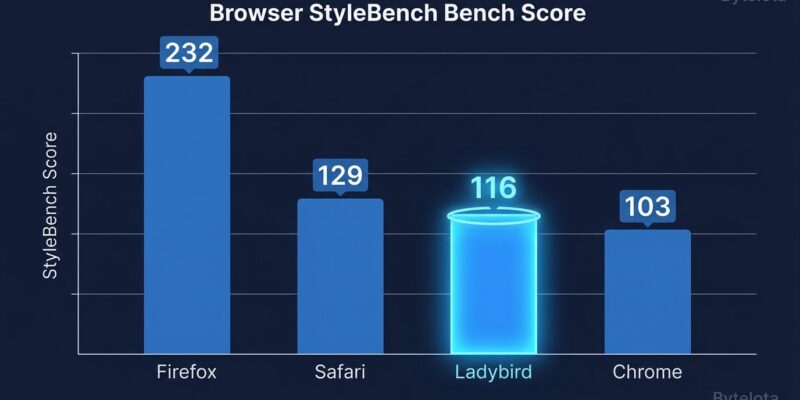
Ladybird’s August 2026 progress report, published last Sunday, contains a number worth examining twice: StyleBench jumped from 3.5 to 83 in a single month. On an M3 MacBook Pro, that puts Ladybird at 116.3 — ahead of Chrome’s 103.8 on this benchmark, behind Safari (129.5) and Firefox (232.8), but in the same room as mature production engines. StyleBench isn’t a vanity metric; it measures incremental CSS restyling, the work that happens on every user interaction that changes the page. That is core web app territory. Ladybird, the independent browser engine built from scratch by a non-profit with no ad revenue and no search deals, just landed a competitive score where it counts.
This Was Architecture, Not Optimization
The 24x StyleBench improvement did not come from micro-tuning. The team replaced their entire selector matching, style invalidation, cascade, and computed-style retention system with a new incremental engine. DOM mutations, state changes, and CSSOM edits are now treated as typed deltas routed to dependent selectors — only what’s affected gets recomputed. Previously, a DOM change could trigger a full style pass. Now it doesn’t.
Two more structural changes compounded the gain. Layout results are now cached based on input constraints, so a subtree that already computed its layout at a given size can replay that result at a new position without full recomputation. CSS animations — opacity and transform specifically — moved off the main thread entirely to the compositor, removing one of the classic sources of jank in browser engines.
Alongside all of this, the painting pipeline migrated fully to Rust. CSS parsing, computed style storage, display list recording, and hit testing are now Rust-owned. The C++ paintable objects were deleted. This matters beyond performance: the code that handles untrusted web content now has memory-safety guarantees by construction. Ladybird’s Rust migration strategy — moving security-critical parsers first, which started with the LibJS frontend in February 2026 — is following the same playbook every serious systems project is now adopting.
Related: RustConf 2026: Rust Is Now Infrastructure, Not Just a Language
Real Features, Real Sites
Performance numbers are one thing. Sites working is another. August added Media Source Extensions support, which means Twitch now plays in Ladybird. That landed alongside fragmented MP4 with AVC, HEVC, AV1, and AAC codecs, plus expanded YouTube format compatibility. A pre-alpha browser that loads Twitch is a different kind of pre-alpha than one that doesn’t.
The month also shipped JavaScript debugging with breakpoints, line-by-line stepping, and watch expressions — a usable DevTools is table stakes for browser adoption by developers. Session restore preserving full back/forward history landed alongside it. On the compatibility side, Strava’s memory usage dropped from 17.8 GiB to 61 MiB after engine fixes, and Web Platform Tests reached 2,088,677 passing subtests, up 9,657 in a single month. These are not cherry-picked improvements. They’re signals that the engine is closing on daily-driver territory, not just benchmark territory.
Why the Non-Profit Structure Matters
The web runs on three engines. Blink (Chromium) handles 78.4% of global sessions. WebKit (Safari) holds 18.8%. Gecko (Firefox) is at 2.6% and declining. Every browser you can name — Chrome, Edge, Brave, Arc, Opera, Vivaldi — is either Blink or WebKit. Two companies with search deals and ad networks effectively write the web platform.
Ladybird is the only serious attempt to build a fourth engine without a commercial parent. It’s governed by a 501(c)(3) non-profit — Shopify, Cloudflare, and FUTO are Platinum sponsors — with no search deals, no data collection, and board seats explicitly not for sale. This isn’t a hobbyist side project; it’s funded infrastructure that exists because the people who build the open web are paying for a browser engine that won’t owe its technical decisions to anyone with an advertising revenue line.
Related: Chrome’s “Clear on Quit” Doesn’t Apply to Google — Again
What It Still Cannot Do
Speedometer — the benchmark that measures end-to-end browser interaction performance — tells a different story: Ladybird at 3.9, mature engines at 300–400+. StyleBench tests one axis of performance. Speedometer tests everything together. That gap doesn’t close in one month, and anyone claiming Ladybird is ready to replace their daily driver is not reading the same numbers.
Governance is also a live tension. External contributions are currently closed — the team cites AI-generated low-quality PRs as the driver — which has drawn criticism from developers who see open contribution as foundational. The SQLite comparison (highly successful, restricted contributions) is defensible, but it’s not settled. Both of these are real constraints, not footnotes. The Hacker News discussion is worth reading if you want the unfiltered community reaction.
What to Watch Next
The alpha is still on track for 2026. Crash reporting, signed builds, and auto-update infrastructure are the remaining blockers. Beta is planned for 2027, stable for 2028. The timeline has held. The team is clear that the alpha will ship before the engine is finished — “that’s what the alpha is for.” That is the right call. An imperfect alpha that ships is more valuable than a perfect engine that doesn’t.
August’s numbers changed what Ladybird is. It’s no longer an interesting experiment with a long way to go. It’s an engine with a competitive style system, a working Rust painting pipeline, Twitch support, and a non-profit governance model that no existing browser can match. Watch the Speedometer number. When that closes, the story changes entirely.
Key Takeaways
- Ladybird’s StyleBench jumped from 3.5 to 83 in August 2026, putting it at 116.3 on M3 MacBook Pro — ahead of Chrome’s 103.8 on this specific benchmark
- The improvement came from architectural rewrites: new incremental style engine, layout caching, CSS animations off main thread, and the full painting pipeline migrated to Rust
- User-visible progress includes Twitch video via Media Source Extensions, JavaScript debugging with breakpoints, session restore, and a 17.8 GiB → 61 MiB Strava memory fix
- Ladybird is governed by a 501(c)(3) non-profit (Shopify, Cloudflare, FUTO as Platinum sponsors) with no ads, no search deals, and no advertiser influence on its technical roadmap
- The Speedometer gap remains wide (3.9 vs 300–400+); the 2026 alpha is on track but this is not a daily-driver replacement — yet