 By ByteBot
On August 25, Broadcom quietly removed the VMware Virtual Disk Development Kit (VDDK) from its download portal — no announcement, no deprecation notice, no migration path. Just 404 errors where every major agentless VM migration tool had pointed for years. If your organization is trying to get off vSphere, that silent removal just made your job significantly harder.
Why VDDK Matters More Than You’d Expect
VDDK is not optional tooling. It is the library that allows migration software to read VMware virtual disks from outside the hypervisor — the technical prerequisite for agentless migration. Virtually every tool in the market depends on it: Azure Migrate, Red Hat’s Migration Toolkit for Virtualization, Nutanix Move, ShapeBlue Migrate, and the open-source virt-v2v engine that underlies most VMware-to-KVM conversion work.
The problem is structural: VDDK’s license explicitly prohibits redistribution. Vendors cannot bundle it in their tooling — they must pull it from Broadcom’s portal. When the portal breaks, the tools break. And for VMs backed by VMware vSAN, there is currently no migration path at all without VDDK — open-source alternatives cannot substitute here.
What Actually Broke
The short answer: most of the agentless migration ecosystem. Here is what major vendors have confirmed:
- Azure Migrate: Microsoft updated its documentation to warn that “Broadcom may restrict access to the VDDK” and now recommends agent-based migration — slower, and requires installing an agent on each VM you want to move.
- Red Hat Migration Toolkit for Virtualization: Red Hat cannot redistribute proprietary software. Their guidance: contact Broadcom support directly.
- Nutanix Move: Agentless migration path affected.
- ShapeBlue Migrate: Two of four migration methods broken — direct migration and changed block tracking both rely on VDDK.
The removal was not sudden. Download buttons were returning JSON errors as far back as September 2024. VDDK 8.x downloads stopped working in November 2025. The full portal removal on August 25, 2026 was the final step in a two-year slowdown that Broadcom never acknowledged publicly.
This Is the Playbook
Price increases of 300 to 1,500 percent since the VMware acquisition are well documented. Gartner puts the typical increase at 300–400%, AT&T cited a 1,050% jump in court filings, and the European cloud association CISPE reported increases up to 1,500% to the EU Commission. Broadcom also eliminated perpetual licensing entirely and collapsed 8,000+ SKUs into a handful of expensive subscription bundles.
Removing VDDK access fits the same logic: if customers cannot easily migrate off vSphere, they negotiate renewals from a position of weakness. A former VMware engineer put it bluntly in the Hacker News discussion: Broadcom views the company as “long past its ability to innovate, extracting as many dollars as possible before its rapidly decreasing value goes to zero.”
That framing is harsh. The timeline is hard to argue with.
What You Can Do Right Now
There are still paths forward, though none are as clean as VDDK-backed agentless migration:
- Agent-based migration: The fallback Microsoft and Red Hat are pointing to. Works, but requires deploying an agent on each guest VM before migration.
- Proxmox import utility: Operates independently of VDDK and is the most complete VDDK-free option for KVM migrations. Multiple organizations report straightforward migrations.
- Platform9 vJailbreak (Accelerated Copy): Uses proxy VMs to connect directly to storage, bypassing VDDK entirely.
- ShapeBlue overlay method: VDDK-free, but requires shared NFS storage and CloudStack 4.22.1 or newer.
- OpenVDDK: A GPL-3.0 clean-room reimplementation of VDDK on GitHub. C ABI-compatible drop-in replacement. Community project — treat as promising but not production-proven. Does not cover vSAN-backed workloads.
- Technology Alliance Partners (TAP): Broadcom support reportedly directs customers here for VDDK access. Worth a support ticket if you are mid-migration and stuck.
Infrastructure Capture at Scale
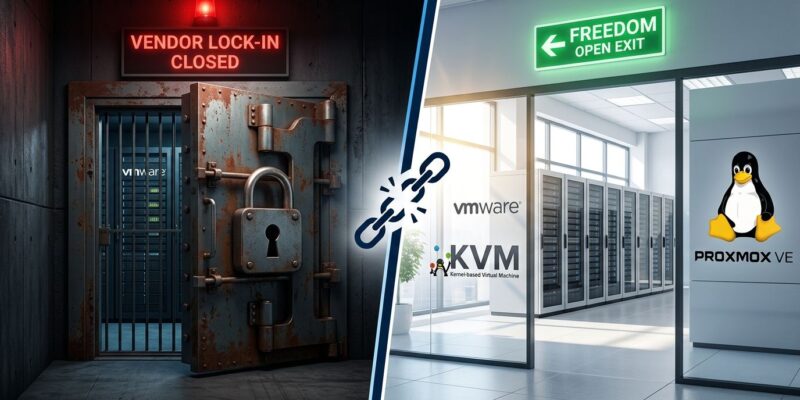
This situation is a case study in what infrastructure lock-in looks like when a vendor decides to collect. Broadcom did not build the VMware customer base — it acquired it. The value was never in shipping better hypervisor software. It was in inheriting millions of tightly locked-in VMs that organizations would pay dearly to keep running.
Any critical dependency on a proprietary library that you cannot redistribute, bundle, or replace carries risk proportional to how much the vendor needs you to stay. VDDK was a single-vendor choke point. Now Broadcom has pulled it. For the full technical breakdown of the removal and affected tools, VirtualizationHowto has the most complete coverage.
Proxmox, KVM, and open-source hypervisor stacks have never looked better by comparison.