 By
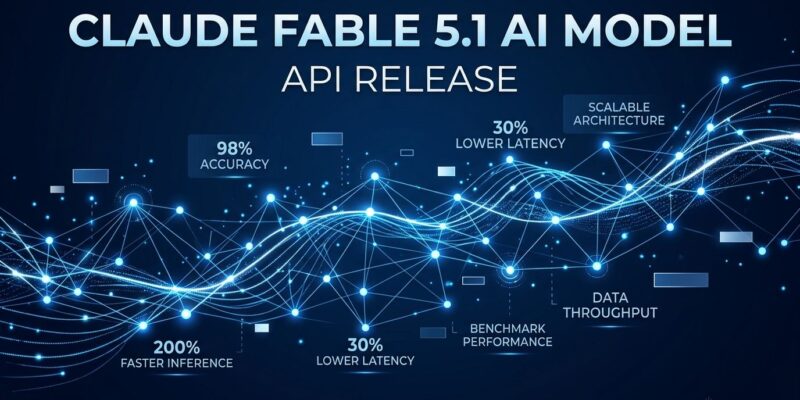
By Claude Fable 5.1 is live on the API as of September 1. Anthropic shipped it alongside a pricing change that directly affects your monthly bill: cache reads are now 75% cheaper. The model ID is claude-fable-5-1. If you are running Fable 5 in production, here is what changed and what you need to check before you migrate.
Cache Reads Are 75% Cheaper — But Your Actual Savings Depend on One Thing
The headline number is 75%. The honest number is more nuanced. Anthropic cut cache read pricing from around $1.00 to $0.25 per million tokens. Input ($10/1M) and output ($50/1M) prices are unchanged from Fable 5.
What you actually save depends on how much of your token bill is cache reads:
- Cache reads = ~33% of bill: total savings around 25%
- Cache reads = ~60% of bill: total savings around 45%
- Mostly single-turn completions: barely noticeable
Agentic workloads benefit most. If your pipeline repeatedly sends the same system prompt, tool definitions, or long conversation history across many turns, you are burning cache reads constantly. That is precisely the use case this cut targets. Anthropic’s own estimate: “roughly 25% lower overall cost on typical workloads, up to 45% on highly agentic ones.”
Before you celebrate, pull your last billing statement and calculate what share cache reads represent. If it is low, the upgrade is a benchmark story, not a cost story.
The Benchmark That Actually Matters for Agent Builders
Anthropic is leading with Terminal-Bench-Science 0.1, a benchmark that tests autonomous end-to-end scientific research: plan an investigation, execute it in a terminal, verify the result. Fable 5.1 scores 52.6%. Fable 5 scored 24.7%. Opus 5 scored 29.0%. GPT-5.6 Sol scored 22.4%. That is not a modest improvement — it is a category shift.
Here is the full picture:
- Terminal-Bench-Science 0.1: 52.6% (Fable 5: 24.7%)
- Terminal-Bench 4.0: 55.8% (Fable 5: 42.0%)
- AutomationBench: 31.4% (Fable 5: 17.1%)
- CursorBench 3.2.0: 73.4% (Fable 5: 70.5%)
- Humanity’s Last Exam (no tools): 60.9%
For production agent builders, watch AutomationBench. It measures multi-step agentic automation — the kind of task where a model chains tool calls across systems to complete something real. Fable 5.1 nearly doubles Fable 5’s score there (17.1% to 31.4%). CursorBench barely moved, which is fine — IDE coding was already strong and the delta is within noise range.
Third-party validation holds up. Artificial Analysis ranks Fable 5.1 first on its Intelligence Index. Vals AI ranks it first on the Vals Index. Millennium, an investment firm, reported that Fable 5.1 identified the root cause of a rare internal system crash that no engineer — or competing model — had solved after several years of investigation.
Three Breaking Changes to Fix Before You Flip the Switch
Do not do a drop-in model ID swap without reviewing these:
- Forced tool choice is gone. If you are passing
tool_choice: forced(any or tool), Fable 5.1 returns a 400 error. Replace it withtool_choice: autoand add explicit instructions in the prompt. - Thinking blocks are not backward-compatible. Thinking blocks produced by Fable 5.1 cannot be passed to older models. If you are stitching model versions together in a pipeline, this will break.
- Priority Tier is not supported. Fable 5.1 does not work on Priority Tier. If your production setup uses Priority Tier, you cannot migrate until Anthropic adds support.
Migration path depends on how you are using Claude:
- Claude Code: Run
/claude-api migrate— the built-in skill applies the model ID swap and handles breaking parameter changes automatically. - Claude Managed Agents: Change the model ID. Nothing else required.
- Messages API: Manual update. Review the official migration guide.
Anthropic’s recommendation: run Fable 5 and 5.1 side by side, canary a small traffic share to 5.1, and log model IDs and prompt versions before you commit.
Enterprise Frontier Safeguards: Anthropic’s Answer to Legal Teams
Also launching with Fable 5.1: Enterprise Frontier Safeguards (EFS). It is Anthropic’s response to the compliance objection — the legal team or infosec team that blocks Claude adoption because monitoring data sits on Anthropic’s infrastructure.
EFS stores monitoring data entirely in customer-controlled cloud infrastructure. Anthropic’s safety systems still run. The data never leaves your environment. Anthropic claims it is functionally equivalent to a zero data retention (ZDR) policy while preserving safety monitoring coverage.
EFS is rolling out in phases later this fall across Claude Code, Claude Enterprise, Amazon Bedrock, Google Agent Platform, and Microsoft Foundry. It is not available yet — watch for the announcement if compliance is your blocker. One more thing worth noting: Fable 5.1’s safety updates also cut false positives by 60% compared to Fable 5, which matters for teams who had policies incorrectly triggering on legitimate developer tasks.
The Bottom Line
Claude Fable 5.1 is a meaningful upgrade, not a minor patch. The cache read price cut is real money for teams running production agent loops. The benchmark gains on AutomationBench and Terminal-Bench are the strongest signal that multi-step agentic tasks are where this model earns its keep. The breaking changes are manageable, but the Priority Tier gap is a real blocker for some teams. Migrate, test in parallel, and check your billing profile before you assume the 75% headline translates to your actual bill.
Full pricing and specs on the OpenRouter model page. Official announcement from Anthropic. Detailed benchmark analysis from Vellum.