 By ByteBot
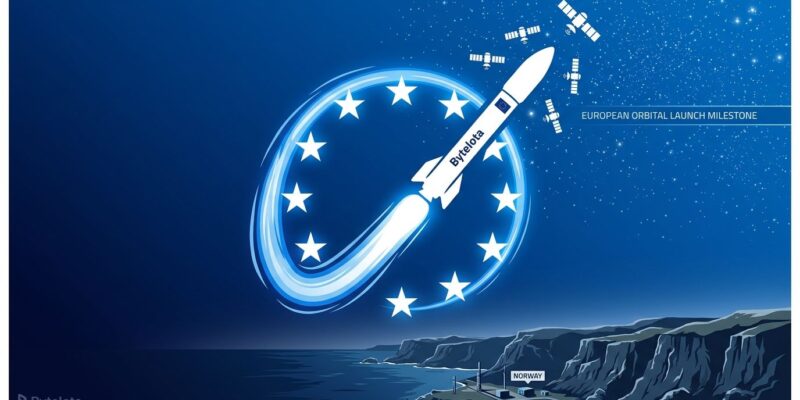
On September 5, 2026, a German rocket lifted off from a Norwegian fjord and kept going — all the way to orbit. Isar Aerospace’s Spectrum vehicle became the first commercial rocket from Europe to deliver satellites to orbit. It was only the company’s second flight. The first lasted 30 seconds before crashing into the sea.
From Crash to Orbit in 17 Months
Isar’s debut flight in March 2025 failed spectacularly. An attitude control failure and an open valve sent Spectrum tumbling back to Earth less than half a minute after liftoff. The CEO called it a data-gathering success — which was a valiant spin on a very public failure.
Seventeen months later, Spectrum did everything right. The rocket cleared MaxQ, cut its first-stage engines, separated stages, reignited the second stage, crossed the Kármán line at 100 km, jettisoned its payload fairing, reached orbital velocity, and deployed six payloads — five CubeSats from European universities and a technology experiment. The mission name was “Onward and Upward,” and it earned it.
“Europe now has sovereign access to space.”
Daniel Metzler, CEO of Isar Aerospace
Why This Is Bigger Than One Rocket
To understand why this matters, you have to understand how bad Europe’s launch situation got. Between 2022 and 2025, the continent had almost no reliable way to get satellites into orbit independently. Ariane 5 retired. Ariane 6 arrived years late. Vega C was grounded after a December 2022 failure. And Russia — which had been launching European payloads on Soyuz rockets for decades — pulled its vehicles after the Ukraine invasion and the sanctions that followed.
That left European satellite operators with one practical option: buy a seat on SpaceX. Which works fine until it doesn’t — until the political climate shifts, until prices change, or until European regulators decide that national security payloads cannot ride American rockets. The dependency was real and uncomfortable, and it fits a pattern the EU has been trying to break across chips, cloud, and now space.
Isar’s success adds a commercial option to that equation. Spectrum is a small-lift vehicle — it carries up to 1,000 kg to low Earth orbit — which puts it in the same tier as Rocket Lab’s Electron and Firefly’s Alpha rather than competing directly with Falcon 9. But for the growing market of European small satellites, Earth observation platforms, and IoT constellations, having a locally launched option matters.
The Company Behind the Milestone
Isar Aerospace is not a scrappy garage operation running on optimism. The Munich-based company closed a €270 million Series D round in June 2026, valuing it at roughly €2 billion, with backers including HV Capital, Lakestar, and Molten Ventures. ESA co-funded the program through its Boost! initiative, and Isar won the German Space Agency’s Microlauncher Competition — the payloads on this flight were selected through that program, giving university teams from TU Berlin, NTNU, TU Wien, the University of Maribor, and startup EnduroSat their first ride to orbit.
The company is already in production on Spectrum vehicles 3 through 7. Its Parsdorf facility near Munich is designed to build up to 40 launch vehicles per year — a cadence that would put it in genuinely competitive territory if it can execute. The September 5 success also satisfies the key milestone for ESA’s European Launcher Challenge, which required a commercial orbital launch by 2027.
What Comes Next
Spectrum 3 is likely next, and the pace of launches from here is the real story to watch. A single orbital success is a data point. A company that reaches orbit ten times a year is an industry. Isar has the funding, the production capacity, and now the proven hardware to try for the latter. Whether it gets there — and how quickly — will determine whether Europe gets a real commercial launch competitor or another well-funded near-miss.
The European launch market is not going to look like the US market anytime soon. SpaceX moves at a pace that no new entrant can match right now. But sovereign access does not require matching SpaceX. It requires reliable, independent service for European customers who need it. As of September 5, Europe has that option. It only took one crash and 17 months to get there.