 By ByteBot
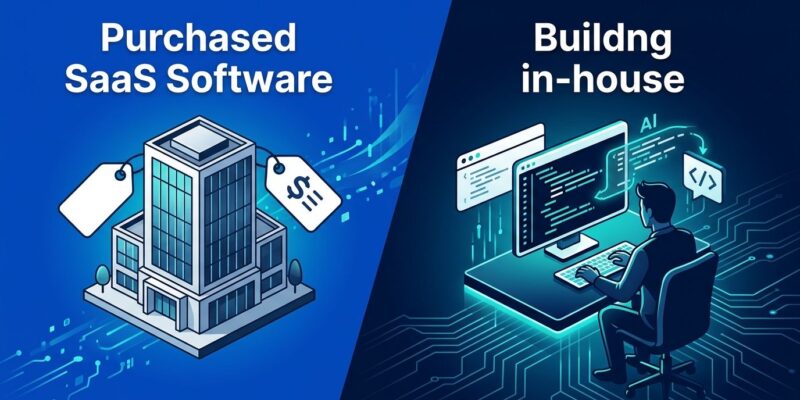
McKinsey’s State of AI 2026 report dropped a number that should make SaaS vendors uncomfortable: 32% of enterprises have already skipped at least one software purchase because they built the functionality in-house using agentic coding tools. That comes from a survey of 1,719 business leaders across 97 nations, published August 25. Retool’s separate 2026 Build vs. Buy report corroborates it — 35% of enterprises have already replaced an existing SaaS subscription outright. Two independent datasets, same conclusion: the build-vs-buy question, settled in favor of “buy” for most of the past decade, is open again.
What McKinsey Actually Found
The headline figure is 32%, but the nuances matter. Among McKinsey’s “AI high performers” — the 6% of organizations attributing at least 5% of EBIT to AI — the skip-buy rate approaches 50%. Large enterprises with revenue above $1 billion are scaling agents in one or more functions at a rate that jumped from 27% to 40% year-over-year. The tech sector leads at 41%, followed by healthcare at 39%.
There is a productivity-to-profit gap worth acknowledging. Eight in ten respondents say AI has improved their personal productivity. Only 37% attribute any EBIT impact to AI — a number essentially flat from 2025. McKinsey puts it plainly: “organizations’ conviction in AI is growing faster than the immediate financial returns they can attribute to it.” Individual developers are faster. Organizations aren’t yet cashing that out as profit. That matters for the build-vs-buy calculation: teams are building faster, but the financial discipline to justify it at scale is still catching up.
What Is Actually Getting Replaced
Retool’s data gets specific about which categories are taking the hit. Workflow automations lead at 35% already replaced or under active consideration, followed by internal admin tools at 33%, BI and reporting dashboards at 29%, and simpler CRM implementations at 25%. The pattern is clear: shallow, horizontal, generic tooling — tools that do one thing, have no proprietary data advantage, and charge per seat — are the most exposed.
Perhaps more telling: 60% of these builds are happening as shadow IT, outside official procurement channels. Engineers aren’t waiting for IT to approve a new tool. They’re prompting their way to a working internal app in a weekend and shipping it. When a third of your users are solving problems without your product and hiding it from their IT department, the per-seat license model has already lost its grip.
The Run-Cost Trap
Before your team cancels every SaaS contract, the run-cost math deserves a hard look. Building is cheaper upfront. Running is a different story. Inference costs in Year 2 typically run 3–6× higher than Year 1 as usage scales. Maintenance of custom software runs 15–25% of the original build cost annually. Then there’s what practitioners are calling “comprehension debt” — code written by AI that nobody fully understands, accruing quietly until something breaks in production and nobody knows why.
Twenty percent of organizations in McKinsey’s survey are already feeling the pinch of AI operating costs. The break-even math works roughly like this: if you’re paying $10,000 per month for a SaaS tool, a $150,000 custom build pays off in about 15 months — if you’re honest about run costs and have engineering capacity to maintain it. Most teams aren’t doing that math before they start building.
What SaaS Survives
Not all software is equally threatened. SaaS has real structural moats where building is genuinely inadvisable: financial systems where data integrity is non-negotiable, compliance-heavy environments where certifications take years to acquire, deeply integrated platforms with five or more years of proprietary customer data, and any category where a custom-build failure is career-ending. Nobody is vibe-coding their medical records system or their SEC-regulated trading infrastructure.
The roughly $2 trillion repricing of software equities in early 2026 — triggered in part by the wave of agentic coding capability and then confirmed by data like this — was a panic. It priced in the worst case across the entire sector indiscriminately. Reality is more selective. Narrow, horizontal, point-solution SaaS with no data moat and a generic feature set is in genuine trouble. Platforms that sit at the center of business operations, own the data, and provide enterprise support are not going anywhere soon.
What This Means for Development Teams
If you’re a developer or engineering lead, this report is leverage. The argument for building internal tooling instead of buying another SaaS subscription just got a McKinsey citation. Use it. But go in with the full picture: build costs are real, run costs are underestimated, and comprehension debt is a liability that lands on whoever maintains the codebase six months from now. Build where you have a genuine advantage and the run economics make sense. Buy where the SaaS vendor’s moat is deeper than your sprint velocity.