 By ByteBot
Linus Torvalds used Gemini to debug a black screen regression in the Intel Xe driver. Andrew Morton used the same model to draft patch summaries for a memory management pull that ran to 1,250 block descriptions. Linux 7.3-rc1 dropped on August 30, and buried under the usual hardware dump is a workflow change nobody voted on: AI is now part of how the kernel gets made.
What Is in 7.3-rc1
The 7.3 merge window closed with roughly 10,000 commits, pushing the kernel past 40.98 million lines of code. Linus flagged the diff as unusually large but attributed most of it to a routine AMD GPU hardware dump. Strip that out and the pattern looks normal. The final stable release is expected in mid-to-late October 2026, giving the rc series about six weeks to shake out regressions.
The AI angle is worth pausing on. Torvalds’ Xe debugging session involved 24 patches and 18 cold kernel boots — the kind of grind where AI able to correlate regressions across a large diff genuinely compresses calendar time. Morton’s use case is different: the MM pull was simply too large to annotate manually, so he used Gemini to draft summaries and edited from there. Both are pragmatic decisions. The open question — already live on LKML — is governance: who maintains the audit trail when AI wrote parts of the changelog? That debate will outlast this release cycle.
Btrfs Gets Its Best Performance Story in Years
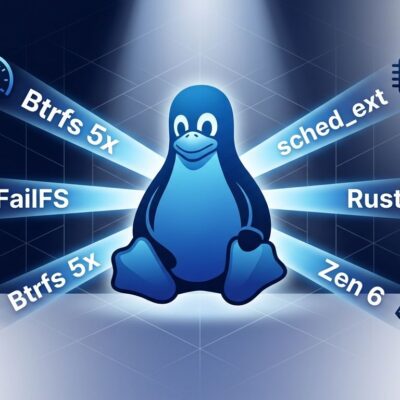
Two independent improvements land in 7.3 that together make a strong case for Btrfs on production workloads. First, a new IOmap bounce-buffer mechanism keeps more operations on the Direct I/O path instead of falling back to buffered I/O. Direct I/O throughput climbs from around 50% of theoretical maximum to roughly 95%, with FIO benchmark results showing gains up to 5x. That is a real-world win for databases, virtual machines, and any workload hammering storage directly.
Second, Zstd decompression gets 71% faster through an embarrassingly simple fix. Usama Arif found the kernel was issuing two serializing CPUID calls to detect BMI2 instruction support every time a new compression context was created. Moving that probe to boot time eliminated the overhead and shaves 18% off compression for crypto_acomp. Any system from the past decade — Intel Haswell or newer, AMD Excavator or newer — benefits automatically.
Rust Reaches PowerPC, DMA Memory Gets Lifetime Safety
Rust kernel support now officially covers PowerPC: both PPC32BE and PPC64LE are marked “maintained” in 7.3, not experimental. The architecture expansion continues its pattern — x86_64 first, ARM64 next, now PowerPC. Assume this keeps moving.
More interesting to driver developers is the DMA lifetime binding work from Danilo Krummrich. DMA allocations are now tied to device-bound lifetimes, enforced by the borrow checker at compile time. The practical meaning: DMA memory cannot outlive the device it was allocated for, and that guarantee is structural rather than conventional. The kernel’s longstanding memory safety problem in drivers now has a path toward being a compiler error rather than a runtime bug. Separately, sched_ext reaches feature completeness, with hierarchical sub-scheduling allowing different cgroup domains to run their own BPF scheduler instance.
Apple Silicon Closes the Gap
USB4 and Thunderbolt support lands in mainline for M1, M2, and M3 SoCs, including a dedicated Thunderbolt switch driver and NHI support. A new Apple PMGR power management driver handles power domain control across SoC generations. M3 Pro, Max, and Ultra variants get initial mainline boot support. Developers running Linux on Apple hardware natively are getting closer to feature parity with the out-of-tree Asahi patches, cycle by cycle.
Hardware Roundup
Intel’s Xe3P iGPU for Nova Lake-S is stable — the force-probe flag is removed, so Linux 7.3 will detect and initialize it automatically. AMD Zen 6 client enablement continues alongside UALink infrastructure support for AI and HPC interconnects and a new Ryzen AI Halo LED/RGB driver. KVM gets a 45-patch overhaul of guest memory conversion, which matters for confidential VM workloads switching between regular and encrypted memory types. On the graphics side, Nouveau picks up NVK Vulkan Video support — NVIDIA’s open-source path now handles video decode through Vulkan.
What to Do Before Stable
The rc series runs through October. If you run hardware from any of the categories above — Apple Silicon, AMD Zen 6, Intel Nova Lake, Btrfs-heavy workloads — test against rc1 and report regressions on LKML or kernel bugzilla. The Btrfs direct I/O path is worth validating against production workload patterns before 7.3 ships in distros. Read the full Phoronix Linux 7.3 feature review for the complete change list. Stable lands mid-to-late October.