 By ByteBot
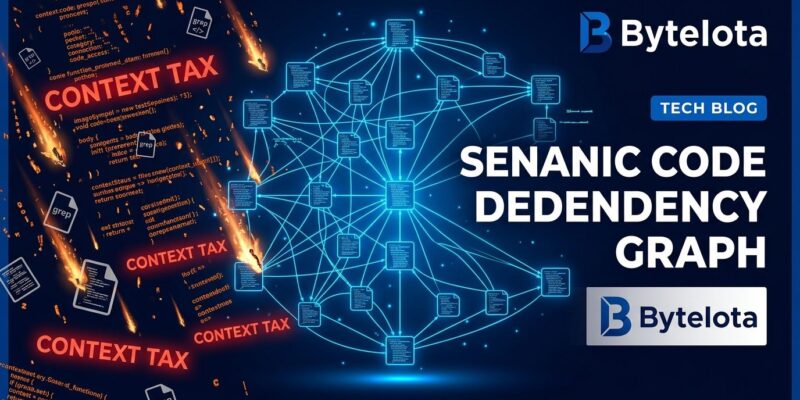
The average pull request processed by an AI coding agent on a large codebase costs $65 in tokens — not because frontier models are expensive, but because of how agents navigate code. Every file an agent opens via text search persists in the conversation context and gets re-billed on every subsequent model turn through prompt caching. Sonar calls this the context tax. Their new product, Sonar Vortex, claims to cut it by up to 36% by replacing grep with a semantic dependency graph.
How a Single File Read Becomes a $0.54 Line Item
The math behind the context tax is straightforward and punishing. When an agent reads a 600-line file on turn 40 of a 512-turn session, it does not pay for 600 lines once. It pays for 600 lines multiplied by roughly 470 remaining turns through prompt cache re-billing. That is 2.7 million cache-read tokens for one unnecessary file read — approximately $0.54 before the session ends.
Sonar measured this across 18 real pull requests on a mid-sized open-source codebase and found an average cost of $65 per PR, with a median of $52. Context windows routinely peaked between 450,000 and 975,000 tokens. Average model round-trips per PR: 700. This is not a pathological edge case — it is what happens when agents use grep-based navigation on real codebases at scale.
Three Ways Grep Lies to Your Agent
Grep-based navigation fails in three distinct ways, each adding tokens to your bill.
Noise floods. A BloomFilter refactoring task produced 461 grep hits against 16 actual edit sites — a 29:1 noise ratio. Every false-positive file the agent opens to investigate persists in context for the rest of the session.
Invisible sites. Grep matches strings, not relationships. If a method is called through an interface, an alias, or a cross-language binding, grep will not find it. The agent misses real call sites entirely, then pays the cost of rework when CI fails.
False matches. Name collisions across scopes produce hits that look relevant but are not. The agent reads, discards, and keeps reading — each failed exploration widening the context window.
grep finds the strings you thought to search for, not the call that reaches your function through an interface.
Sonar Engineering Blog
What Sonar Vortex Does Instead
Sonar Vortex introduces SemSitter, a semantic navigation engine that builds a Unified Dependency Graph of the codebase. Instead of text search, agents issue structural queries against typed graph edges.
The graph models functions, methods, classes, fields, and parameters as nodes, with typed edges for relationships: calls, references, returns, extends, and cross-language semantically_related connections. Available queries include trace-callers, trace-callees, get-type-hierarchy, and get-references.
| Question | Grep and file read | SemSitter graph query |
|---|---|---|
| Which backend definition applies? | Open files, guess among six results | One references edge to the Python method |
| Return type? | Read until signature is visible | One returns edge to the type |
| Who calls it? | Grep per file, miss indirect callers | Complete upstream calls plus owner edges |
| Context tokens carried forward | Thousands per file times remaining turns | Single method body, once |
The graph builds in seconds for roughly 1,000 source files and refreshes in about one millisecond after each edit. It requires no compiler, no language server, and no network calls — computation is local and in-process, adding zero tokens to the agent context.
The Benchmark Numbers
Sonar ran 10 trials per task using Claude Opus 4.8 across six real-world refactoring scenarios in Java, Python, TypeScript, and C#. Cost reductions ranged from 6% to 36%.
- BloomFilter self-typing in Java: 36% cheaper, from $14.29 to $9.38, with 31% fewer input tokens
- SQLAlchemy compiler kwargs in Python: 29% cheaper, from $1.71 to $1.22
- QuartzNET return types in C#: 20% cheaper, from $10.20 to $8.11
- AssertJ argument reordering in Java: 15% cheaper, from $5.61 to $4.78
The launch announcement reports 92% issue reduction and a 3.2% false positive rate across the full benchmark suite. Gains are strongest on refactoring tasks where the agent needs to find every implementation of an abstraction — the exact scenario where grep generates the most noise. For a deeper look at the methodology, read Sonar’s full context tax analysis.
How to Get It
Sonar Vortex ships as part of Sonar Agent Essentials, available to SonarQube Cloud Enterprise and Teams Annual subscribers. Integration runs through either the SonarQube CLI or a locally running SonarQube MCP Server — no new infrastructure required if your team already uses SonarQube Cloud.
The engine supports Java, Python, JavaScript, TypeScript, C#, and Rust. Sonar’s benchmark tests used Claude Opus 4.8 as the primary model, with Claude Sonnet also performing well; smaller models reached for the semantic tools less consistently.
One honest caveat: the gains are real when navigation is the bottleneck. If your agent costs are dominated by build loops, long test suites, or tasks where sufficient context fits in a single pass, savings will land at the lower end of the range. Security Boulevard published independent benchmark coverage worth reading before deciding whether your workflow fits the profile.
The Context Tax Is Structural, Not Temporary
The context tax is not a quirk of early agentic tooling that will disappear as models improve. It is a structural consequence of how prompt caching works combined with text-based codebase navigation. Models will get cheaper, but the multiplier effect of loaded context does not go away. It scales with session length.
Semantic navigation is where serious AI coding infrastructure is heading. Sonar Vortex is the first production tool to quantify the problem rigorously and ship a graph-based answer. For teams already spending real money on AI coding agent infrastructure, auditing your navigation approach before upgrading to a more expensive frontier model is the smarter move. You can review the broader AI coding cost landscape to benchmark where your current spend sits.