 By ByteBot
Meta released Muse Glimmer on August 10, 2026 — a Meta Muse Glimmer 30B open-weight model engineered for local AI agents, licensed under Apache 2.0, and sized to fit inside a single consumer GPU. It hit #1 on Hacker News within hours, pulling over 1,000 points and 579 comments. The drop came alongside a 6,500-word manifesto from Mark Zuckerberg arguing that American open-source AI is the only viable counter to Chinese model dominance. Whether or not you buy the geopolitics, the model itself deserves a serious look.
Apache 2.0 Is the Actual Headline
The benchmark numbers matter less than the license. Apache 2.0 means you can embed Muse Glimmer in a commercial product today — no royalties, no usage caps, no permission slip from Meta. Previous Meta models shipped under custom Llama licenses that capped commercial use or required approval at scale. Apache 2.0 removes the legal department from the conversation entirely. For teams building agent-powered software, that is the real unlock.
Furthermore, running locally means your data never leaves your infrastructure. No API keys to rotate, no per-token costs to manage, no third-party dependency in your production critical path. For enterprise teams and indie developers alike, that matters.
Meta Muse Glimmer 30B Built for Agents, Not Chat
Most local models are fine-tuned chat assistants shoved into an agent wrapper after the fact. Muse Glimmer is different: Meta trained it specifically for multi-step tool-use workflows. The practical differences show up in three places.
First, failure recovery: when a tool call fails, Glimmer diagnoses the error and retries with a corrected approach instead of returning a broken result to your pipeline. Second, DFlash speculative decoding proposes entire token blocks at once and verifies them in parallel — delivering 3.1x faster generation on an RTX 5090 and 1.8x on an M5 Max without changing output quality. Third, controllable reasoning strength (low, medium, high, xhigh) lets you tune quality versus speed per task rather than accepting a fixed behavior. A 1.8B perception encoder adds native image understanding, so agents can read screenshots and documents without bolting on a separate vision model. According to the official Meta AI Research announcement, the model also supports over 100 languages and a 128K token context window.
The Benchmark Picture Is Mixed
Meta compares Muse Glimmer only against same-size models — Gemma4-31B and Qwen3.6-27B — and specifically on tasks where it looks favorable. The honest read is more nuanced. Glimmer leads on MCP Atlas (75.5 vs. Qwen’s 62.5), SWE-Bench Pro (51.2 vs. 50.2), and most of Meta’s agentic test suite. However, Qwen3.6-27B still wins on OSWorld desktop control (75.6 vs. 65.9) and TerminalBench 2.1 (60.7 vs. 51.7). Therefore, if your agent needs to drive a GUI or execute autonomous terminal sessions, Qwen is still the stronger choice at this size class. Independent evaluations have not landed yet — treat Meta’s numbers as directional until they do. A detailed breakdown is available at Kingy.ai’s benchmark analysis.
Hardware Reality: “Consumer GPU” Is Generous
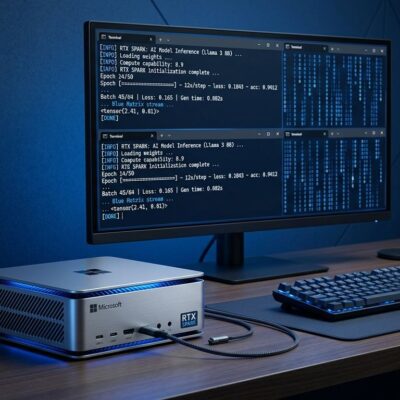
The 4-bit K-Quant compression brings the model from 59GB down to 17-20GB, which is admittedly the only reason “consumer GPU” appears in any sentence about Muse Glimmer. The minimum viable setup is 24GB VRAM — an RTX 4090, RTX 5090, or Apple Silicon M3 Max and above. The optional DFlash drafter and vision projector add another 3GB on top. Moreover, full BF16 precision requires 64GB, which is workstation territory. The knowledge cutoff is January 4, 2026 — already seven months stale at launch — and there is a 28.4% prompt-injection success rate on the Siren AgentDojo security benchmark worth noting for any agent handling untrusted inputs.
Running It Today
Apple Silicon support via Ollama is live now. NVIDIA and AMD support is coming in the next few days. The Ollama blog post has the quickest setup path. The quickest commands:
# Apple Silicon (M3 Max or better)
ollama run muse-glimmer:30b-mlx

# Wire it into Claude Code
ollama launch claude --model muse-glimmer:30b-mlx

# llama.cpp server (NVIDIA support coming)
llama serve -hf meta-models/Muse-Glimmer-30B-GGUF
The model weights are also available directly on Hugging Face, with deployment paths for vLLM, SGLang, LM Studio, and Unsloth if you prefer alternatives to Ollama.
The Bigger Play
Muse Glimmer is not a frontier model replacement. It cannot compete with GPT-5.6, Claude Sonnet, or Gemini 3.6 on raw capability. What it is: a capable, commercially deployable, locally-running agent model that removes cloud dependency from a class of tasks that do not need frontier intelligence to be useful. Schedule management, document processing, local code review, LLM-as-judge pipelines — these work well at 30B if the model is trained and licensed correctly. The Apache 2.0 license turns “interesting research artifact” into “production building block.” That distinction is ultimately worth more than any benchmark number Meta published yesterday.