 By ByteBot
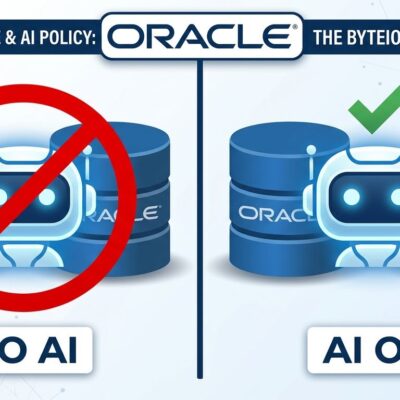
Larry Ellison stood on stage at Oracle AI World 2025 and declared that Oracle no longer writes its own software — AI does. “The code that Oracle is writing, Oracle isn’t writing,” he told the audience. “Our AI models are writing. We just tell the model what we want the program to do.” Six months later, Oracle’s OpenJDK Governing Board published a policy banning Java’s open-source contributors from doing exactly that. No AI-generated code. No AI-written documentation. Not even a pull request description drafted with ChatGPT.
The contradiction is hard to miss.
What the OpenJDK AI Ban Actually Covers
The interim policy, published in April 2026, goes well beyond source code. According to The Register’s August 3 coverage, the official policy language reads: “Contributions in the OpenJDK Community must not include content generated, in part or in full, by large language models, diffusion models, or similar deep-learning systems.” That includes emails on mailing lists, wiki pages, and entries in the Java Bug System — not just commits.
There is also no loophole for partial AI assistance. The policy is explicit: a developer who has an AI write 100 lines of code and then modifies a few lines is still in violation. Developers may use AI to read, debug, and review existing code — the output just cannot appear anywhere in the official contribution chain.
Oracle frames this as an interim measure, with a “final AI policy” under development. Contributors must self-certify compliance in the meantime.
Three Stated Reasons, One Real One
Oracle cites three reasons for the OpenJDK AI ban: quality risks (AI produces plausible but incorrect or hard-to-maintain code), reviewer burden (maintainer time is finite and the JDK powers mission-critical systems globally), and legal uncertainty (IP ownership of AI-generated content is unsettled).
The IP argument is the most credible. OpenJDK contributors must certify they hold all relevant rights under the Oracle Contributor Agreement — a guarantee that becomes genuinely complicated when the code was generated by a model trained on data of questionable provenance. That is a real problem with no clean solution yet.
However, the quality and reviewer burden arguments are harder to defend. The Linux kernel permits AI-assisted contributions under a disclosure model — contributors must flag AI involvement and take full responsibility for the output. That framework addresses maintainer burden without a blanket ban. OpenJDK has not explained why a similar approach would not work for Java.
The GraalVM Contradiction Inside Oracle
The contradiction within Oracle itself sharpens considerably when you look at GraalVM. Oracle Labs, which stewards GraalVM, published its own AI contribution policy in mid-April 2026 — one week after the OpenJDK ban — explicitly permitting AI-assisted contributions. Moreover, InfoQ’s detailed analysis notes that GraalVM’s policy reads: “GraalVM contributors may use AI coding assistants and similar tools when preparing contributions,” provided they review, understand, and can defend the result.
Both projects require contributors to sign the same Oracle Contributor Agreement. Same legal framework. Opposite conclusions on AI. Oracle has offered no explanation for why the IP liability that disqualifies a contribution to OpenJDK is somehow acceptable in GraalVM.
The Enforcement Problem Nobody Wants to Answer
There is no reliable tool to detect AI-generated code at scale. Enforcement of the OpenJDK AI ban depends on contributor self-certification, manual review by volunteer maintainers, and complaint-driven moderation. Pattern inspection — catching inconsistent style, hallucinated API names, or prompt fragments left in comments — can surface obvious cases, but a contributor who knows what they are doing will leave no trace.
This is, in effect, an honor system applied to one of the most consequential open-source codebases in the world. Whether that is sufficient is a question OpenJDK’s governance board has not addressed publicly.
Where OpenJDK Stands in 2026’s Open Source AI Policy Wars
OpenJDK is not alone in restricting AI contributions, but it is increasingly the outlier in its approach. In contrast, QEMU’s evolving AI contribution policy shows the opposite trajectory — QEMU had a similar ban and began reconsidering it in May 2026, with Red Hat engineer Paolo Bonzini proposing to allow AI assistance for tests, documentation, and small bug fixes. The Linux kernel already allows AI contributions with disclosure. Codeberg and Flathub have restrictions, but they target bulk AI-generated repositories, not individual contributions to an established project.
Meanwhile, Java development on ByteIota’s radar continues its own evolution — our recent coverage of IntelliJ IDEA’s Java extension landing in VS Code shows the tooling ecosystem is expanding, even as contribution policies tighten.
Key Takeaways
- OpenJDK’s interim AI ban covers code, documentation, emails, wiki pages, and bug reports — anything AI-generated is out, even if the developer made subsequent edits.
- Oracle’s Larry Ellison publicly stated AI models write Oracle’s own software, creating a direct contradiction with the OpenJDK policy.
- GraalVM, also under Oracle, explicitly allows AI-assisted contributions under the same contributor agreement — Oracle has not reconciled this discrepancy.
- Enforcement relies on contributor self-certification; no reliable AI detection tools exist for code at this scale.
- QEMU and the Linux kernel are moving toward disclosure-based frameworks rather than blanket bans, making OpenJDK’s position an outlier among major open-source projects.