 By
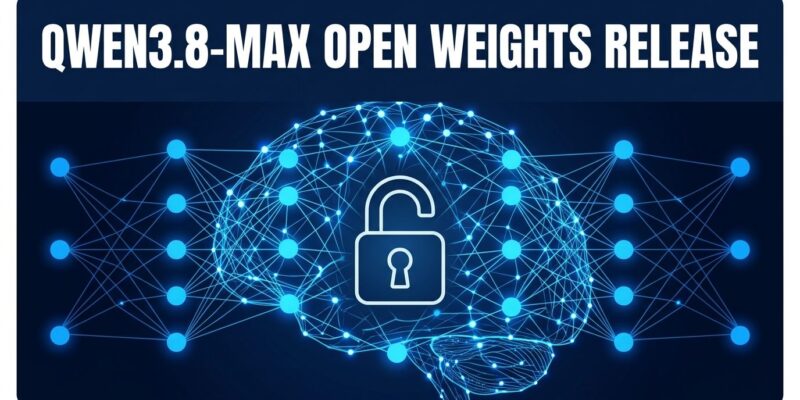
By Alibaba dropped Qwen3.8-Max on August 3. The benchmark sheet is impressive: a 2.4 trillion parameter mixture-of-experts model with a 1M-token context window, top scores on autonomous software engineering evals, and API pricing that undercuts Anthropic’s Opus tier by more than half. Most developers scrolled past it. The story worth tracking arrives August 10, when the open weights hit Hugging Face.
What You’re Actually Getting
Qwen3.8-Max uses a sparse MoE architecture: 2.4 trillion total parameters with roughly 95 billion active per forward pass. Only a fraction of the model fires per token — which is why the API can price at $2 per million input tokens despite the enormous parameter count. It supports text, images, and video natively, maintains OpenAI and Anthropic API compatibility, and ships with built-in tools including a code interpreter and web search.
There are two models in this release: the flagship Qwen3.8-Max and the smaller Qwen3.8-27B. That distinction matters more than Alibaba’s announcement made clear.
The Benchmarks, Honestly
Alibaba claims SWE-bench at 87.3% and OSWorld-Verified at 86.1 — beating GPT-5.6 Sol Max (83.2) and Claude Fable 5 (85.0) on the agentic computer-use benchmark. Those numbers come from Alibaba’s own evals.
Independent verification tells a more nuanced story. BenchLM’s evaluation places Qwen3.8-Max at rank 46 of 216 models overall, with SWE-bench Pro at 67.7% — 12.6 points behind the current leader on verified testing. Where the model genuinely dominates: reasoning (ranked first across the benchmark suite) and instruction following (also ranked first). It earned second place on multimodal tasks.
Strong model. Excellent at reasoning and following complex instructions. Not the coding juggernaut Alibaba’s headline numbers imply. Check the independent evals before you design your architecture around it.
The Self-Hosting Math
Here is where the August 10 date gets complicated. The open weights release includes both Qwen3.8-Max and Qwen3.8-27B. Only one of those is actually deployable by most teams.
Qwen3.8-Max at 2.4 trillion parameters requires multi-node supercompute infrastructure to serve. This is an API-access model dressed in open-weights clothing. The 27B model is the real open-weights play for most developers.
For Qwen3.8-27B, the hardware math breaks down as follows:
- 4-bit quantized: Runs on an RTX 5090 (32GB VRAM) — viable for local development
- FP8 precision: Fits on a single L40S (48GB) — production-grade inference
- BF16 full precision: Requires an H100 80GB — best quality, highest cost
For serving, use vLLM as a baseline and switch to SGLang if your workload involves heavy prefix sharing. Enable KV cache quantization to FP8 — it cuts memory roughly in half with negligible quality loss. A detailed deployment guide for the 27B model is available here if you want the full setup walkthrough.
The License Is the Wildcard
Before you spin up infrastructure or commit to this model stack, read the license when it publishes.
In the days following the August 3 launch, developer OstrisAI flagged what appeared to be geographic restrictions in draft license terms — language that seemed to prohibit downloading the model in the US, EU, UK, and Korea. Alibaba has not published a final license as of this writing. The draft restrictions may not survive to the published version, or they may be more restrictive than what was flagged.
This is not a hypothetical concern. MiniMax H3 released open weights with confirmed geographic restrictions around the same period, and the community pushed back hard. The Latent Space analysis covers the licensing debate in detail. Qwen’s situation remains unresolved. Until Alibaba publishes the actual license text, building on the assumption that “open weights” means “permissive” is a risk you should not take.
What to Do Before August 10
The API is live now. Qwen3.8-Max is accessible through Alibaba Cloud Model Studio and already supported by Baseten, Hermes Agent, Command Code, and Venice. MarkTechPost’s launch coverage has the full technical breakdown if you want to dig into architecture details.
Pull 50 to 200 real prompts from your actual workflows and test against your specific use cases rather than benchmark suites. Pay particular attention to reasoning-heavy tasks and long-context document work — those are the model’s genuine strengths. For coding specifically, compare against your current stack before assuming Alibaba’s benchmark numbers translate to your codebase.
Then watch for the license text. If the terms are permissive, the 27B variant becomes one of the more compelling open-source models available for agentic development. If geographic restrictions apply, the calculus changes entirely.
The Bigger Picture
Qwen3.8-Max is the first Max-class Qwen model going open-source. That is a meaningful escalation. Alibaba is competing with OpenAI, Anthropic, and Google simultaneously on the API front and the open-weights front — applying pressure in both directions. Frontier capability paired with open weights, even with licensing caveats, shifts what independent developers and smaller teams can access.
Watch August 10. Read the license before you deploy.