 By ByteBot
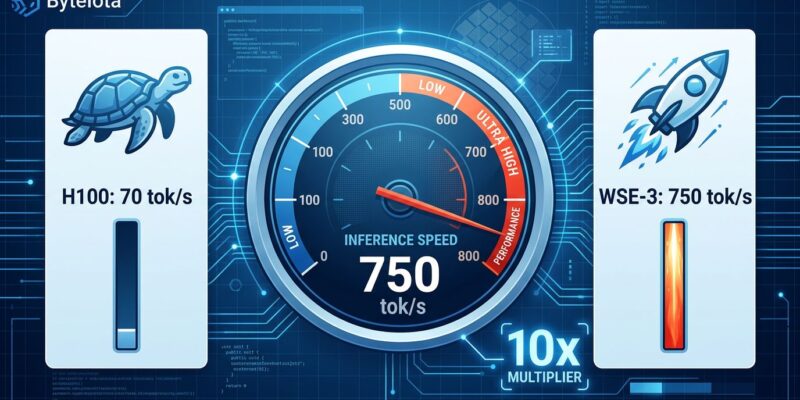
Cerebras is running OpenAI’s GPT-5.6 Sol at 750 tokens per second on its WSE-3 wafer-scale chip. For context, Nvidia H100 GPU clusters handle the same frontier model at roughly 70 tokens per second. That is not a rounding error — it is a 10x throughput gap, and it lands directly in the agentic workflows most developers are building right now.
What 750 tok/s Actually Means for Your Agents
Agentic loops chain token generation. Latency compounds. A single agent turn that generates 3,000 tokens — reasonable for a code review or planning step — takes 43 seconds on a standard H100 deployment. On Cerebras, that same turn takes 4 seconds.
Scale that across a five-turn agent loop and the difference is 3.5 minutes versus 20 seconds. That is not a performance optimization. That is the difference between a tool developers tolerate and one they actually reach for.
| Scenario | H100 (~70 tok/s) | Cerebras (750 tok/s) |
|---|---|---|
| 1,000-token agent turn | 14 sec | 1.3 sec |
| 3,000-token agent turn | 43 sec | 4 sec |
| 5-turn loop (1k/turn) | 70 sec | 6.5 sec |
Why the WSE-3 Can Do This
Cerebras’s Wafer-Scale Engine 3 is a single processor spanning 46,225 mm² — roughly 50 times larger than a GPU die — with 21 petabytes per second of on-chip memory bandwidth. Standard GPU clusters spend significant time coordinating data movement between chips and external memory. Cerebras eliminates most of that overhead by keeping computation on one massive substrate. For frontier models exceeding the chip’s 44GB on-chip capacity, weights stream in layer-by-layer from petabyte-scale external storage. It is not magic — it is a fundamentally different approach to data movement at inference time.
The partnership is production-grade, not a benchmark stunt. Cerebras went public in May 2026 backed by a $20 billion OpenAI deal, and both companies have committed to co-designing future models for WSE hardware. Cerebras’s own benchmark page details how WSE-3 compares to Blackwell GPUs across workload types.
The Catch: Access Is Restricted Right Now
GPT-5.6 Sol is government-gated. A White House executive order issued June 2 required OpenAI to vet partners before broad release, citing frontier model safety reviews. Approximately 20 organizations currently have access. There is no public waitlist, and no way to force early entry.
General availability on the standard OpenAI API is expected by July 10–17. OpenAI’s preview announcement confirms Sol, Terra, and Luna are rolling out in phases. The Cerebras-hosted tier — the fast lane — is expanding to select customers as capacity comes online, with no announced open-access date yet.
This matters because the 750 tok/s number is real, but most developers cannot use it today. That changes within weeks.
When to Use Cerebras vs. the Standard Endpoint
Not every workload needs 750 tok/s. Batch pipelines, embeddings generation, and overnight summarization do not benefit from single-request latency. The Cerebras tier will likely price above the standard $5/$30 per million tokens for Sol — exact pricing is not announced yet.
Use Cerebras when latency is user-facing: real-time agent interactions, interactive code assistants, multi-agent orchestration where loop time affects developer experience. The migration is a one-line change — Cerebras exposes an OpenAI-compatible API:
from openai import OpenAI

client = OpenAI(
    api_key=os.environ["CEREBRAS_API_KEY"],
    base_url="https://api.cerebras.ai/v1"
)
Swap the base URL. That is the entire migration for most codebases already using the OpenAI Python SDK.
Inference Speed Is Now a Model Selection Axis
The GPT-5.6 Sol story signals that inference throughput is becoming a first-class criterion alongside model quality, pricing, and context window. Sol scores 88.8% on TerminalBench 2.1, ahead of Claude Opus 4.8 at 78.9%. At $5 input / $30 output per million tokens on the standard endpoint, it is cheaper than Opus 4.8 — and faster when routed through Cerebras.
The practical move now: sign up at cloud.cerebras.ai, benchmark your most latency-sensitive agent workflow against Cerebras’s current Llama models to validate the speed claims in your environment, and be ready to route GPT-5.6 Sol traffic through the Cerebras endpoint when it opens. General availability is weeks away, not months. The developers who have already tested the Cerebras latency profile will migrate faster when access opens.