 By ByteBot
The U.S. government is days away from finalizing its first systematic framework for reviewing frontier AI models before public release. If you build on GPT-5.6, Claude Fable 5, or any top-tier model API, pay attention — the “voluntary” label on this frontier AI model deal is doing a lot of work it does not deserve.
Two Labs, Two Disruptions, One Pattern
The informal version of this framework has already caused real disruptions for developers. In late June, the White House asked OpenAI to restrict access to GPT-5.6 — the Sol, Terra, and Luna model family — to approximately 20 government-approved “trusted partners.” Commerce Secretary Lutnick personally signed off on each one. If your organization was not on that list, you still cannot access the newest OpenAI models through the API. OpenAI has said general availability is coming “in the coming weeks,” with third-party reporting suggesting mid-July as a best case. No confirmed date.
Two weeks before that, the U.S. Commerce Department imposed export controls on Anthropic’s Claude Fable 5 and Mythos 5 after Amazon researchers discovered a jailbreak — a prompt that caused the model to flag software vulnerabilities and write exploit code. The government ordered Anthropic to cut off both models from all foreign nationals. Since Anthropic had no reliable way to verify user nationality in real time, it shut both models down globally — including for its own non-U.S. staff.
On June 30, the controls were lifted, but at a price. Anthropic had to build a classifier that blocks the jailbreak technique in more than 99% of attempts, commit to proactive security hunting, coordinate on future launches, and promise early government access for future frontier model releases. Fable 5 is back. Mythos 5 is not — it remains limited to roughly 100 U.S. companies and federal agencies handling critical infrastructure. For more on the jailbreak scoring framework that emerged from this episode, see Anthropic’s CJS Jailbreak Severity Framework.
What the Frontier Model Framework Actually Says
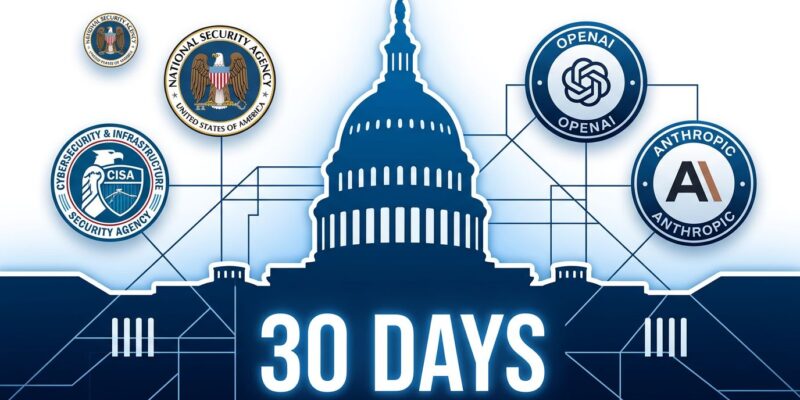
Executive Order 14409, signed June 2, establishes the legal foundation. Federal agencies — NSA, CISA, Treasury — have until August 1 to design a classified benchmarking process that defines what counts as a “covered frontier model.” Once a model hits that threshold, developers can voluntarily provide the government up to 30 days of pre-release access before the model reaches other trusted partners.
The EO is explicit that this is not a mandatory licensing or pre-clearance regime. That line is doing heavy lifting. However, the Anthropic case showed that the government does not need a formal mandatory process to effectively halt access to a model. Export controls are a bigger stick, and labs know it. Five labs — OpenAI, Anthropic, Google, Microsoft, and Amazon — are finalizing the voluntary agreement, with an announcement expected this week. According to SecurityWeek’s reporting, both OpenAI and Anthropic have already applied the framework informally to their most recent releases.
The “Voluntary” Problem
Stanford cybersecurity expert Alex Stamos put it directly: “pretty much nobody in the cybersecurity industry believes there’s any factual basis” for the Anthropic export controls. OpenAI’s statement on the GPT-5.6 restriction was equally pointed: “We don’t believe this kind of government access process should become the long-term default. It keeps the best tools from users, developers, enterprises, cyber defenders, and global partners who need them.”
Both companies complied anyway. The alternative — export controls, market exclusion, regulatory friction — is a worse outcome than a 30-day delay. Moreover, the framework’s classified benchmarks mean labs cannot even publicly argue about whether they qualify as a “frontier model.” “Voluntary” participation in a framework backed by export control authority is participation under pressure, regardless of what the EO text says. Additionally, Anthropic’s experience shows the process involves negotiated technical conditions — not just a simple review.
What Developers Should Do Now
The framework formalizes on August 1. Here is what that means in practical terms:
- GPT-5.6 access: No confirmed GA date. If your project depends on Sol, Terra, or Luna, build in a buffer. Mid-July is optimistic.
- Claude Fable 5: Restored globally, but the new safety classifier may generate false positives on legitimate security research and vulnerability scanning work.
- Claude Mythos 5: Still restricted. Access requires being one of approximately 100 approved U.S. organizations. Most developers will not qualify.
- Future frontier model releases: Plan for a 30-day government review window before any major model reaches general API availability. Build that delay into project timelines.
- International teams: The Anthropic situation demonstrated that nationality-based access controls are operationally messy. Design your model access strategy with that fragility in mind.
The classified benchmarks due August 1 will define what triggers a government review. Developers will not see those benchmarks directly — they are classified — but the August 1 announcement from labs is expected to clarify the practical mechanics for API access tiers. The White House is calling this light-touch. The two incidents in June tell a different story. Plan accordingly.