 By ByteBot
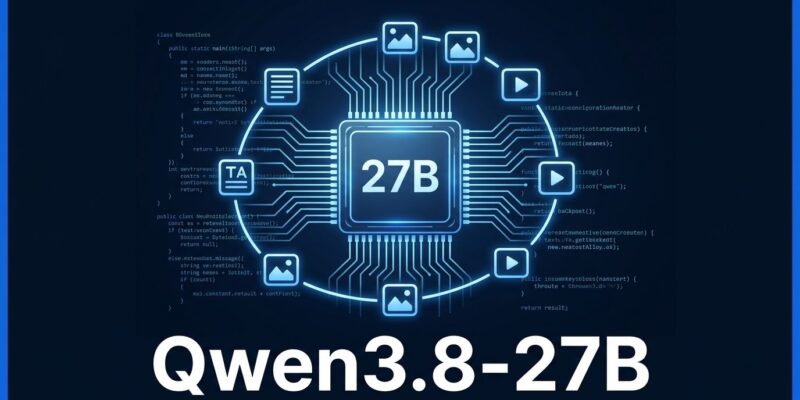
Alibaba dropped Qwen3.8-27B open weights yesterday afternoon — Apache 2.0, 27 billion dense parameters, natively multimodal, and the #1 story on Hacker News with over a thousand upvotes. Headlines are chasing the 2.4-trillion-parameter Max model. That one is API-only. The 27B is the release that actually matters to you.
What You Are Getting
Qwen3.8-27B is a dense 27.78-billion-parameter model with a vision encoder baked in. It accepts text, images, and video natively — no external adapters, no separate embedding pipeline. The native context window is 262,144 tokens (extendable to 1 million via YaRN, though production deployments should plan around 262K). Architecture is a hybrid decoder: alternating Gated DeltaNet linear attention layers with full attention blocks.
The reasoning mode is configurable. Pass reasoning_effort=xhigh for complex agentic tasks. Pass enable_thinking=false to cut chain-of-thought entirely when latency matters more than correctness. This lever makes the model significantly more practical for mixed workloads than earlier Qwen releases.
Weights are on Hugging Face at Qwen/Qwen3.8-27B under Apache 2.0. Unsloth had GGUF quantizations up within hours of release.
The Benchmark Numbers
These are vendor-reported figures from Alibaba’s model card. Community verification will follow over the next few days, so treat them as directional until confirmed.
The standout is OSWorld-Verified: 63.9 on Qwen3.6-27B, 84.3 on Qwen3.8-27B. That is a 20-point jump on a computer-use benchmark that measures real GUI agent tasks — the kind of work that matters for agentic pipelines. SWE-bench Pro moves from 53.5 to 61.7. Terminal-Bench 2.1 goes from 63.4 to 73.0. LiveCodeBench v6 lands at 90.3.
| Benchmark | Qwen3.6-27B | Qwen3.8-27B | Change |
|---|---|---|---|
| OSWorld-Verified | 63.9 | 84.3 | +20.4 |
| SWE-bench Pro | 53.5 | 61.7 | +8.2 |
| Terminal-Bench 2.1 | 63.4 | 73.0 | +9.6 |
| LiveCodeBench v6 | — | 90.3 | — |
| GPQA Diamond | — | 89.2 | — |
At the 27B class, this beats what Llama requires a 70B model to match for coding tasks. If your current local model is Qwen3.6-27B, upgrading is straightforward.
The Hardware Reality
Guides are circulating with 16–17 GB VRAM as the requirement. That figure covers weights only in 4-bit quantization. Add KV cache for practical context lengths and the real number is 20–24 GB. An RTX 4090 (24 GB) is the realistic consumer floor for comfortable operation.
- 4-bit quant (Ollama/GGUF): 20–24 GB with KV cache — RTX 4090 class
- FP8 (
Qwen/Qwen3.8-27B-FP8): ~28 GB — L40S or RTX 6000 Ada - BF16 (full precision): ~56 GB — H100/H200 territory
AMD shipped Day 0 support for Ryzen AI Max and Radeon AI PRO R9700 (32 GB). The R9700 hits 51.8 tokens per second in AMD’s testing. If you are on AMD hardware, llama.cpp and LM Studio are ready today.
How to Run It
Easiest path for local testing — Ollama with the 4-bit GGUF quantization:
ollama run qwen3.8:27bFor production workloads with an OpenAI-compatible endpoint:
vllm serve Qwen/Qwen3.8-27B --tensor-parallel-size 2Use SGLang instead of vLLM when your system prompts are large and shared across requests — SGLang’s prefix caching wins that workload. Both frameworks confirmed day-one support. See the OrcaRouter developer guide for full production configuration options.
To dial reasoning depth at inference time:
completion = client.chat.completions.create(
    model="Qwen/Qwen3.8-27B",
    messages=messages,
    reasoning_effort="xhigh",  # xhigh | medium | low
    stream=True,
)
Why the License Is the Real Story
Apache 2.0 means no user-count thresholds, no royalties, full fine-tuning rights, and the ability to redistribute derived weights commercially. You can white-label the model, fine-tune it on proprietary data, and ship derivatives to customers without negotiating with Alibaba as you scale.
For regulated industries — healthcare, finance, EU public sector — where source code cannot leave the building, this is the practical frontier alternative to cloud APIs. The dilemma of whether to send patient data or financial records to an external API is no longer a tradeoff you have to make.
The Right Architecture Going Forward
The instinct is to go pure local or stay pure cloud. Neither is the right answer. At the 27B class, Qwen3.8-27B is a volume model with a judgment ceiling: excellent at 80–90% of coding and reasoning tasks that are routine, less reliable on the hardest 10% of problems.
Route high-volume routine tasks — triage, refactors, boilerplate generation, document analysis — to the local 27B. Route genuinely complex reasoning to a hosted frontier model. The cost savings compound fast, and the latency advantage of local inference is real. Qwen3.8-27B is the model that finally makes this split architecture worth building into your stack.
Weights are live now. Start with Ollama, move to vLLM when you need throughput, and treat the Apache 2.0 license as the long-term unlock it is.