 By
By OpenAI launched GPT-5.6 on June 26 — and most developers still can’t touch it. The release introduced three model tiers (Sol, Terra, and Luna) under the first US government-gated AI rollout in history, limiting access to roughly 20 approved partners. General availability is expected mid-July. Here is what the pricing, benchmarks, and agentic architecture changes mean for your stack before the gates open.
Three Tiers, One Family
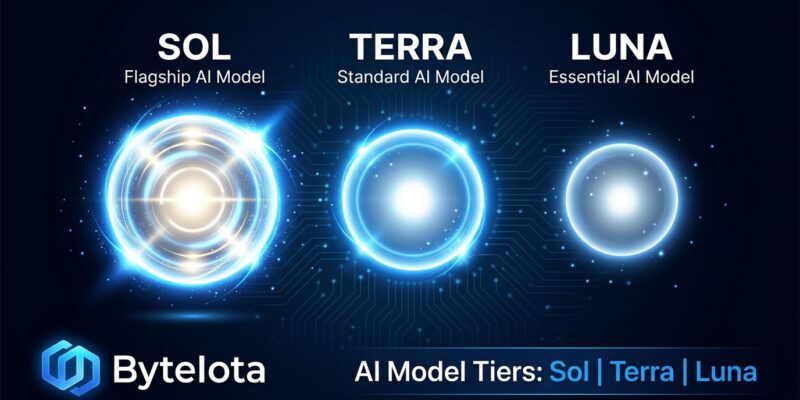
GPT-5.6 introduces a new naming convention: the number marks the generation, the codename marks the capability tier. Sol is the flagship, built for frontier reasoning and long-horizon agentic tasks — complex multi-step coding problems, security research, and scientific reasoning. Terra is the balanced workhorse. Luna is the fast, cheap option for high-volume, low-complexity work.
Here is the pricing breakdown:
| Model | Input (per 1M tokens) | Output (per 1M tokens) | Best For |
|---|---|---|---|
| Sol | $5 | $30 | Hard reasoning, security, biology |
| Terra | $2.50 | $15 | Production apps, RAG, everyday code |
| Luna | $1 | $6 | Routing, classification, preprocessing |
| GPT-5.5 | $5 | $30 | (Being replaced) |
The real story here is Terra, not Sol. Sol costs exactly the same as GPT-5.5 at $5 input / $30 output. Terra, however, delivers GPT-5.5-level performance at half the price. If you are running production workloads on GPT-5.5 today, the migration path when GA arrives is straightforward: switch to Terra and cut your inference spend in half. Sol is overkill for 90% of production applications.
Why You Still Cannot Use It
The access restriction is the direct result of a Trump administration executive order signed June 2, 2026. The order established a voluntary 30-day pre-release review for frontier AI models with advanced cyber capabilities. GPT-5.6 Sol triggered that review by scoring 96.7% on OpenAI’s internal Capture-the-Flag cybersecurity evaluations — clearing the “high” cyber risk threshold. All three tiers (Sol, Terra, and Luna) were rated “high” on both bio and cyber risk assessments, pulling the entire family into the restricted preview.
OpenAI was not happy about it. The company stated plainly: “We don’t believe this kind of government access process should become the long-term default. It keeps the best tools from users, developers, enterprises, cyber defenders, and global partners who need them.” OpenAI framed the limited rollout as a short-term concession, not a policy endorsement. That said, the precedent is set — and developers should factor in that frontier model launches may face similar delays going forward.
There is no public waitlist. There is no self-service enrollment. Each of the roughly 20 preview partners was individually approved by the US government. GA is expected mid-July, though no specific date has been confirmed. TechCrunch reported that OpenAI complied while warning that such restrictions should not become standard practice.
Build Your Tier Routing Strategy Now
You have a few weeks before GA. The core agentic pattern for GPT-5.6 is a plan-act-verify loop distributed across tiers: Sol for the hard reasoning step, Terra for execution, Luna for cheap subtasks. A practical routing approach:
# Tier routing — implement before GA
if task.complexity == "high" or task.domain in ["security", "reasoning"]:
    model = "gpt-5.6-sol"
elif task.complexity == "medium":
    model = "gpt-5.6-terra"
else:
    model = "gpt-5.6-luna"
In a real pipeline: Luna handles intent classification and request routing. Terra handles standard code generation, RAG responses, and API-layer tasks. Sol gets invoked when a task requires multi-file reasoning, architecture decisions, or anything that failed a lower tier. Most workloads will spend the majority of token budget on Terra, with Luna as the inexpensive routing backbone.
Codex integrates naturally into this pattern. The Codex CLI can operate as an MCP server, making it invocable by other agents in a multi-agent graph. Combined with the OpenAI Agents SDK, this enables sandboxed code execution with tracing, handoffs, and guardrails inside larger orchestration workflows. If you are running Codex today, read our breakdown of OpenAI Codex Micro — the lightweight companion model scheduled for general availability on July 15.
Benchmark Context: Strong but Incomplete
Sol scores 88.8% on Terminal-Bench 2.1, OpenAI’s primary coding evaluation, with the “Ultra” reasoning configuration reaching 91.9%. Those are state-of-the-art numbers on that benchmark. What OpenAI has not published is a SWE-bench Pro score — the benchmark most closely watched by developers for real-world coding capability. Claude Opus 4.8 currently leads SWE-bench Pro at 69.2%. Until Sol’s number appears, comparing it directly to Claude on practical coding tasks requires taking OpenAI’s internal benchmarks at face value, which is a reasonable position to be skeptical about.
One Pricing Gotcha: Cache Writes
GPT-5.6 introduces a new cache write charge: 1.25x the uncached input rate. Cache reads still get the 90% discount that applied to prior models. But cache writes were previously free — this is a change. If your application writes large prompts to cache that are then read infrequently, your actual cost under GPT-5.6 will be higher than a straight per-token comparison suggests. Audit your caching patterns before migrating.
What to Do Right Now
GA is coming. The productive use of the next two to three weeks is straightforward:
- Identify which workloads on GPT-5.5 map to Terra (most of them) and plan the migration
- Design your tier routing logic so you can deploy on day one of GA
- Review your caching architecture for the new 1.25x write-overhead
- Monitor the official OpenAI announcement page and the Help Center article for GA confirmation
The government gating will not last. When GA arrives, the developers who already have a routing strategy and cost model will ship faster than those still figuring out which tier to call. Terra is your default. Sol is for when Terra fails. Luna is what runs the pipes.