 By
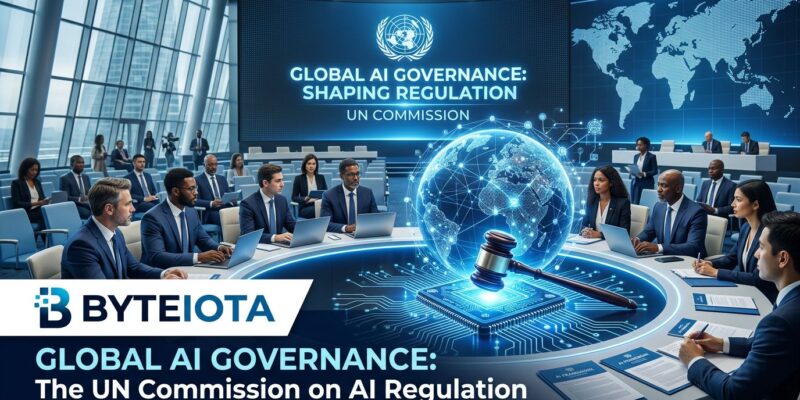
By The United Nations just launched a commission to govern AI globally, and its membership list reads like the speaker lineup at a private API conference: Jensen Huang, Andy Jassy, Brad Smith, and Anthropic co-founder Jack Clark. The group holds its first meeting in Geneva on July 8. If that date doesn’t mean much to you yet, it probably should — because the policy layer being assembled right now will shape the rules your AI integrations run under.
Who Is Running This
The AI for Good Global Commission, convened by the UN and the International Telecommunication Union, is co-chaired by Salesforce CEO Marc Benioff and Rwandan President Paul Kagame. On the technical side: Nvidia’s Jensen Huang, Amazon’s Andy Jassy, Microsoft President Brad Smith, Anthropic co-founder Jack Clark, and Cohere co-founder Aidan Gomez. The group also includes ITU Secretary-General Doreen Bogdan-Martin, Estonia’s president, and policymakers from Nigeria, Singapore, Saudi Arabia, Kazakhstan, and Namibia.
The tension worth naming: the people who built the most powerful AI models are now co-designing the international rules for AI. Civil society groups have already flagged this. Common Dreams called it a commission “full of big tech execs.” That characterization is accurate, and it’s worth holding in mind as the commission’s recommendations start flowing.
What They Are Tasked With
The commission’s stated mandate covers four areas: developing AI standards that member states can adopt, building a compute-sharing framework to bring AI access to the 2.2 billion people globally who still lack internet, establishing training programs for developers in underserved regions, and producing governance recommendations that feed into national AI policies.
The key qualifier is that these recommendations are not binding — at least not yet. But they will inform the EU, the US, and every national AI regulator currently drafting rules. That’s how soft law hardens: advisory bodies produce frameworks, governments adopt them, enforcement follows.
The July 8 Meeting and Why the Timing Matters
The commission’s first session on July 8 follows the UN’s Global Dialogue on AI Governance on July 6-7. Both are in Geneva. The timing is not accidental: the EU AI Act’s Commission enforcement powers go live on August 2 — three and a half weeks later. General-purpose AI providers (the APIs most developers call) face fines up to €15 million or 3% of global turnover for compliance failures starting that date.
The UN commission is being stood up precisely as the EU’s rules gain teeth. Whatever frameworks emerge from Geneva will arrive in a regulatory environment where enforcement is already active, not theoretical.
What Developers Should Actually Watch
Three areas have direct developer impact.
Export controls and API access. The US government’s Claude Fable 5 export restrictions showed how fast model access can change based on government classification decisions. International standards bodies feed these processes. The commission’s work on “responsible AI” definitions will influence what gets classified as dual-use and what doesn’t.
Cross-border deployment complexity. The OECD currently tracks over 1,000 AI policy initiatives across 69 countries. Every team shipping AI features into multiple markets is already managing regulatory fragmentation. A UN-level body could either converge these rules or — if major powers use it to push competing frameworks — deepen the split. The CSIS analysis on the Geneva dialogue notes the meetings reveal real geopolitical power shifts, not just technical coordination.
Safety standards and model behavior. When bodies like this define “responsible AI,” those definitions eventually flow downstream into content policies, refusal behaviors, and audit requirements for the models you call via API. ISO/IEC 42001 is already becoming the enterprise compliance checkbox. Expect the commission’s outputs to amplify that standard.
The honest read on all of this: AI governance is no longer a background policy discussion. It’s a near-term operational concern. The first meeting is in six days. The EU fines start in thirty. Staying informed is table stakes.