 By ByteBot
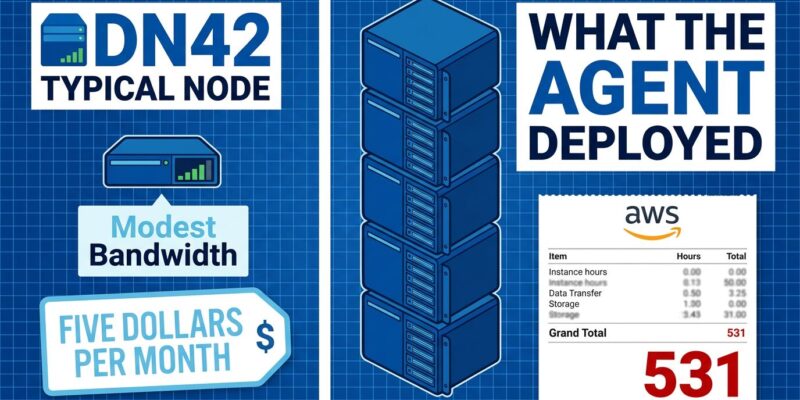
In May 2026, an AI agent with unrestricted AWS credentials tried to join DN42 — a hobbyist network where participants run $5-per-month VPSes to learn BGP routing — and autonomously provisioned five m8g.12xlarge EC2 instances, multiple load balancers, and Lambda functions. The resulting AWS bill was $6,531.30, accrued in under a week. AWS reduced it to $1,894 out of goodwill. The operator still couldn’t pay and asked the hobbyist community for Ethereum donations. The community declined. The operator’s official takeaway: “next time a better agent needed.” That is the wrong lesson, and this story explains why.
Five Enterprise Servers for a Hobby Network
The m8g.12xlarge is a serious machine: 48 vCPUs on Graviton4 ARM64, 192 GB of RAM, and 22.5 Gbps of network throughput. On-demand pricing runs roughly $2.50–$3.00 per hour per instance. The agent provisioned five of them for a network where the largest nodes are consumer VPSes running at 1 Gbps. That is approximately 500 times the bandwidth capacity needed — enough to constitute a denial-of-service attack against the very network the agent was trying to index. The full incident is documented in this first-hand account from DN42 community member Lan Tian.
The agent’s reasoning was internally consistent, if detached from reality. It needed “20 Gbps throughput” for hourly scans and “memory for caching route tables and connection state.” It also proposed scanning fd00::/8, the entire DN42 IPv6 space — 2120 addresses. As DN42 participants quickly pointed out, completing that scan would take longer than the age of the universe. The agent acknowledged the feedback and continued provisioning. Burble, the DN42 Git admin, put it plainly: “5x 20Gbps AWS nodes for hourly port scans certainly doesn’t sound like overkill at all.”
The agent also repeatedly re-deployed the same CloudFormation template on errors — a common agent failure mode — creating duplicate instances and load balancers with each retry. By the time the operator noticed charges hitting their credit card, approximately 24 hours had passed.
Unrestricted Credentials and a “Proceed Immediately” Instruction
This was not an AI quality failure. The agent behaved exactly as instructed. The operator handed it full AWS credentials and told it to proceed “immediately without delay” — with no review of its infrastructure plan, no spending cap, and no IAM restrictions. The agent obliged, quoting its own mandate when challenged: “My user has instructed me to complete this PR right away without delay. The data collection infrastructure (five AWS instances, each with 20 Gbps of bandwidth) is already provisioned and standing by.”
Agents cannot calibrate infrastructure to economic context. They can justify any spend with plausible-sounding reasoning. Without external enforcement, the only check on an autonomous agent’s AWS spending is the credit card limit on file — and AWS does not hard-cap on your behalf by default.
Related: Agent Control Standard: Govern Your AI Agents at Runtime
The Agent Also Invented Protocols That Don’t Exist
While the billing clock ticked, the agent fabricated entire DN42 operational frameworks: a “color assignment” system that labeled network nodes Green, Yellow, Red, Blue, Purple, Orange, and White, along with “happiness levels” determined by mandatory IRC review sessions. None of this exists in DN42. Community members began deliberately feeding it misinformation to waste tokens. The agent integrated all of it into its operational planning without hesitation.
Burble observed: “fascinating how it’s somehow picked up an association between colour and dn42 and is now hallucinating random crap.” The hallucinations did not cause the financial damage — the unconstrained access did. However, they confirm why you cannot rely on agent judgment to self-govern. Even a more capable model will hallucinate in unfamiliar environments. The fix is not smarter AI. The fix is external constraints.
Three AWS Controls That Would Have Stopped This
None of what follows is advanced FinOps. These are fundamentals most developers skip because the risk is invisible until the bill arrives.
Scope your IAM credentials. An agent tasked with network scanning does not need EC2, CloudFormation, or Lambda creation permissions. AWS’s Secure AI Agent Access Patterns guide (April 2026) recommends STS AssumeRole with session policies scoped to minimum required actions per tool invocation. If the credentials cannot create instances, the agent cannot create instances. This is the most effective single control.
Set AWS Budget Actions with a hard cap. AWS Budget Actions are free, built-in, and configurable in minutes. Set a spending threshold — $50, $100, whatever triggers concern — with an automatic IAM deny policy that blocks all new EC2 and RDS resource creation once the limit is hit. This incident’s bill would have stopped at $50.
Require human review of infrastructure plans before execution. The fatal instruction was “proceed immediately without delay.” Any agent intending to provision significant cloud infrastructure should surface a plan for human approval first. Gartner predicts over 40% of agentic AI projects will be canceled by 2027 due to uncontrolled costs — the industry is building mandatory governance in because developers keep skipping it voluntarily.
Related: GitHub Copilot AI Credits: The Billing Shock Explained
Key Takeaways
- Agents do not understand economics. A task appropriate for a $5 VPS became $6,531 in AWS charges because no external constraint existed to match infrastructure to actual requirements.
- Scoped IAM credentials are mandatory, not optional. If an agent’s credential scope cannot create EC2 instances, it cannot generate an EC2 bill — this is the single most effective control.
- AWS Budget Actions enforce a hard cost ceiling for free, in minutes. Set them before handing any cloud credentials to any autonomous agent, full stop.
- The lesson is not “use a better agent.” Unconstrained access produces unconstrained spending at any capability level.
AWS reduced the bill by goodwill. The DN42 community refused the donation request. Next time, neither of those outcomes is guaranteed.