 By ByteBot
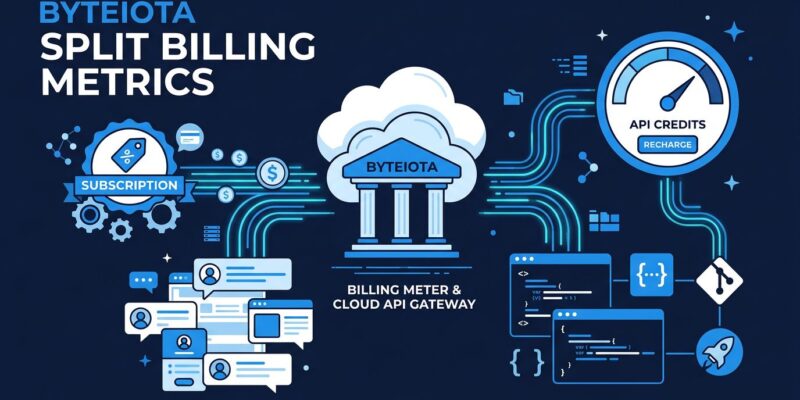
Anthropic is splitting Claude’s billing in seven days. Starting June 15, any code that runs the Agent SDK, calls claude -p, or uses Claude Code GitHub Actions stops drawing from your subscription’s shared usage pool and moves to a separate monthly credit billed at full API rates. If you haven’t opted in and enabled overflow billing before that date, your automated workflows will silently stop when that credit runs out — no warning, no fallback, just failure.
What’s Changing and What Isn’t
The line Anthropic draws is interactive versus programmatic. Interactive Claude stays on your subscription limits exactly as before. Programmatic usage gets its own metered bucket.
Moves to the credit pool on June 15:
- Claude Agent SDK (Python and TypeScript)
claude -pcommand (non-interactive, scripted runs)- Claude Code GitHub Actions
- Third-party apps authenticating through the Agent SDK
Stays on subscription limits (unaffected):
- Claude.ai (web, mobile, desktop)
- Claude Code running interactively in a terminal
- Claude Cowork
The credit amounts are $20 for Pro, $100 for Max 5x, and $200 for Max 20x — all billed at standard API list rates when consumed.
The Two Steps Most Developers Will Miss
Here is the catch. Claiming the credit and protecting yourself from hard failures requires two separate actions in two separate places, and neither is automatic.
Step 1: Claim your Agent SDK credit. Anthropic is sending opt-in emails around June 8. If you haven’t received one yet, check your Claude account settings. Without this one-time claim, your credit balance is $0 when June 15 hits.
Step 2: Enable usage credits (overflow billing). This is a separate toggle, also in account settings. Without it, when your $20/$100/$200 credit is exhausted mid-month, every subsequent automated request fails outright. Enabling overflow billing means additional Agent SDK usage continues at standard API rates instead of stopping cold.
Both steps are required. Most developers running personal automation will complete Step 1 and assume they’re done. They aren’t. The official Claude Help Center documentation walks through both steps in detail.
Why Teams Have a Bigger Problem
Credits are per-user, non-poolable, and do not roll over at the end of the billing cycle. This matters enormously for teams.
A GitHub Actions workflow triggered by different committers draws from each committer’s individual credit pool. When one developer’s $20 is gone, every automated run they trigger fails — while a colleague’s credit might be untouched. You cannot aggregate those credits. Anthropic’s own documentation is explicit: teams running shared production automation should migrate to Claude Platform API keys, not subscription credentials.
The right migration path for any team CI/CD pipeline is to switch to a Developer Platform API key from platform.anthropic.com with an ANTHROPIC_API_KEY environment variable. Pay-as-you-go billing on an org-level key scales with actual usage and doesn’t hit a per-user wall mid-month. If you’re already using a platform API key, nothing changes — this entire billing split only affects subscription-authenticated workloads.
The Token Math
At Sonnet 4.6 list rates — $3 per million input tokens, $15 per million output tokens — the math on $20 is tighter than it sounds. A medium agent task (code review, test generation, debugging session) can run 50–100K tokens in and out. At that rate, the $20 Pro credit covers roughly 30–50 tasks for the month. One heavy CI run on a large codebase — 200K+ tokens in and out — can cost $4–8, leaving a Pro user with 3–5 heavy runs per month total.
Boris Cherny, Head of Claude Code at Anthropic, put the previous situation plainly: a $20 Pro subscription was running agent workflows that would cost $500 on a direct API key. That gap was never sustainable. The credit system is Anthropic closing it. The New Stack’s analysis breaks down the full economics of the transition.
One More June 15 Deadline: Model Retirements
While you’re auditing your codebase for billing configuration, check your model strings too. Claude Sonnet 4 and Opus 4 (the older versions) also retire from the API on June 15. If your Agent SDK code is pinned to claude-sonnet-4 or claude-opus-4 without the .6 or .7 suffix, it will break independently of the billing change. Update to claude-sonnet-4-6 and claude-opus-4-7.
The Action Checklist
- Check your email from Anthropic and complete the one-time Agent SDK credit opt-in in your account settings.
- Enable usage credits (overflow billing) in Claude account settings — separately from step 1.
- Audit your CI/CD pipelines. If they use subscription credentials with Agent SDK or
claude -p, migrate to a Developer Platform API key now. Do not wait until mid-month failures tell you that you needed to. - Update your model strings. Pin to
claude-sonnet-4-6orclaude-opus-4-7before June 15.
This change has caused real frustration — community threads are calling it a quiet price increase, and they’re not entirely wrong for heavy SDK users. But the direction makes sense. Flat-rate subscriptions absorbing $500-equivalent agent compute for $20 a month was always going to end. The question now is whether you migrate before June 15 or find out the hard way on June 16.