 By
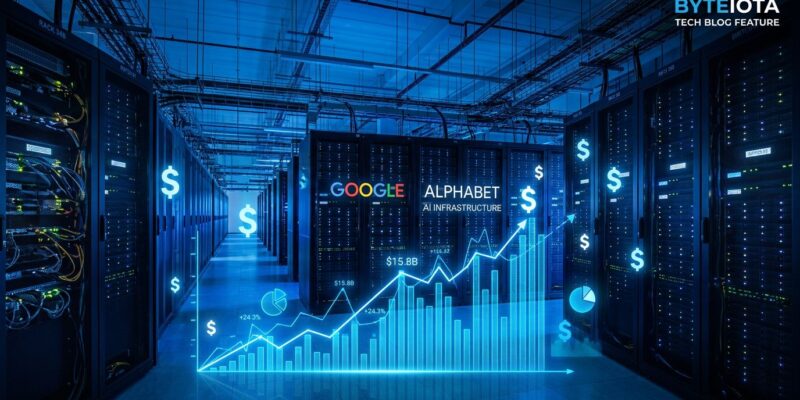
By Alphabet closed the largest equity offering in any industry’s history last week — $84.75 billion raised in under 72 hours. The stated purpose: build enough AI infrastructure to stop turning developers away. If you’ve been fighting Gemini API 429 errors, watching free tier quotas disappear, or wondering how a company processing 19 billion tokens per minute still can’t keep up with demand, this capital raise is the official acknowledgment that you weren’t imagining the problem.
The Numbers Behind the Raise
Alphabet announced an $80 billion equity offering on June 1. Within 48 hours, it was upsized to $84.75 billion because the public offering portion was oversubscribed. The structure breaks down as follows: $30 billion in a public offering, $10 billion in a private placement to Berkshire Hathaway, and $40 billion in an at-the-market program scheduled to begin in Q3 2026.
That last piece matters: the $40B doesn’t land in one shot. It gets deployed gradually over quarters as Alphabet sells shares into the open market. So the full capital injection is spread over 2026 and into 2027.
The purpose, per Alphabet’s own SEC filing: “demand exceeding available supply.” Their 2026 capital expenditure guidance is $180–190 billion — six times 2022 levels and double 2025. Every dollar is going toward servers, chips, networking, and data centers to serve AI workloads at a scale that’s currently impossible to meet.
Warren Buffett Just Called AI Infrastructure a Utility
The most significant signal in this deal isn’t the amount — it’s who’s buying. Warren Buffett’s Berkshire Hathaway committed $10 billion via private placement: $5 billion in Class A shares at $351.81 and $5 billion in Class C shares at $348.20. Berkshire famously avoided most tech investments for decades, including passing on Google early. Buffett bet on it now.
That’s not a growth bet. That’s a value investor treating AI compute infrastructure the same way he treats railroads and utilities: as essential, durable, defensible. When Buffett’s money shows up in an equity deal like this, institutional capital follows. Expect the construction timelines to hold — this isn’t a project getting shelved when sentiment shifts.
The Supply Problem Is Real, and You’ve Felt It
8.5 million developers build on Google models every month. Gemini’s API is processing 19 billion tokens per minute — up 60% quarter-over-quarter from Q1 2026 earnings. Despite that scale, the developer experience in 2026 has been rough:
- Free tier image generation quota: zero since December 2025
- February 2026: a “ghost 429” bug hit recently upgraded Tier 1 accounts; Google confirmed it and took weeks to patch
- April 2026: Pro model access removed from the free tier entirely
- The Gemini CLI to Antigravity CLI migration cut individual developer request quotas from roughly 1,000/day to around 20 — a 98% reduction
Alphabet wasn’t hiding any of this. Sundar Pichai said demand is “meaningfully exceeding” supply on the Q1 earnings call. The equity raise is the plan to fix that. But infrastructure doesn’t appear overnight.
The Catch: Infrastructure Takes Time
Data centers have lead times of 12 to 24 months from groundbreaking to operational. Google’s Andhra Pradesh facility in India broke ground in April 2026 — completion is targeted for 2028. The Norway facility in Skien is coming online this year with 240MW of capacity, but that’s one data center against a global capacity shortfall.
Realistic timeline: expect incremental quota relief through late 2026 as existing infrastructure gets optimized and Norway capacity activates. Meaningful capacity expansion from new builds won’t reach developers until 2027 at the earliest.
What to Do While Waiting
Free tier developers are last in the queue. Paid tier users with payment history can request manual quota increases, and Google’s tier system automatically upgrades you as spending matures. But the most immediate lever right now is context caching.
On Gemini 2.5 and newer models, implicit caching is enabled by default — you don’t configure anything. If your request prefix matches a previous call, Google automatically applies a 90% discount on the cached tokens. In practice, a code review agent running on a large codebase dropped from $0.08 to $0.006 per review once caching kicked in. That’s a 13x cost reduction with zero code changes.
For model selection: Gemini 2.5 Flash-Lite remains the cheapest route at $0.10 per million input tokens. Gemini 3.5 Flash ($1.50/M input) is significantly faster and better suited for agentic workloads — but note it’s three times more expensive than Gemini 3 Flash was. More compute coming online doesn’t automatically mean cheaper access; it means more availability. Pricing is a separate decision Google makes.
The Bottom Line
$84.75 billion is a credible commitment to fix the supply problem. Buffett’s involvement makes it harder for Alphabet to walk it back. But the honest timeline for Gemini API developers is 2027, not next month. Optimize for cost now — use caching, pick the right model tier, and request quota increases if you’re on a paid plan. The capacity is coming. Just not for today’s sprint.