 By
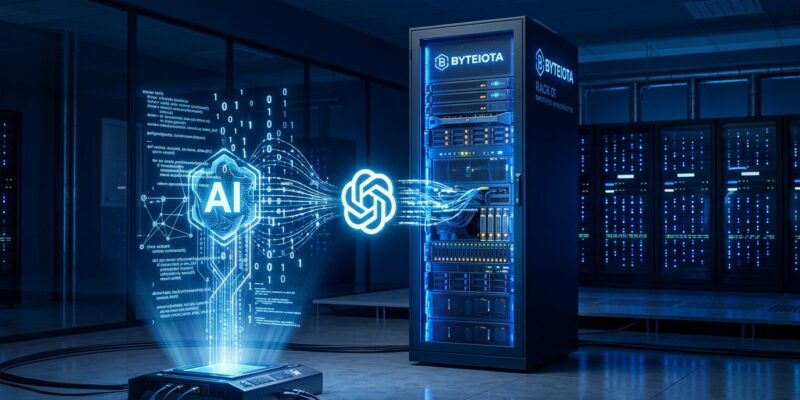
By OpenAI and Dell Technologies announced on May 18 a multi-year partnership to run Codex inside enterprise on-premises and hybrid environments. For developers at banks, hospitals, and government agencies who have watched Codex from the sidelines — because sending proprietary code to OpenAI’s cloud triggers compliance violations — this changes the calculation. OpenAI’s first explicit on-prem enterprise distribution play is here, and it comes bundled with Dell’s 5,000-customer AI Factory install base.
The Compliance Wall Was Real
A significant portion of enterprise developers have been blocked from Codex entirely. HIPAA, SOX, FINRA, ITAR, GDPR — the regulatory acronyms stack up fast, and their shared message is the same: proprietary code and data cannot leave the building through an external cloud API. Dell’s own survey data backs this up — 67% of enterprise AI workloads already operate outside the cloud, and 88% of organizations run at least one on-premises AI workload. The compliance wall was blocking adoption at scale.
The OpenAI-Dell partnership directly addresses this by connecting Codex to the Dell AI Data Platform, which keeps data on-premises within governed, encrypted environments. Michael Dell framed the core risk plainly: losing control of “your data, your cost, your security, your intellectual property, and your speed.” On-prem Codex is the answer to that specific anxiety.
What Codex Gets Access to Inside Your Enterprise
Once running on Dell infrastructure, Codex moves beyond the public-internet tasks it handles in the cloud version. It gains access to internal codebases, documentation, operational knowledge, and business systems — the context that makes autonomous coding agents actually useful for production work. OpenAI has confirmed these use cases for the on-prem deployment:
- Code review automation across internal repositories
- Test coverage analysis at scale
- Incident response workflows with access to internal runbooks
- Large repository reasoning across millions of lines
- Cross-tool context gathering — reading Jira tickets, Confluence docs, and Slack threads alongside code
The platform also expands beyond pure engineering into report preparation, feedback routing, and documentation. Codex tasks run sandboxed before results hit production, with durations from 1 to 30 minutes depending on complexity. This is meaningfully different from inline code completion — Codex running a 20-minute refactor unattended while you are in a meeting.
Dell Is the Distribution Play
Dell brings 5,000+ AI Factory enterprise customers to the table — organizations already running Dell AI Data Platform infrastructure. OpenAI gets a procurement channel into financial services, healthcare, and government accounts it could not reach with a cloud-only product. Dell gets Codex as a marquee application that justifies AI Factory investment.
The technical backbone is the Dell AI Factory (PowerScale, Lightning, and ObjectScale storage with NVIDIA AI Enterprise) and NVIDIA OpenShell — a consistency layer that lets you build and test agents locally, then promote them to data-center-scale infrastructure without rebuilding governance primitives. That last part matters: retrofitting governance after deployment is expensive. Engage NVIDIA OpenShell’s security model in your architecture phase, not after.
The Catches Are Real Too
This is not a “deploy Codex on your existing servers” announcement. If your enterprise does not already run Dell AI Factory infrastructure, the path to on-prem Codex involves a procurement process with Dell before you get near the API. The governance details — how access controls work, what audit logs look like, how model behavior is governed when Codex reasons across sensitive repositories — are not yet publicly specified.
The 87% cost-reduction projection versus cloud APIs (Dell’s stated 3-month break-even estimate) also needs real-world validation. Compute at enterprise AI scale is the most constrained resource in the industry right now; adding Codex workloads on-prem compounds that pressure.
What Developers Should Do Now
- If you’re at a Dell AI Factory customer: Contact your Dell account team about the Codex integration roadmap. The partnership is multi-year — early adopters typically get migration support.
- If you’re evaluating on-prem AI coding agents: Ask specifically about audit logs, access controls, and model governance before signing. These are the gaps that matter at enterprise scale.
- Set up AGENTS.md: Codex uses this file in your repository to understand conventions, test commands, and project structure. Getting this right before Codex runs autonomously saves significant rework.
- Do not confuse Codex with Copilot: GitHub Copilot Enterprise has no native on-premises deployment path — it runs through Microsoft’s cloud. If your compliance requirement demands strict on-premises, Codex with Dell is currently the only major-vendor option.
The Bigger Picture
OpenAI partnering with Dell is enterprise distribution chess. By integrating with an infrastructure vendor that already has 5,000 enterprise accounts, OpenAI bypasses the typically multi-year enterprise procurement cycle and lands Codex inside organizations it could not previously serve. For regulated-industry developers, this is the announcement that makes Codex a credible option for the first time.
The governance gaps are real and the Dell infrastructure dependency is a genuine barrier. But the direction is clear: the era of “just send your code to the cloud” is ending for enterprise teams, and the major AI labs are racing to serve what is left behind.